01Facts
The parties entered into a five-year Outsourcing Agreement under which Viceroy supplied technicians and related services to Smiths.
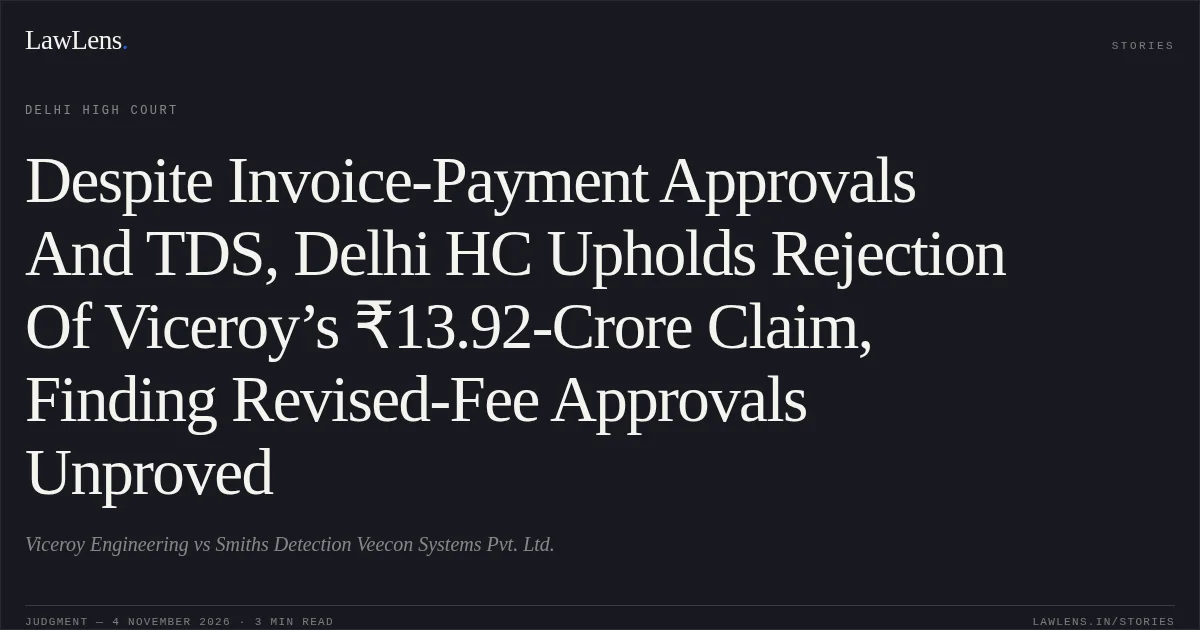
Viceroy claimed approximately ₹13.92 crore in unpaid invoices, damages for breach of a non-solicitation clause, reputational damages, and ₹63.02 lakh for services allegedly provided after the Agreement expired.
The arbitral tribunal rejected both parties’ claims and counterclaims.
The Single Judge dismissed Viceroy’s Section 34 challenge, and Viceroy appealed under Section 37.
The appeal challenged, among other things, the tribunal’s rejection of the invoice counterclaim and its refusal to admit correspondence relating to a 2011 fee amendment.
¶ 3–1202Issues
i.1. Whether the tribunal’s refusal to admit correspondence concerning the 2011 amendment denied Viceroy a fair opportunity to present its case under Section 34(2)(a)(iii).
¶ 27–48ii.2. Whether the rejection of Viceroy’s invoice counterclaim was vulnerable to interference under Sections 34 and 37, including in light of alleged admissions, payment records and the parties’ conduct.
¶ 53–79iii.3. Whether the rejection of the non-solicitation, reputational-loss and post-expiry-services counterclaims warranted appellate interference.
¶ 80–9203Law Applied
Sections 37 and 34 of the Arbitration and Conciliation Act, 1996 confine appellate review to the grounds available for setting aside an award; the appellate court does not reappreciate the merits.
¶ 19–22Under Section 34(2)(a)(iii), read with Sections 18 and 19, a tribunal’s procedural discretion must be exercised consistently with equal treatment and a full opportunity to present one’s case, assessed in the circumstances of the proceedings.
¶ 27–29Under Ssangyong Engineering and Construction Co. Ltd. v. NHAI, patent illegality must go to the root of the matter; a possible contractual interpretation or disagreement over evidence is insufficient.
¶ 20OPG Power Generation Pvt. Ltd. v. Enexio Power Cooling Solutions India Pvt. Ltd. permits a court to explain reasons discernible from an award but not to supply a different basis for it.
¶ 23A clear pleading admission may dispense with proof, but its scope must be accurately identified and read in context; arbitral flexibility under Section 19 does not eliminate that principle.
¶ 54Sections 23(2) and 23(3) address supporting documents and amendment of claims or defences, subject to the tribunal’s procedural assessment.
¶ 28The court also relied on Daman Singh v. State of Punjab for the principle that a party cannot complain of a court’s failure to consider a ground that was not argued.
¶ 90Provisions in the judgment · 5 · Linked ones open on LawLens
Arbitration and Conciliation Act, 1996 Section 37Section 34Section 18Section 19Section 23
04Reasoning
The court held that the correspondence was relevant, but its late production followed Viceroy’s earlier opportunity to plead and prove the contractual basis for its invoices.
¶ 33–48Smiths had completed its evidence, and Viceroy had not identified an earlier impediment to producing the material.
¶ 33–48In that context, exclusion remained within the tribunal’s procedural discretion and did not establish denial of a fair hearing.
¶ 33–48On the invoice counterclaim, the court distinguished admissions that invoices were raised or remained unpaid from proof that the revised rates had received the approvals required by Clause 4.3.
¶ 54–72It found that the tribunal’s interpretation of the original fee schedule and its conclusion that the prescribed approvals had not been proved were available on the record; the alleged admissions, tax records and payment conduct did not establish those approvals or a waiver.
¶ 54–72The tribunal’s assessment of Viceroy’s costs under the original charging arrangement therefore remained sustainable.
¶ 73–79Although the evidence did not support all of the tribunal’s observations about the timing of alleged solicitation, Viceroy did not show that the claimed business loss had been established.
¶ 82–85Its reputational-loss claim likewise lacked evidence of attributable injury.
¶ 86–87The post-expiry-services challenge was not argued before the Single Judge, and the appeal did not explain why it should be entertained at that stage.
¶ 88–9205Holding
The Division Bench dismissed the appeal and pending applications, sustaining the Single Judge’s refusal to set aside the award.
¶ 93–94It found no ground for interference with the rejection of the invoice, non-solicitation or reputational-loss counterclaims, and declined to reopen the post-expiry-services challenge.
¶ 79, 85, 87, 91–94It expressed no fresh view on the merits of that latter claim.
¶ 91–94Original Court PDF
Viceroy EngineeringvsSmiths Detection Veecon Systems Pvt. Ltd.
Click to open original judgment
Original judgment, available to read, download and summarize on LawLens.in