01Facts
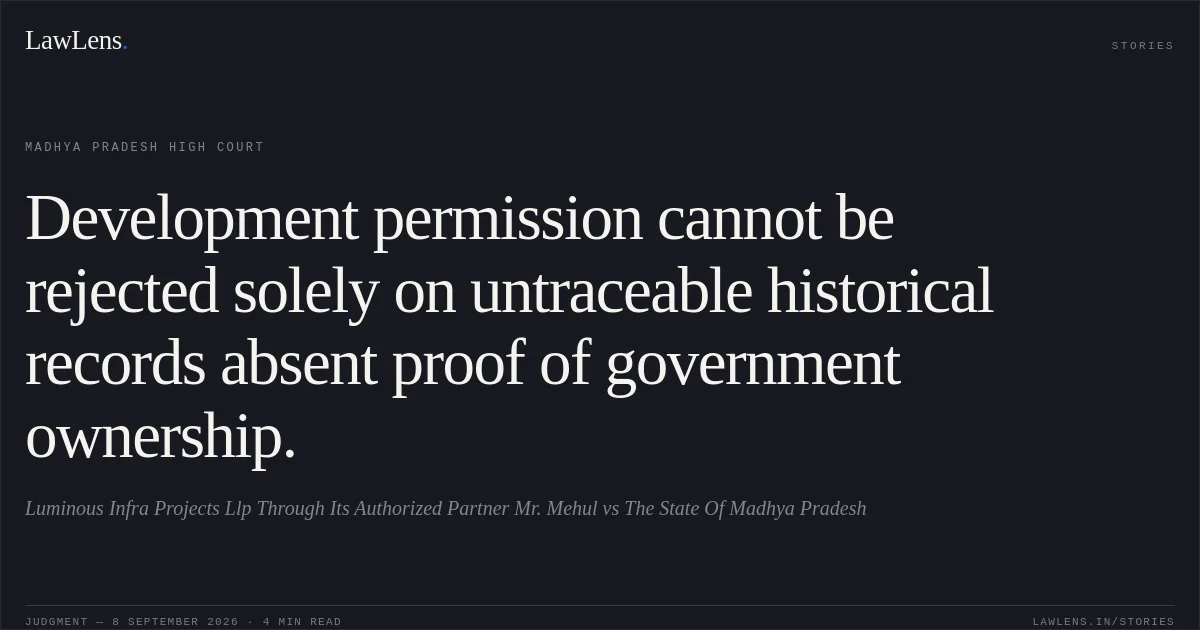
The petitioner purchased land through registered sale deeds executed during 2023–2026 for development of a residential colony known as “Luminous Corridor-II” and obtained mutation, diversion of land use, and layout/planning approval from the competent authorities.
pp. 2–4 · ¶ 3–4Earlier ceiling proceedings concerning the land had culminated in an order of the Board of Revenue dated 30 June 2004, passed in review, by which the earlier ceiling proceedings were set aside; that order was not challenged by the State.
pp. 2–3 · ¶ 4 · p. 8 · ¶ 8Revenue entries subsequently reflected private ownership, allegedly pursuant to an order dated 8 December 2010 of the Sub-Divisional Officer, Hatod. However, when the petitioner applied for development permission, the authorities reported that the relevant 2010 case and order could not be traced in the official register.
pp. 5–7 · ¶ 5, 8Relying on the historical ceiling entries and the non-availability of the 2010 order, the competent authority rejected the petitioner’s application by order dated 3 July 2026.
pp. 1–2 · ¶ 1, 3The petitioner challenged that rejection under Article 226 of the Constitution.
02Issues
i.Whether the petitioner’s application for development permission could be rejected solely because the historical 2010 revenue order could not be traced in the government record, despite the unchallenged 2004 Board of Revenue order, subsequent private-ownership entries, registered sale deeds, mutation, diversion, and layout approval.
pp. 8–14 · ¶ 8–10ii.Whether the High Court could exercise its writ jurisdiction under Article 226 and issue a positive direction despite the State’s objection regarding disputed title, availability of an alternative remedy, and the alleged absence of the 2010 order.
pp. 6–11 · ¶ 5–7iii.Whether the impugned rejection was arbitrary, unsupported by the existing record, and violative of the petitioner’s constitutional property rights under Articles 19 and 300A of the Constitution.
pp. 13–14 · ¶ 10–1103Law Applied
The Court applied Article 226 of the Constitution, holding that the existence of an alternative statutory remedy is not an absolute bar to writ jurisdiction, although writ jurisdiction is ordinarily exercised with restraint; exceptions include violation of natural justice or fundamental rights, lack of jurisdiction, and challenge to statutory validity.
pp. 8–10 · ¶ 7The Court applied the principles in T.N. Cements Corpn. Ltd. v. Unicon Engineers, (2025) 4 SCC 1, Whirlpool Corporation v. Registrar, Trade Marks, Harbanslal Sahnia v. Indian Oil Corporation Ltd., and Radha Krishan Industries v. State of H.P.
pp. 8–10 · ¶ 7The Court also relied on State of U.P. v. Ehsan, (2024) 14 SCC 269, and Army Welfare Education Society, New Delhi v. Sunil Kumar Sharma, (2024) 16 SCC 598, regarding the exercise of writ jurisdiction where the matter has been entertained and the record permits adjudication.
p. 11 · ¶ 7The Court treated the unchallenged 2004 Board of Revenue order and the continuous revenue entries reflecting private ownership as relevant circumstances, and held that an authority could not reject development permission merely on the basis of an untraceable historical order or an old revenue entry without positive material establishing government ownership or fraud.
pp. 11–14 · ¶ 8–10State action affecting the petitioner’s enjoyment of property was also examined in the context of Articles 19 and 300A of the Constitution.
p. 14 · ¶ 10Provisions in the judgment · 1
the Act (alias, unresolved) Section 170
04Reasoning
The Court found that the 2004 Board of Revenue order setting aside the earlier ceiling proceedings had remained unchallenged for more than two decades.
pp. 11–14 · ¶ 8, 10Thereafter, the land was continuously recorded as privately owned from 2010–11, the petitioner purchased it through registered instruments, obtained mutation, diversion, and layout approval, and no competent authority had previously challenged the relevant orders or entries.
pp. 11–13 · ¶ 8The mere inability of the authorities to trace the 2010 order did not establish that the order never existed, that the land vested in the State, or that fraud had been committed.
The Court further noted that the Tehsildar’s order did not state that the land was government land.
p. 13 · ¶ 9–10Accordingly, the development authority acted arbitrarily by relying on inconclusive historical material and by effectively treating revenue entries as proof of continuing ceiling restrictions without determining the present legal status of the land or producing a valid vesting order.
pp. 13–14 · ¶ 10–11In these circumstances, the Court considered the case appropriate for issuance of a writ of mandamus notwithstanding the objection concerning alternative remedy.
p. 14 · ¶ 1105Holding
The High Court held that the rejection order dated 3 July 2026 was ex facie illegal, arbitrary, and unsupported by the available record.
pp. 1–2 · ¶ 2 · p. 14 · ¶ 11It allowed both writ petitions, set aside the impugned rejection, and granted relief in terms of the petitioner’s prayers, including issuance of development permission for the “Luminous Corridor-II” project.
pp. 1–2 · ¶ 2 · p. 14 · ¶ 11No order was made as to costs.
p. 14, concluding orderOriginal Court PDF
Luminous Infra Projects Llp Through Its Authorized Partner Mr. MehulvsThe State Of Madhya Pradesh
Click to open original judgment
Original judgment, available to read, download and summarize on LawLens.in