Facts
The appellants were Higher Secondary School Teachers (Junior) appointed through direct recruitment in Government-aided schools in Kerala pursuant to the Government Order dated 13 May 1998. They claimed the full-time pay scale and allowances granted to HSST (Junior) teachers appointed by transfer or promotion, contending that both categories possessed identical qualifications and performed the same duties and responsibilities.
Source reference: para. 1–2The Single Judge allowed their writ petitions, holding that the differential treatment was discriminatory.
Source reference: para. 5The Division Bench reversed that decision, reasoning that promotee/transferee teachers had prior experience as full-time permanent school teachers and that the higher pay protected their pre-existing status, whereas direct recruits were fresh entrants.
Source reference: para. 6The appeals challenged the Division Bench’s judgment.
Source reference: para. 1Issues
Whether directly recruited HSST (Junior) teachers were entitled to the same pay scale and allowances as HSST (Junior) teachers appointed by transfer or promotion, merely because both categories performed identical work.
Source reference: para. 2Whether the difference in prior teaching experience and source of appointment constituted a valid basis for classification and differential pay under Articles 14 and 39(d) of the Constitution.
Source reference: paras. 8–14Law Applied
The Court applied the constitutional principles of equality under Article 14 and equal pay for equal work under Article 39(d), as interpreted through Article 14. It held that equal pay is not mechanically attracted by similarity of designation or duties; the claimant must establish substantial or complete parity, including similarity in recruitment source, educational qualifications, experience, mode of appointment, responsibilities, reliability and accountability.
Source reference: paras. 8–13Relying on State Bank of India v. M.R. Ganesh Babu, the Court recognised that differences in responsibility, reliability and other relevant service conditions may justify different pay scales if based on a bona fide, rational and intelligible criterion.
Source reference: para. 9Government of West Bengal v. Tarun Kumar Roy and State of Haryana v. Charanjit Singh further establish that educational qualifications, experience, merit, source of recruitment and the absence of an identical recruitment process may validly support classification and pay differentiation.
Source reference: paras. 10–11The Court also relied on State of Bihar v. Bihar Secondary Teachers Struggle Committee for the limitations on the doctrine and held that equal pay is enforceable only where there is complete parity in all material factors and the work is of equal value.
Source reference: paras. 12–13Reasoning
The Court accepted that the two categories of HSST (Junior) teachers performed similar teaching work, but held that functional similarity alone was insufficient to establish entitlement to equal pay.
Source reference: paras. 2, 8–13Promotee or transferee teachers had prior experience as full-time teachers in lower schools, whereas directly recruited teachers entered service as fresh recruits.
Source reference: paras. 6, 14This difference in experience was considered an intelligible differentia having a rational nexus with the State’s objective of preserving the status and benefits previously enjoyed by promotee/transferee teachers.
Source reference: paras. 6, 14Since the two groups lacked parity in experience and other relevant service circumstances, the constitutional requirement of equal pay for equal work of equal value was not satisfied.
Source reference: paras. 13–17The Court also held that the Calcutta High Court’s contrary decision in State of West Bengal v. Anirban Ghosh was per incuriam to the extent that it conflicted with binding Supreme Court precedent; dismissal of the special-leave petition against that decision did not alter the position.
Source reference: para. 16Holding
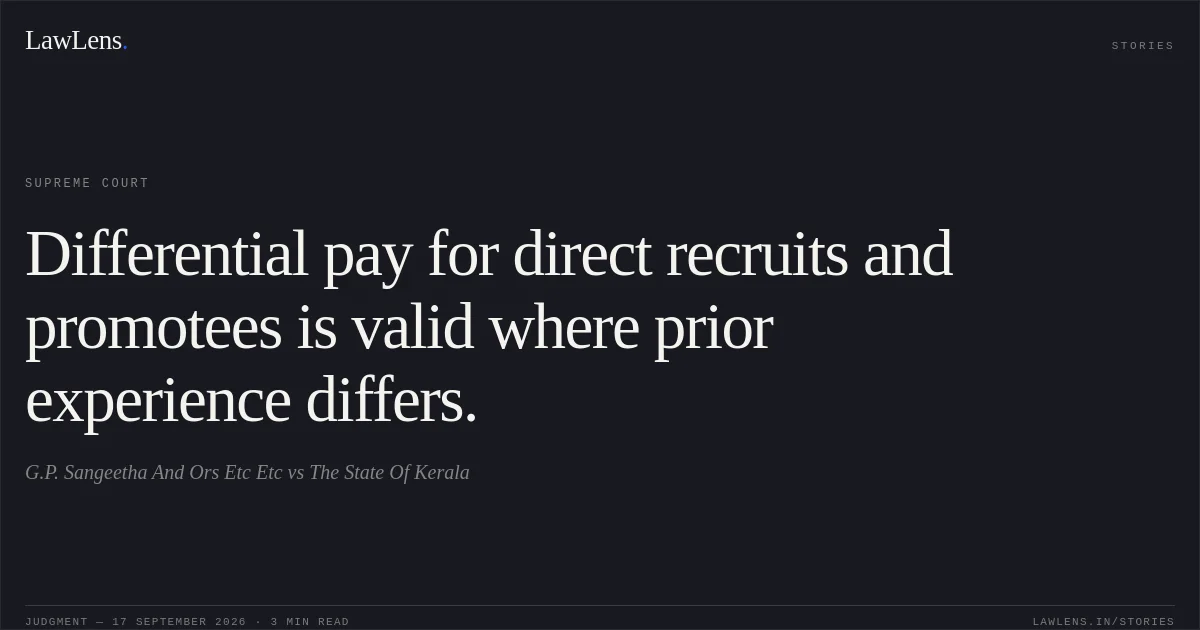
The Court held that prior teaching experience of promotee/transferee HSST (Junior) teachers constituted a valid and intelligible basis for granting them a higher pay scale than directly recruited HSST (Junior) teachers.
The appellants were therefore not entitled to pay parity merely on the basis that both categories performed the same work.
Source reference: paras. 17–20The Division Bench’s judgment was upheld, and the civil appeals were dismissed. Pending applications, if any, were also disposed of.
Source reference: paras. 17–20Original Court PDF
G.P. Sangeetha And Ors Etc EtcvsThe State Of Kerala
Click to open original judgment
Original judgment, available to read, download and summarize on LawLens.in