Facts
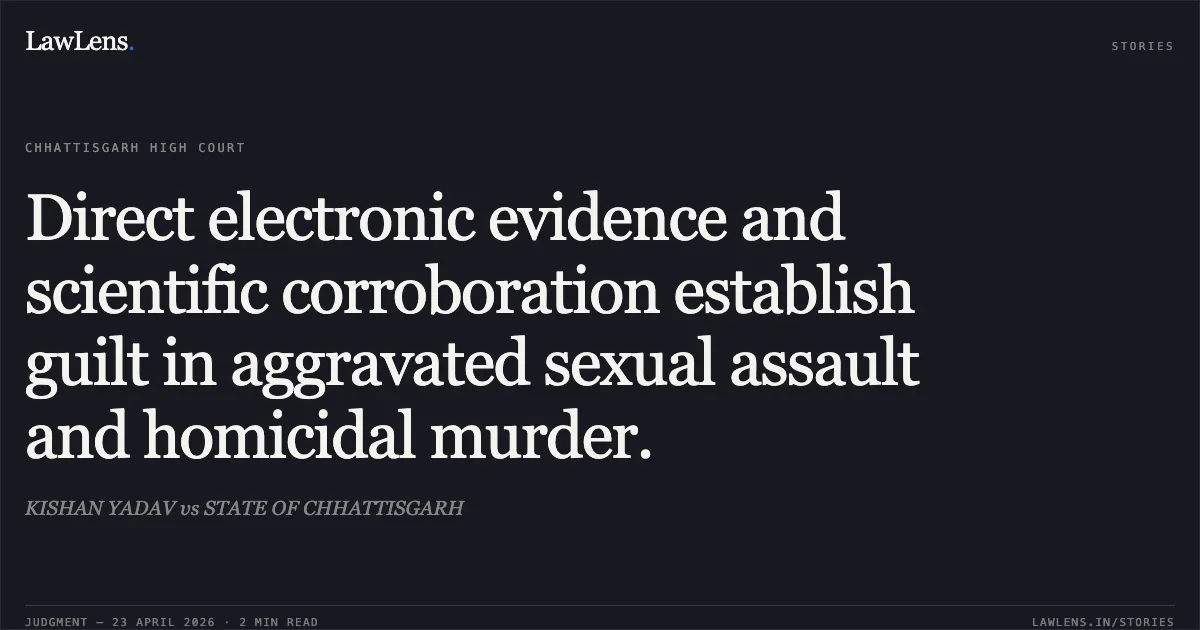
The Appellant was convicted for the rape and murder of a 55-year-old mentally unstable woman
Source reference: para 4On the intervening night of April 4–5, 2022, CCTV footage captured the Appellant dragging the deceased by her hair and assaulting her
Source reference: paras 6, 47The deceased was later found with catastrophic injuries, including a fractured skull and a ruptured uterus resulting from the insertion of an iron rod
Source reference: paras 29, 30Following a memorandum statement under Section 27 of the Evidence Act, the police recovered a blood-stained iron rod and clothing from the Appellant
Source reference: para 59The Trial Court sentenced the Appellant to life imprisonment until natural death under Sections 376(2)(l)(m), 376(A), and 302 of the IPC
Source reference: para 3The Appellant challenged the conviction primarily on the grounds of misappreciation of circumstantial evidence
Source reference: para 14Issues
1. Whether the death of the deceased was homicidal in nature?
Source reference: para 182. Whether the circumstantial evidence, including the "last seen" theory and electronic evidence, establishes the guilt of the Appellant beyond reasonable doubt?
Source reference: para 34Law Applied
The court applied Section 302 (Murder), Section 376 (Rape), Section 376(2)(l)(m) (Rape of a person with mental disability), and Section 376A (Rape causing death or persistent vegetative state) of the Indian Penal Code
Source reference: para 3Procedurally, it applied Section 65-B of the Indian Evidence Act for the admissibility of electronic CCTV evidence
Source reference: para 15, 39Section 27 regarding the discovery of facts based on an accused's disclosure
Source reference: para 57The court relied on the Panchsheel principles of circumstantial evidence established in Sharad Birdhichand Sarda v. State of Maharashtra, requiring an unbroken chain of events
Source reference: para 35, 84It further applied Section 106 of the Evidence Act regarding the burden of proving facts especially within one’s knowledge, as interpreted in State of Rajasthan v. Kashi Ram
Source reference: para 51Reasoning
The Court found the medical evidence conclusive of homicidal death, noting multiple lacerated wounds and internal organ rupture caused by a blunt object
Source reference: para 29-33Regarding the chain of circumstances, the Court held that the CCTV footage placed the victim in the exclusive company of the Appellant shortly before her death, invoking the "last seen" theory
Source reference: para 47-50Under Section 106, the Appellant failed to offer any explanation for the victim's injuries or the presence of human blood found on his seized clothing and the iron rod
Source reference: para 52, 73The Cyber Forensic Lab report authenticated the CCTV footage, identifying the Appellant and ruling out tampering
Source reference: para 45The Court observed that the insertion of an iron rod fell squarely within the definition of rape under Section 375 IPC
Source reference: para 75, 100Integrating the forensic, medical, and "last seen" evidence, the Court determined that the chain of circumstances was complete and inconsistent with any hypothesis of innocence
Source reference: para 78-79Holding
The High Court dismissed the appeal and upheld the conviction and sentence of life imprisonment until natural death
The Court held that the prosecution successfully proved the Appellant's guilt through a complete chain of circumstantial evidence
Source reference: para 98-99It further noted that the barbaric nature of the crime—targeting a vulnerable, mentally unstable woman—shocks the collective conscience of society and warrants the strictest judicial response
Source reference: para 100, 105The Appellant remains in custody to serve his remaining term
Source reference: para 109Acts & Sections Cited
7 provisions across 2 statutes referred to in this judgment. Each provision opens on LawLens.
Indian Penal Code, 18603
Code of Criminal Procedure, 19734
Original Court PDF
KISHAN YADAVvsSTATE OF CHHATTISGARH
Click to open original judgment
Original judgment, available to read, download and summarize on LawLens.in