01Facts
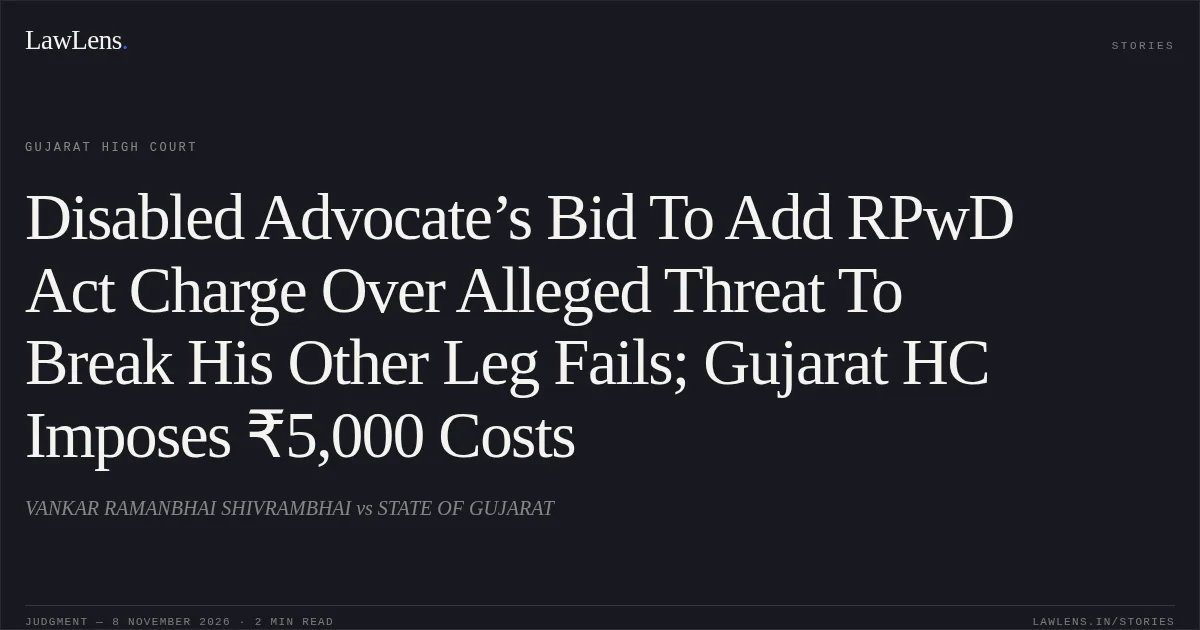
The petitioner, the original complainant and a person with a locomotor disability, lodged an FIR alleging that the accused abused and threatened him, including by saying they would break his remaining leg.
pp. 2–4, 9The police filed a charge-sheet for offences under Sections 504, 294(kh), 506(2) and 114 of the IPC, but not Section 92 of the Rights of Persons with Disabilities Act, 2016. The petitioner’s application under Section 216 CrPC to add that charge was rejected by the Magistrate on 11 April 2022 and by the Sessions Court in revision on 6 July 2024.
pp. 2–4, 902Issues
i.Whether the material on record disclosed the ingredients of an offence under Section 92 of the Rights of Persons with Disabilities Act, 2016, warranting addition of that charge under Section 216 CrPC.
pp. 7–10, 16ii.Whether the complainant had an enforceable right to require the trial court to exercise its Section 216 CrPC power to add a particular charge.
pp. 10–12, 1503Law Applied
Section 92(a) of the Rights of Persons with Disabilities Act, 2016 criminalises intentionally insulting or intimidating a person with a disability, with intent to humiliate, in a place within public view; Section 92(b) addresses assault or use of force against such a person with intent to dishonour him or outrage the modesty of a woman with a disability.
pp. 7–8Under Section 216 CrPC, a court may alter or add a charge at any time before judgment, where supported by the material on record and subject to safeguards against prejudice to the accused. That power is vested in the court; a party has no right to demand its exercise in a particular manner (*P. Kartikalakshmi v. Sri Ganesh*, (2017) 3 SCC 347; *Anant Prakash Sinha v. State of Haryana*, (2016) 6 SCC 105).
pp. 10–12The High Court’s Article 227 supervisory jurisdiction does not warrant interference absent patent illegality or material infirmity in the orders below.
p. 9Provisions in the judgment · 6 · Linked ones open on LawLens
Code of Criminal Procedure, 1973 Section 216
Rights of Persons with Disabilities Act, 2016. Section 92
Indian Penal Code, 1860 Section 504Section 294Section 506Section 114
04Reasoning
The Court considered the FIR’s allegations that the accused threatened to break the petitioner’s other leg and that others gathered at the scene. It concluded that the FIR did not disclose the necessary ingredients of Section 92, including the requisite intent to humiliate or dishonour on account of disability and, for Section 92(a), commission of the act in a place within public view.
pp. 8–10, 16The Court also held that Section 216 CrPC conferred a discretionary power on the trial court, not an enforceable right in the complainant to compel addition of a specific charge. Finding no patent illegality or material infirmity in the decisions below, it declined to intervene under Article 227.
pp. 9–12, 15–1605Holding
The High Court dismissed the petition, discharged the Rule and vacated any interim relief. It declined to direct addition of a charge under Section 92 of the Rights of Persons with Disabilities Act, 2016.
pp. 13–14The Court imposed costs of ₹5,000, payable by the petitioner to the District Legal Services Authority, Patan, within 15 days of receipt of the order; in default, the amount was made recoverable as a fine and as arrears of land revenue.
pp. 13–14Original Court PDF
VANKAR RAMANBHAI SHIVRAMBHAIvsSTATE OF GUJARAT
Click to open original judgment
Original judgment, available to read, download and summarize on LawLens.in