Facts
The appellant was appointed as a Special Police Officer in Police District Batala on 17 October 1991 and was later selected for appointment as a Constable in the First Indian Reserve Battalion, Patiala.
Source reference: para. 7Although he reported for joining on 30 August 2002, he was not permitted to join because a criminal case under Sections 324/326/34 IPC was pending against him.
Source reference: para. 7–8Separately, on 14 January 2003, he was discharged from his existing service solely with reference to the pending criminal proceedings.
Source reference: para. 7–8The appellant was subsequently convicted under Section 324 IPC, while his conviction under Section 326 IPC was set aside in appeal; he was released on probation, with the appellate court observing that the conviction would not affect his service career.
Source reference: para. 7The trial court decreed the suit and directed reinstatement with continuity of service and consequential benefits, but denied back wages.
Source reference: para. 2The first appellate court reversed the decree and dismissed the suit, and the High Court dismissed the appellant’s second appeal under Section 100 CPC.
Source reference: para. 3–4Before the Supreme Court, the appellant challenged the legality of his discharge and sought reinstatement or, alternatively, damages.
Source reference: para. 9–12Issues
1. Whether the appellant’s discharge from service merely because a criminal case was pending, without notice or opportunity of hearing, was illegal and arbitrary
Source reference: para. 24–262. Whether release on probation under Sections 3 or 4 of the Probation of Offenders Act, 1958, and the appellate court’s direction that the conviction would not affect the appellant’s service career, prevented the respondents from terminating or refusing to continue his service
Source reference: para. 15–223. Whether, despite the defective suit, the failure to challenge the discharge order, and the limitation on granting reinstatement in a civil suit, the Supreme Court could award compensation under Article 142 of the Constitution
Source reference: para. 24–27Law Applied
Section 12 of the Probation of Offenders Act, 1958, removes only statutory disqualifications attaching to a conviction; release on probation does not obliterate the conviction or confer an absolute right to continue in public service.
Source reference: para. 17, 20–22The Court relied on Southern Railway v. T.R. Chellapan, Trikha Ram v. V.K. Seth, Union of India v. Bakshi Ram, Karam Singh v. State of Punjab, DIG of Police v. P.R.K. Mohan, Shankar Dass v. Union of India, State of Uttar Pradesh v. Ranjit Singh, Punjab Water Supply Sewerage Board v. Ram Sajivan, and Sushil Kumar Singhal v. Punjab National Bank, which establish that conviction may justify disciplinary action notwithstanding probation.
Source reference: para. 17Under the second proviso to Article 311(2), a civil servant may be dismissed, removed, or reduced in rank on the basis of conviction without a departmental enquiry, subject to the constitutional scheme.
Source reference: para. 21However, mere pendency of a criminal case, without conviction or other lawful authority, does not by itself justify termination of a public employee, particularly without notice or an opportunity to defend.
Source reference: para. 26Further, the civil court could not grant reinstatement in view of Section 14 of the Specific Relief Act, 1963, and the appellant’s failure to challenge the discharge order materially restricted the relief available.
Source reference: para. 24The Supreme Court could nevertheless mould relief and do complete justice under Article 142 of the Constitution.
Source reference: para. 27Reasoning
The Court rejected the appellant’s principal reliance on Section 12 of the Probation of Offenders Act.
Source reference: para. 15–22It held that probation did not erase his conviction, and the Sessions Court’s observation that the conviction would not affect his service career could not override the settled law permitting service consequences based on conviction.
Source reference: para. 15–22Nevertheless, the respondents’ actual action in 2003 was not based on the later conviction but solely on the pendency of the criminal case.
Source reference: para. 24At that stage, no conviction had been recorded, the appellant was not given notice or an opportunity of hearing, and the respondents identified no legal provision authorising discharge of a police employee merely because criminal proceedings were pending.
Source reference: para. 25–26The subsequent conviction could not retrospectively validate the original discharge, since the legality of the order had to be assessed when it was made.
Source reference: para. 24Although the appellant had not challenged the discharge order, had framed the suit improperly, and could not obtain reinstatement through the civil action, the respondents’ admitted conduct remained illegal and arbitrary.
Source reference: para. 24–27In view of the procedural and evidentiary deficiencies, the Court declined to order reinstatement but invoked Article 142 to grant monetary compensation.
Source reference: para. 24–27Holding
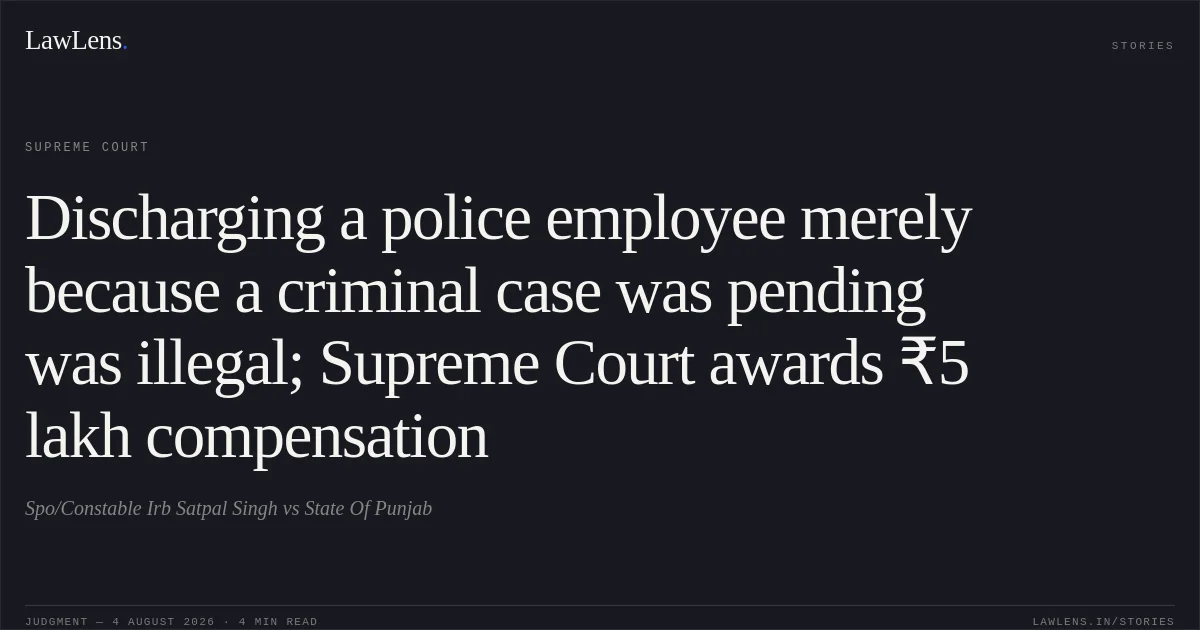
The Supreme Court held that the appellant’s discharge merely on the ground of pendency of a criminal case was illegal and arbitrary, and that his subsequent conviction and release on probation did not cure the original illegality.
Section 12 of the Probation of Offenders Act did not entitle him to reinstatement or prevent service action based on conviction.
Source reference: para. 17–22However, because the discharge order had not been challenged, the suit was procedurally defective, and reinstatement could not be granted by the civil court under Section 14 of the Specific Relief Act, the Court did not direct reinstatement.
Source reference: para. 24Exercising power under Article 142, it directed the respondents to pay the appellant compensation of ₹5,00,000 within three months.
Source reference: para. 27The appeal was accordingly disposed of.
Source reference: para. 28Original Court PDF
Spo/Constable Irb Satpal SinghvsState Of Punjab
Click to open original judgment
Original judgment, available to read, download and summarize on LawLens.in