Facts
The Petitioner, a retired Headmaster, challenged a criminal proceeding initiated against him under Section 500 of the IPC
Source reference: para. 1The dispute originated from a long-standing disciplinary proceeding initiated by the school management against the Opposite Party’s husband (an assistant teacher) in 2002
Source reference: para. 2Despite various litigations in the High Court and Supreme Court, and subsequent orders for payment of dues, the Opposite Party (the teacher’s wife) alleged that the Petitioner intentionally withheld salaries and benefits to financially cripple the family
Source reference: para. 10, 15The Opposite Party filed a complaint alleging that these administrative actions caused mental trauma and lowered the family's reputation
Source reference: para. 25The Judicial Magistrate at Chandannagar took cognizance of the offence on May 29, 2017
Source reference: para. 11Issues
1. Whether the administrative actions taken by a Headmaster in the course of disciplinary proceedings constitute the offence of defamation under Section 499 of the IPC.
Source reference: para. 27-312. Whether the wife of a defamed person has the locus standi to file a complaint for defamation in a representative capacity.
Source reference: para. 13, 343. Whether prior sanction under Section 197 of the CrPC is mandatory for prosecuting a Headmaster for acts done in the discharge of official duties.
Source reference: para. 14, 33Law Applied
The court applied Section 499 of the IPC, specifically Exceptions 7, 8, and 9, which protect accusations made in good faith to authorized persons or for the public good
Source reference: para. 30-31It relied on Section 199 of the CrPC, which mandates that only a "person aggrieved" can file a defamation complaint
Source reference: para. 34The court also invoked Section 197 of the CrPC, which provides protection and requires prior government sanction for public servants accused of offences committed while acting in the discharge of official duties
Source reference: para. 33Additionally, it applied Section 468 of the CrPC regarding the statutory bar of limitation for taking cognizance
Source reference: para. 14Reasoning
The court reasoned that for an offence under Section 500 IPC to be made out, the imputation must lower the moral or intellectual character of the person in the estimation of others as per Explanation 4 of Section 499 IPC
Source reference: para. 27It found that the complaint only ventilated grievances regarding financial harassment and administrative delays, which lacked the essential elements of defamation
Source reference: para. 28The court observed that the Petitioner’s actions were taken in his official capacity as Headmaster following school committee resolutions, squarely falling under Exceptions 7, 8, and 9 of Section 499 IPC
Source reference: para. 30-31Furthermore, the court held that since the teacher (the allegedly defamed person) was an adult male capable of approaching the court, his wife lacked the locus standi to file the complaint under Section 199 CrPC
Source reference: para. 34Finally, the court determined that the acts complained of were inextricably linked to the Petitioner's official duties, making prior sanction under Section 197 CrPC mandatory, the absence of which rendered the cognizance illegal
Source reference: para. 33Holding
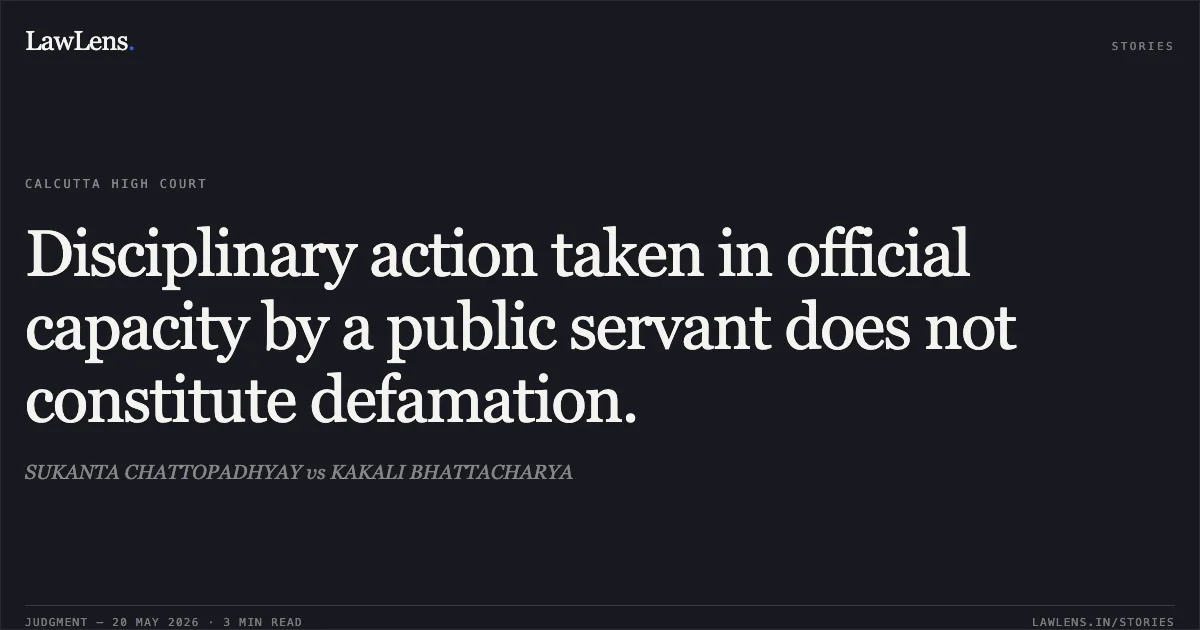
The court held that administrative disciplinary measures do not per se constitute defamation and that the Magistrate exercised discretion mechanically without finding a prima facie case
The court concluded that the complaint was an abuse of the process of law due to the lack of locus standi of the complainant, the absence of mandatory prior sanction, and the protection afforded to the Petitioner under the statutory exceptions of Section 499 IPC
Source reference: para. 31, 33-34The court allowed the revisional application and quashed the proceedings in CR No. 187 of 2017
Source reference: para. 36-37Acts & Sections Cited
10 provisions across 2 statutes referred to in this judgment. Each provision opens on LawLens.
Indian Penal Code, 18603
Code of Criminal Procedure, 19737
Original Court PDF
SUKANTA CHATTOPADHYAYvsKAKALI BHATTACHARYA
Click to open original judgment
Original judgment, available to read, download and summarize on LawLens.in