Facts
The petitioner, a police constable, was charged in a departmental proceeding with assisting persons involved in an incident that led to a criminal case under the IPC and NDPS Act.
Source reference: p. 4–5The Enquiry Officer found the charge proved, and the Superintendent of Police, Vaishali, dismissed the petitioner on 25 June 2021.
Source reference: p. 4–5The petitioner’s appeal and memorial were rejected.
Source reference: p. 4–5After his acquittal in the criminal case on 21 December 2023, he made further representations, which were also rejected.
Source reference: p. 8–9In his writ petition, he challenged the dismissal and subsequent orders, alleging procedural defects in the enquiry and failure by the appellate and memorial authorities to consider his submissions.
Source reference: p. 5–7Issues
1. Whether the departmental enquiry and the dismissal order were unlawful because the enquiry was allegedly restarted and the evidence was not properly proved or considered.
Source reference: p. 9–112. Whether the appellate and memorial orders were sustainable when they did not address the petitioner’s contentions.
Source reference: p. 11–123. Whether the petitioner’s acquittal in the criminal case required the departmental dismissal to be set aside.
Source reference: p. 7–8, 12–13Law Applied
Under Rule 18(1) of the Bihar Government Servants (Classification, Control and Appeal) Rules, 2005, a disciplinary authority may remit a case to the enquiring authority for further enquiry, which must proceed in accordance with Rule 17.
Source reference: p. 9–12Rule 17(14) provides for oral and documentary evidence to prove the articles of charge.
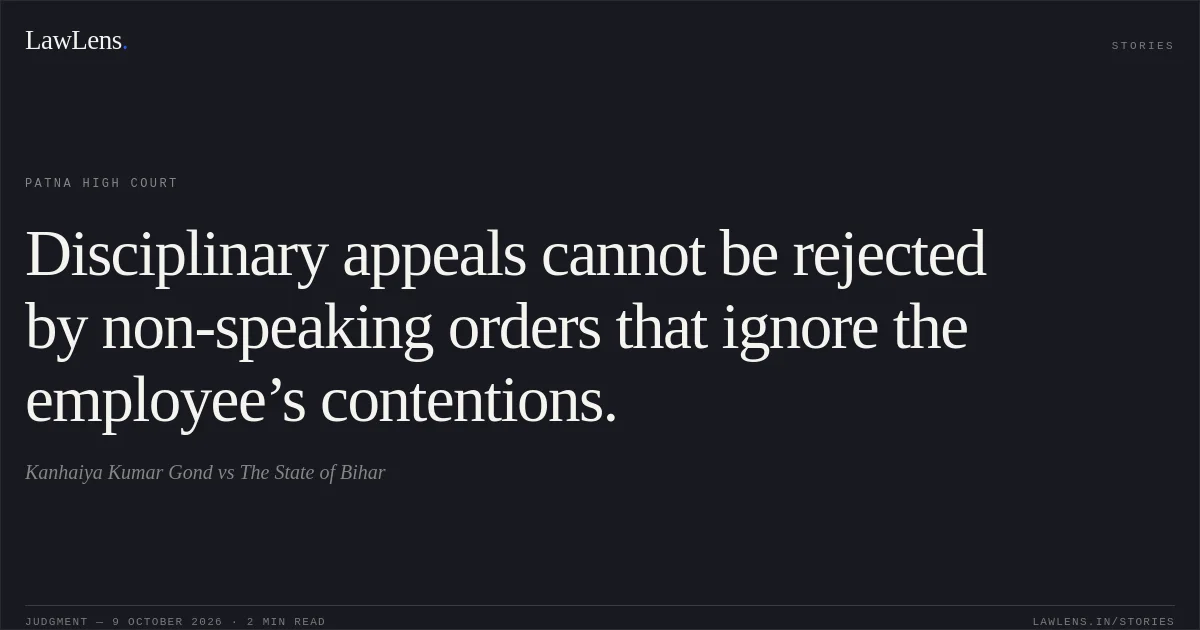
Source reference: p. 9–12An appellate authority and an authority deciding a memorial must consider the employee’s material contentions; an order rejecting them without such consideration is unsustainable.
Source reference: p. 9–12In judicial review under Article 226, the Court examines the decision-making process and does not ordinarily reappraise the merits where the finding is supported by evidence.
Source reference: p. 9–12Acquittal in a criminal case does not, by itself, negate departmental findings: criminal charges require proof beyond reasonable doubt, whereas departmental charges are determined on the preponderance of probabilities.
Source reference: p. 7–8, 9–12Reasoning
The Court found no basis to invalidate the enquiry on the asserted ground that it had been improperly restarted: the alleged earlier report was not established on the record, and Rule 18(1) permitted further enquiry in any event.
Source reference: p. 9The enquiry report referred to two witnesses who were cross-examined by the petitioner and to documentary material; the case was therefore not one of no evidence.
Source reference: p. 10The Court also found no illegality in the disciplinary authority’s dismissal order.
Source reference: p. 11However, the appellate order did not consider the grounds raised in the appeal, and the memorial order rejected the memorial without addressing its contents; both were therefore unsustainable.
Source reference: p. 11–12The petitioner’s acquittal did not warrant setting aside the departmental finding because the applicable standards of proof differ.
Source reference: p. 12–13Holding
The Court upheld the disciplinary proceedings and the dismissal order, but set aside the orders rejecting the petitioner’s appeal and memorial for failure to consider his contentions.
It remitted the matter to the Inspector General of Police, Tirhut Division, to pass a fresh order on the appeal within three months of receiving or being presented with the judgment and to communicate that order to the petitioner forthwith.
Source reference: p. 13The writ application was disposed of accordingly.
Source reference: p. 13Acts & Sections Cited
5 provisions across 2 statutes referred to in this judgment. Each provision opens on LawLens.
Indian Penal Code, 18602
Narcotic Drugs and Psychotropic Substances Act, 19853
Original Court PDF
Kanhaiya Kumar GondvsThe State of Bihar
Click to open original judgment
Original judgment, available to read, download and summarize on LawLens.in