Facts
The petitioner, Dr. S.C. Paliwal, was subjected to departmental disciplinary proceedings, culminating in an order dated 4 August 2011 imposing the punishment of withholding two annual increments with cumulative effect.
Source reference: para. 2He preferred an appeal against the punishment order, but the appellate authority rejected it by order dated 1 August 2012, primarily relying on the opinion of the Director, Animal Husbandry, and the absence of any “new facts” in the appeal.
Source reference: paras. 2, 5The petitioner thereafter filed a review application, which was rejected on 14 October 2019.
Source reference: para. 11He invoked Article 226 of the Constitution seeking quashing of the disciplinary, appellate, and review orders.
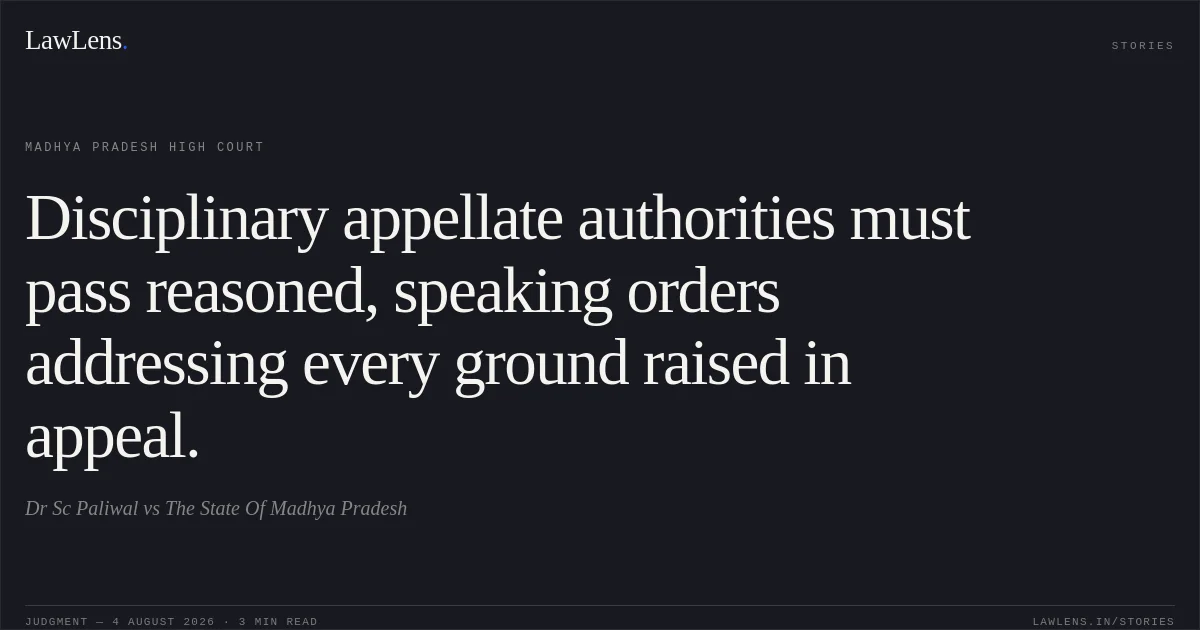
Source reference: para. 1The principal challenge before the High Court was that the appellate order was non-speaking and failed to consider the grounds raised in the appeal.
Source reference: paras. 2, 6Issues
1. Whether the appellate authority’s order rejecting the petitioner’s departmental appeal was a valid, reasoned, and speaking order, having regard to its quasi-judicial character?
Source reference: paras. 6–72. Whether the review rejection order was liable to be quashed consequentially because the appellate order did not disclose proper consideration of the petitioner’s grounds?
Source reference: para. 113. Whether the matter should be remanded to the competent appellate authority for fresh consideration without expressing any opinion on the merits of the disciplinary punishment?
Source reference: paras. 11–12Law Applied
The Court exercised jurisdiction under Article 226 of the Constitution of India to review the legality of the disciplinary appellate process.
Source reference: para. 1It applied the principle that an appellate authority exercising quasi-judicial power must independently apply its mind to the facts and grounds raised by the employee and must record cogent, clear, and legally sustainable reasons; a mere administrative endorsement or rubber-stamp conclusion is insufficient.
Source reference: paras. 6–7Relying on State of Punjab v. Bandeep Singh, (2016) 1 SCC 724, the Court held that every administrative or executive decision affecting rights must be composite, self-contained, and supported by the reasons that actually influenced the decision.
Source reference: paras. 8–9It further relied on Kranti Associates (P) Ltd. v. Masood Ahmed Khan, (2010) 9 SCC 496, which recognises recording of reasons as an essential component of fair decision-making, judicial accountability, transparency, and effective judicial review.
Source reference: para. 10The Court also referred to the settled rule that discretion must be exercised diligently, reasonably, and rationally, rather than arbitrarily.
Source reference: para. 7Reasoning
The appellate order did not examine the specific factual and legal grounds raised by the petitioner. Instead, it relied substantially on the Director’s opinion that the departmental proceedings were fair and lawful and stated that no new facts had been presented in the appeal.
Source reference: para. 5The High Court held that such reasoning did not demonstrate independent consideration of the appeal or explain why the petitioner’s objections were rejected.
Source reference: para. 6Since the appellate authority was exercising quasi-judicial powers, it was required to provide a reasoned decision showing application of mind to the entire record and to each material ground urged by the petitioner.
Source reference: paras. 6–7Applying the principles in Bandeep Singh and Kranti Associates, the Court concluded that the appellate order was not a speaking order and therefore could not sustain the consequential review order.
Source reference: paras. 8–11The Court confined its review to the legality of the decision-making process and expressly declined to assess the merits of the disciplinary punishment.
Source reference: para. 12Holding
The High Court held that the appellate rejection order dated 1 August 2012 and the review rejection order dated 14 October 2019 were unsustainable for want of adequate reasons and consequently quashed both orders.
The petitioner was directed to submit a fresh appeal, along with the earlier appeal, before the competent authority within one month.
Source reference: para. 12The appellate authority was directed to provide the petitioner a personal hearing and decide the appeal by a reasoned and speaking order, considering every fact and ground raised in the appeal, within three months from receipt of the certified copy of the judgment.
Source reference: para. 12The Court clarified that it had expressed no opinion on the merits of the disciplinary proceedings or punishment, and disposed of the writ petition accordingly.
Source reference: paras. 12–13Original Court PDF
Dr Sc PaliwalvsThe State Of Madhya Pradesh
Click to open original judgment
Original judgment, available to read, download and summarize on LawLens.in