Facts
A complaint dated 30 March 2015 alleged that, during 2012–13, two borewells intended for Lingsugur Taluk were drilled in Kushtagi Taluk; bills of ₹3,00,000 were settled without an agreement; and substandard materials were used.
Source reference: paras. 2–5The Lokayukta investigated under Section 9 of the Karnataka Lokayukta Act, 1984 and submitted a report under Section 12(3), after which the State Government entrusted a disciplinary enquiry under Rule 14(A) of the Karnataka Civil Services (Classification, Control and Appeal) Rules, 1957.
Source reference: paras. 2–5The Lokayukta then issued articles of charge dated 12 May 2017.
Source reference: paras. 2–5Maidunnisa challenged the entrustment order and charges before the Karnataka State Administrative Tribunal, which allowed his application on 23 August 2021, finding the entrustment order unsupported by proper application of mind and the charges insufficiently specific.
Source reference: paras. 2–5The Karnataka Lokayukta challenged that decision by writ petition.
Source reference: paras. 2–5Issues
1. Whether the Tribunal could quash the enquiry-entrustment order and articles of charge at the threshold, including by assessing the specificity or evidentiary sufficiency of the charges
Source reference: paras. 5–12, 172. Whether the complaint was barred under Section 8(2)(c) or Section 8(2)(d) of the Karnataka Lokayukta Act, 1984
Source reference: paras. 8, 12–15Law Applied
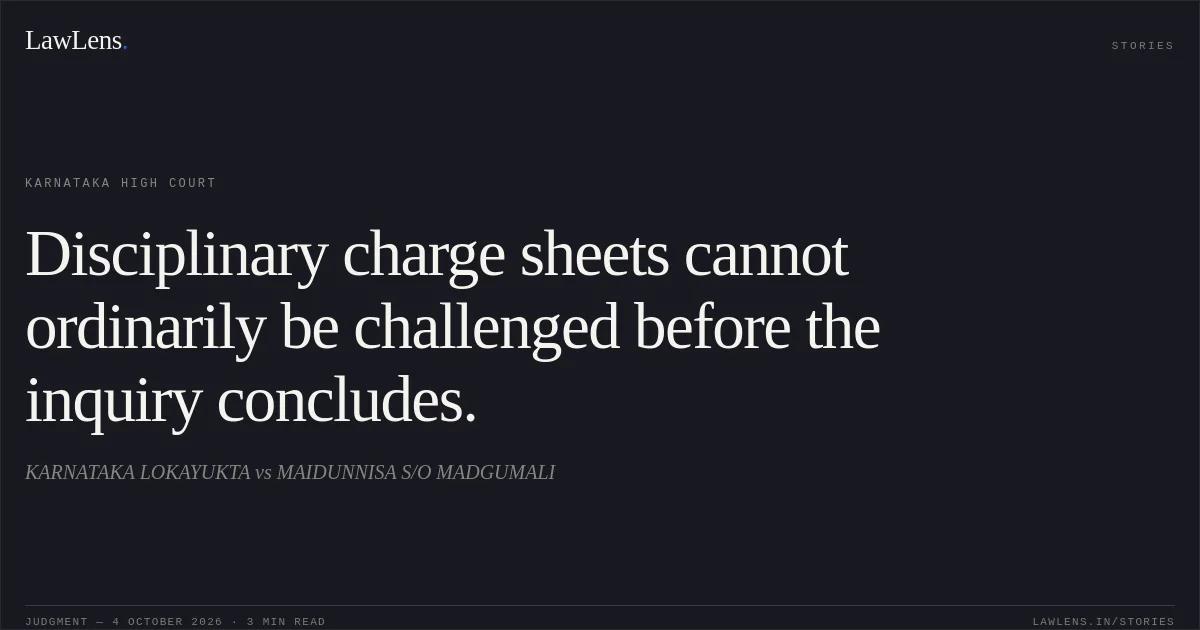
Ordinarily, courts and tribunals should not interfere with a charge-sheet or show-cause notice before the disciplinary process concludes, because its issuance alone does not infringe the charged employee’s rights; intervention may be justified in exceptional cases, such as where the issuing authority lacks jurisdiction or competence, or the charge-sheet is wholly illegal.
Source reference: paras. 10–11The Court applied Union of India v. Kunisetty Satyanarayana, (2006) 12 SCC 28, and Secretary, Ministry of Defence v. Prabhash Chandra Mirdha, (2012) 11 SCC 565, including the principles that the truth or correctness of charges is ordinarily for the disciplinary authority to determine and that a charge-sheet should not be quashed routinely.
Source reference: paras. 10–11Under Section 8(2)(c) of the Karnataka Lokayukta Act, a complaint involving a grievance must ordinarily be made within six months of the complainant learning of the action; under Section 8(2)(d), a complaint involving an allegation must ordinarily be made within five years of the action complained of.
Source reference: paras. 13–14The proviso permits the Lokayukta or Upalokayukta to entertain a late complaint where sufficient cause is shown.
Source reference: paras. 13–14The enquiry was entrusted under Rule 14(A) of the KCS (CCA) Rules following a report under Section 12(3) of the Act.
Source reference: para. 3Reasoning
The Court held that the Tribunal had prematurely assessed the charges, the material supporting them, and Maidunnisa’s alleged role—matters to be examined during the disciplinary enquiry.
Source reference: paras. 10–12, 16–17Maidunnisa could raise his objections and present evidence in that process; the charges did not fall within an established exception warranting threshold judicial intervention.
Source reference: paras. 10–12, 16–17On limitation, the Court characterised the complaint as one involving allegations of misappropriation and irregularities, rather than a grievance governed by the six-month period in Section 8(2)(c).
Source reference: paras. 13–15The alleged events occurred in 2012–13 and the complaint was made on 30 March 2015, within the five-year period in Section 8(2)(d); the Court therefore rejected the limitation objection.
Source reference: paras. 13–15It also rejected the argument that proceedings against Maidunnisa were invalid because other officials were not proceeded against, observing that there is no doctrine of negative equality.
Source reference: para. 15Holding
The Court allowed the writ petition, set aside the Tribunal’s order dated 23 August 2021, and dismissed Application No. 5861 of 2017.
The entrustment of the enquiry and the articles of charge were therefore left in place for the disciplinary proceedings to continue.
Source reference: para. 18Acts & Sections Cited
3 provisions across 1 statute referred to in this judgment. Each provision opens on LawLens.
KARNATAKA LOKAYUKTA ACT, 19843
Original Court PDF
KARNATAKA LOKAYUKTAvsMAIDUNNISA S/O MADGUMALI
Click to open original judgment
Original judgment, available to read, download and summarize on LawLens.in