Facts
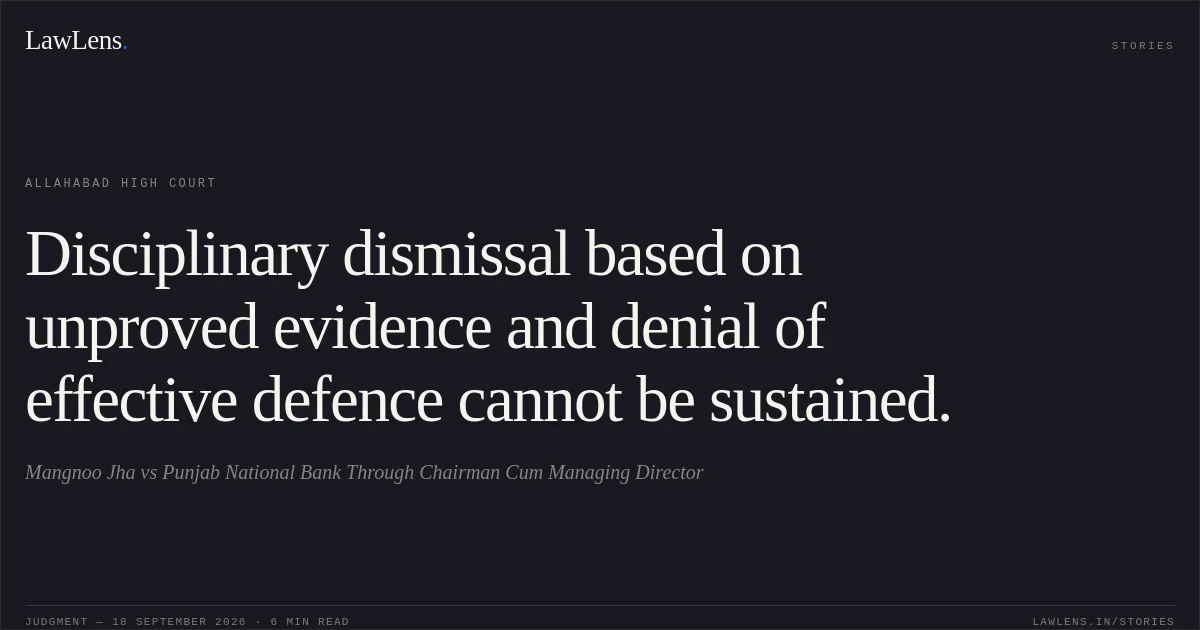
The petitioner, appointed as Clerk-cum-Cashier in Punjab National Bank in 1978 and subsequently promoted as Assistant Manager, was suspended in 1999 following registration of criminal cases alleging fraud, defalcation and unauthorised banking transactions.
Source reference: paras. 3–7A departmental charge-sheet was issued in 2002, approximately three years after his suspension, alleging financial irregularities committed while he was functioning as a “System Administrator” at the Bank’s Mahanagar and Vidhan Sabha Marg branches.
Source reference: paras. 7, 32, 66–72The petitioner repeatedly sought relevant documents, including 48 documents required for his defence. The documents were not fully supplied, and several were later declared unavailable.
Source reference: paras. 8–9, 15–19Although this Court, in an earlier writ petition, directed the Bank to supply the documents or permit inspection, the petitioner alleged that originals were not produced and disputed photocopies were relied upon.
Source reference: paras. 69, 136–140The enquiry proceeded on several dates in the petitioner’s absence; material management witnesses were examined without effective cross-examination, and the petitioner’s requested defence witnesses were not summoned.
Source reference: paras. 12–14, 23–26, 151–155The petitioner also denied ever being appointed or posted as System Administrator. The Bank produced no appointment or posting order.
Source reference: paras. 32–35In earlier civil proceedings between the parties, the Civil Court held that the Bank had failed to establish that the petitioner had worked as System Administrator; the appeal against that finding was dismissed.
Source reference: paras. 141–146Nevertheless, the Enquiry Officer treated that status as established and found all charges proved.
Source reference: paras. 27–28, 51–52The Disciplinary Authority dismissed the petitioner from service, forfeited salary for the suspension period except subsistence allowance, and treated the suspension period as not spent on duty.
Source reference: para. 28The departmental appeal was rejected on the ground that the petitioner had failed to disprove the charges by producing fresh facts; the appellate authority did not meaningfully address the objections concerning natural justice, evidence, documents or proportionality.
Source reference: paras. 29–30, 52–59, 164–167The petitioner challenged the dismissal and appellate orders under Article 226 of the Constitution.
Source reference: no citationIssues
1. Whether the departmental enquiry violated the principles of natural justice by denying relevant documents, refusing production or inspection of original records, proceeding in the petitioner’s absence, and denying examination of material defence witnesses?
Source reference: paras. 135–140, 151–155, 1732. Whether the findings of guilt were based on legally relevant and reliable evidence, or were findings based on no evidence, conjecture or an erroneous shifting of the burden of proof?
Source reference: paras. 148–150, 156–163, 174–1773. Whether the Bank could treat the petitioner as a System Administrator when his appointment or posting to that position was not established by departmental evidence and had been negatived in prior civil proceedings?
Source reference: paras. 141–147, 1744. Whether the Disciplinary Authority and Appellate Authority independently considered the petitioner’s objections and complied with the applicable disciplinary regulations?
Source reference: paras. 164–167, 178–1795. Whether the dismissal order and appellate order were liable to be quashed and whether the petitioner was entitled to continuity of service and consequential benefits?
Source reference: paras. 177–193Law Applied
The Court applied the principles of natural justice applicable to disciplinary proceedings, including the right to a meaningful opportunity of defence, disclosure and inspection of relevant documents, cross-examination of management witnesses and production of relevant defence evidence.
Source reference: paras. 136–140, 151–155Relying on Kashinath Dikshita v. Union of India, Government of A.P. v. A. Venkata Naidu, and State of U.P. v. Saroj Kumar Sinha, the Court held that non-supply of material documents causing prejudice vitiates the enquiry and that an Enquiry Officer must remain an impartial adjudicator rather than act as a representative of the management.
Source reference: para. 130, paras. 136–140Under Roop Singh Negi v. Punjab National Bank, Narinder Mohan Arya v. United India Insurance Co. Ltd., and M.V. Bijlani v. Union of India, disciplinary findings must rest on evidence having probative value; suspicion, conjecture, ipse dixit and a reversal of the burden of proof cannot substitute for evidence.
Source reference: paras. 148–150, 162–163The Court also applied the judicial-review principles stated in P. Gunasekaran v. Union of India, permitting interference where the enquiry violates natural justice, the findings are based on no evidence, relevant evidence is ignored, or no reasonable person could reach the conclusion recorded.
Source reference: paras. 132–134, 171The requirement of a reasoned and independent decision by the disciplinary and appellate authorities was also applied, particularly under Regulation 17 of the Punjab National Bank Officers’ Employees (Discipline & Appeal) Regulations, 1977.
Source reference: paras. 29–30, 164–167Reasoning
The Court held that the defects were cumulative and went beyond a minor procedural irregularity.
Source reference: no citationThe petitioner had consistently sought documents that were directly relevant to old banking transactions, disputed the authenticity of photocopies, and requested production or inspection of originals.
Source reference: paras. 136–140The earlier judicial direction requiring supply or inspection of relevant documents enhanced the Bank’s obligation to provide an effective defence opportunity; the subsequent non-availability or non-production of records materially prejudiced the petitioner.
Source reference: paras. 136–140The refusal to summon members of the balancing team and the non-examination of material witnesses further impaired the defence.
Source reference: paras. 151–153The Court found that the management failed to establish the foundational fact that the petitioner was appointed or authorised as System Administrator.
Source reference: paras. 141–146No appointment order was produced, the Bank’s own handbook contemplated a Scale-II officer for that role whereas the petitioner was in Scale-I, and the prior civil adjudication had rejected the Bank’s case on that issue.
Source reference: paras. 141–146Consequently, charges based on duties, access and responsibilities allegedly attached to that post could not be sustained merely by repeating the allegation in the charge-sheet.
Source reference: paras. 147, 159The findings on individual transactions were also unsupported by a satisfactory nexus between the petitioner and the alleged misconduct.
Source reference: paras. 156–160For example, the chronology relating to Account No. 16488 did not connect the petitioner with the account because it had been closed before his posting at the relevant branch; disputed signatures and photocopies were not adequately proved; and the complainant or other material witnesses were not examined.
Source reference: paras. 156–160The appellate authority’s conclusion that the petitioner had failed to produce fresh material to disprove the charges demonstrated an impermissible reversal of the burden: the Bank was required first to establish the charges through reliable evidence.
Source reference: paras. 162–163, 167Because the Enquiry Officer’s findings were vitiated by denial of natural justice, reliance on an unestablished foundational fact and absence of adequate evidentiary nexus, the Disciplinary Authority could not validly base the dismissal upon that report.
Source reference: paras. 164–179The appellate order was independently defective because it failed to address the petitioner’s material grounds or examine the legality and sustainability of the punishment.
Source reference: paras. 164–179Holding
The writ petition was allowed.
The Court set aside the dismissal order dated 1 November 2012/10 November 2012 and the appellate order dated 27 March 2014, and annulled the enquiry findings forming the basis of the punishment.
Source reference: paras. 183–185The petitioner was directed to be treated as continuing in service from the date on which the dismissal operated, without break in continuity, with restoration of his service status and correction of service records.
Source reference: para. 186He was held entitled to consequential service benefits, including continuity, pay fixation, increments, seniority and other benefits, subject to applicable rules and adjustment of amounts already paid.
Source reference: paras. 187–188The Bank was directed to complete restoration, calculation and payment of admissible benefits within three months of production of the certified order.
Source reference: para. 189No order as to costs was made.
Source reference: para. 194Acts & Sections Cited
6 provisions across 1 statute referred to in this judgment. Each provision opens on LawLens.
Indian Penal Code, 18606
Original Court PDF
Mangnoo JhavsPunjab National Bank Through Chairman Cum Managing Director
Click to open original judgment
Original judgment, available to read, download and summarize on LawLens.in