Facts
The petitioner, a salesman at a fair-price shop operated by the fifth respondent co-operative society, was suspended and faced an initial charge memo concerning absence from duty and a stock shortage, followed by a second charge memo alleging further irregularities, including false entries and improper distribution of ration commodities.
Source reference: para. 3–19He repeatedly sought copies of documents to prepare his defence.
Source reference: para. 3–19After a departmental inquiry, he was dismissed from service on 26 September 2013.
Source reference: para. 3–19His revisions were rejected by the third respondent and the State Government.
Source reference: para. 3–19He then sought certiorari to quash the dismissal and revisional orders and mandamus for reinstatement with consequential benefits.
Source reference: para. 23–24Issues
Whether the petitioner was afforded an adequate opportunity to defend himself, or whether the inquiry and resulting orders violated the principles of natural justice
Source reference: para. 26Whether the findings were unsupported or perverse, or the dismissal punishment was liable to be set aside as disproportionate
Source reference: para. 27, 29, 32Law Applied
In judicial review under Article 226, the Court does not sit as an appellate authority to reappreciate evidence; interference may be warranted where there is misreading of evidence, no evidence, or perversity.
Source reference: para. 27In disciplinary proceedings, charges are assessed on the balance of probabilities, rather than the criminal standard of proof beyond reasonable doubt.
Source reference: para. 30A revisional or appellate authority must independently apply its mind to the material on record, as recognised in S.N. Mukherjee v. Union of India, (1990) 4 SCC 594.
Source reference: para. 31The Court also considered whether the punishment was shockingly disproportionate to the proved misconduct.
Source reference: para. 32Reasoning
The Court found that the petitioner had notice of the inquiry and appeared before the Inquiry Officer on multiple occasions.
Source reference: para. 28–30It considered that he had been given an opportunity to peruse the documents on file and that he did not establish denial of an opportunity to cross-examine witnesses.
Source reference: para. 28–30On that record, the Court held that the complaints about non-supply of documents and the absence of cardholder evidence did not demonstrate a breach of natural justice, perversity, or a case of no evidence.
Source reference: para. 28–30It further held that the disciplinary authority’s findings met the applicable evidentiary standard and that both revisional authorities had independently considered the relevant material.
Source reference: para. 30–31The petitioner also failed to show that dismissal was shockingly disproportionate.
Source reference: para. 32Holding
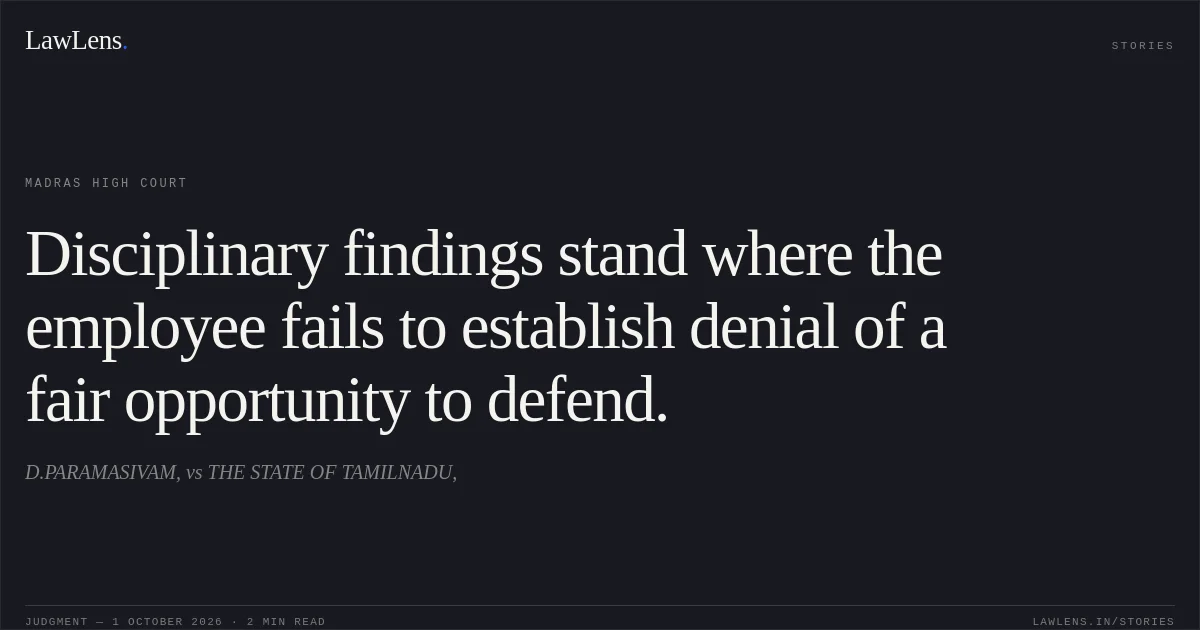
The Court answered the natural-justice and evidentiary challenges against the petitioner and found no basis to interfere with the dismissal or the revisional orders.
The writ petition was dismissed, with no costs; the connected miscellaneous petition was closed.
Source reference: para. 29–33Acts & Sections Cited
1 provisions across 1 statute referred to in this judgment. Linked provisions open on LawLens.
Right to Information Act, 20051
Original Court PDF
D.PARAMASIVAM,vsTHE STATE OF TAMILNADU,
Click to open original judgment
Original judgment, available to read, download and summarize on LawLens.in