Facts
Late Ramesh Chand Kangali, a Group ‘D’ Railway employee since 1981, was removed from service on 29.05.1997 following a departmental inquiry for unauthorized absence from 06.07.1995 to 13.03.1996
Source reference: p. 2The inquiry report noted that only 13 days were unauthorized, while the remaining period was supported by private medical treatment
Source reference: p. 2The employee filed a departmental appeal on 11.07.1997, which remained pending for 13 years until his death on 06.08.2010
Source reference: p. 3Following a direction from the Tribunal in a previous O.A. (No. 887/2013), the Appellate Authority substituted the deceased's daughter (the applicant) but dismissed the appeal on 16.06.2017, upholding the removal
Source reference: p. 3, 9-10The applicant challenged both the removal and appellate orders, seeking retiral benefits.
Source reference: no citationIssues
1. Whether the disciplinary proceedings and the penalty of removal stand abated if the employee dies during the pendency of a departmental appeal
Source reference: p. 11, 122. Whether the prolonged inaction of the respondents in deciding the statutory appeal for 20 years (including during the employee's lifetime) vitiates the proceedings
Source reference: p. 10, 11Law Applied
Railway Board Circular (R.B.E. No. 115/2000) dated 19.06.2000, which mandates that disciplinary proceedings must be closed immediately upon the death of the charged railway servant
Source reference: p. 12Smt. Manju Lata Srivastava v. Union of India & Ors (O.A. No. 1121/2005), which established the principle that if a charged official dies while an appeal against punishment is pending, the entire disciplinary proceeding abates, and the employee is deemed to have died in service
Source reference: p. 11Reasoning
The Tribunal reasoned that departmental proceedings and appeals constitute a single continuous process
Source reference: p. 12Since the deceased employee had preferred a timely appeal in 1997 that was never decided during his lifetime, the proceedings had not attained finality
Source reference: p. 10The Tribunal rejected the respondents' argument that the employee’s failure to appear for a personal hearing excused the delay, holding that the Appellate Authority had a statutory duty to decide the appeal on merits based on available records
Source reference: p. 11Applying R.B.E. No. 115/2000, the Tribunal held that the death of the employee during this pendency triggered an automatic abatement of the proceedings
Source reference: p. 12Consequently, the punishment of removal was rendered legally non-existent, and the employee must be treated as having died while "in service"
Source reference: p. 11-12Holding
The Tribunal allowed the Original Application, quashing the removal order dated 29.05.1997 and the appellate order dated 16.06.2017
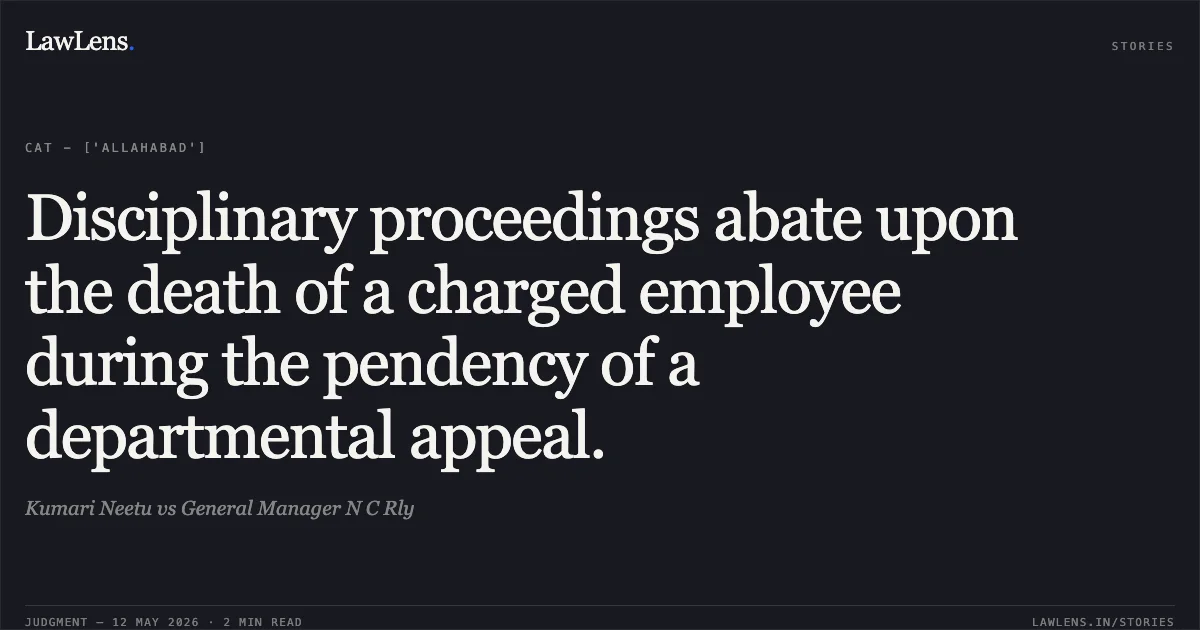
It held that the disciplinary proceedings abated upon the employee's death in 2010
Source reference: p. 12The respondents were directed to treat the employee as having died in service and to release all death-cum-retiral benefits, service benefits, and arrears to the applicant within four months
Source reference: p. 13Regarding compassionate appointment, the applicant was granted liberty to file a separate application
Source reference: p. 13Acts & Sections Cited
1 provisions across 1 statute referred to in this judgment. Each provision opens on LawLens.
Administrative Tribunals Act, 19851
Original Court PDF
Kumari NeetuvsGeneral Manager N C Rly
Click to open original judgment
Original judgment, available to read, download and summarize on LawLens.in