01Facts
The petitioner, a government employee, was placed under deemed suspension after his arrest in March 2001 on a corruption charge.
pp. 3–6 · ¶ 2, 5–7A departmental proceeding was initiated against him in September 2001; the Inquiry Officer’s 2012 report found Charge No. 2 proved, Charge No. 3 not proved, and made no finding on Charge No. 1.
pp. 3–6 · ¶ 2, 5–7The petitioner was convicted by the Special Judge in 2011 but acquitted by the High Court in 2018, which held that the prosecution had not proved demand and acceptance of illegal gratification.
p. 3 · ¶ 4The petitioner retired in January 2019.
pp. 6–7 · ¶ 8–10After a public notice in September 2023, he submitted a response to the inquiry report; he then sought, among other reliefs, quashing of the disciplinary proceeding and payment of pensionary benefits.
pp. 6–7 · ¶ 8–10The respondents submitted that the proceeding could be concluded within a stipulated period.
p. 7 · ¶ 1202Issues
i.1. Whether the disciplinary proceeding should be quashed because of its prolonged pendency, the petitioner’s retirement, and his acquittal in the criminal appeal.
pp. 7–8 · ¶ 11–16ii.2. Whether the Disciplinary Authority should be permitted to conclude the proceeding within a fixed time, and what consequences should follow for the petitioner’s pension and other benefits.
pp. 8–9 · ¶ 16–1903Law Applied
The petition was brought under Article 226 of the Constitution.
p. 3 · ¶ 2The petitioner’s deemed suspension was made under Rule 6(1) of the Assam Services (Discipline and Appeal) Rules, 1964; the charges also referred to Rule 3 of the Assam Civil Services (Conduct) Rules, 1965.
p. 3, 5 · ¶ 2, 7The petitioner sought relief under FR 54-B(1)(a) and (b), but the Court did not decide his substantive entitlement under those provisions.
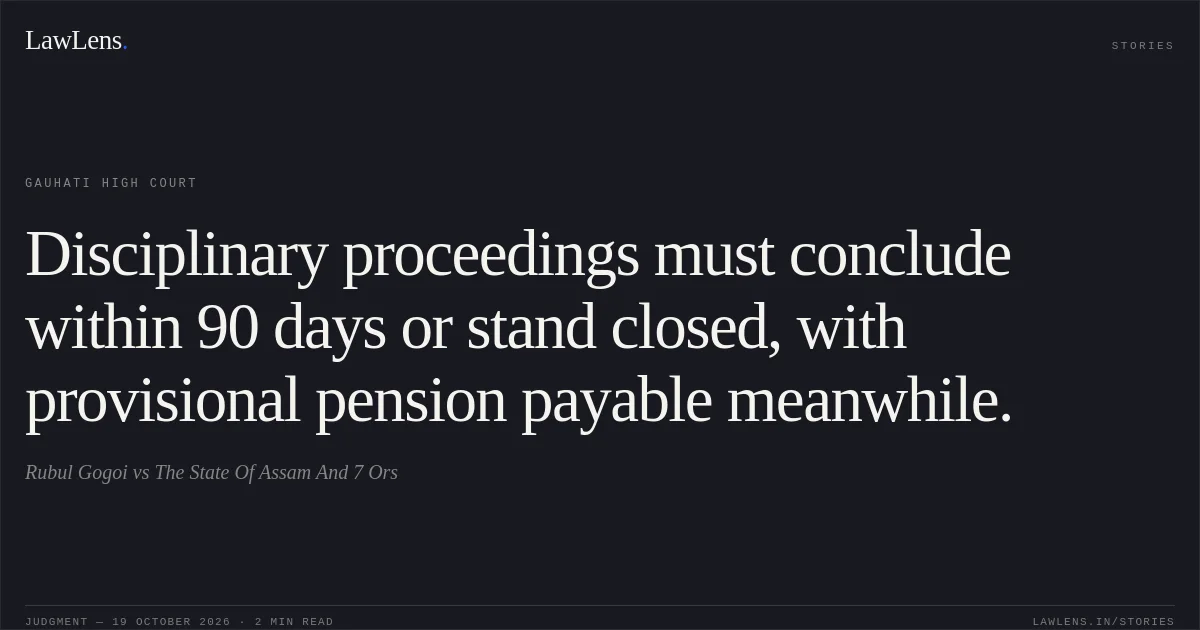
p. 6 · ¶ 10The Court’s operative direction was that the Disciplinary Authority could decide the proceeding in accordance with law within 90 days, failing which the proceeding would be deemed closed; provisional pension was payable pending that decision or deemed closure.
pp. 8–9 · ¶ 17–19No precedent was cited.
Provisions in the judgment · 3 · Linked ones open on LawLens
Prevention of Corruption Act, 1988 Section 7Section 12
Indian Penal Code, 1860 Section 161
04Reasoning
The Court declined to quash the proceeding because the petitioner had not produced documentary evidence that he had submitted an earlier response to the inquiry report, and the Department had awaited his representation, which was ultimately submitted in 2023.
p. 8 · ¶ 15It nevertheless considered a fixed deadline necessary in light of the proceeding’s long duration and the petitioner’s retirement in 2019.
p. 8 · ¶ 16In directing the Disciplinary Authority to consider the criminal acquittal, the inquiry findings, and the petitioner’s representation, the Court preserved the authority’s opportunity to decide the matter while preventing further indefinite delay.
pp. 8–9 · ¶ 17–18It also held that provisional pension could not be withheld pending the decision without due process.
p. 9 · ¶ 1905Holding
The writ petition was disposed of without quashing the disciplinary proceeding.
pp. 8–9 · ¶ 17–20The Disciplinary Authority was directed to make a final decision within 90 days, taking into account the specified materials.
pp. 8–9 · ¶ 17–20If it failed to do so, the proceeding would be deemed closed.
pp. 8–9 · ¶ 17–20If the petitioner was exonerated, the Authority was to decide his consequential benefits; if found guilty, it could impose a penalty permitted by law.
pp. 8–9 · ¶ 17–20The petitioner was entitled to provisional pension until a final decision or deemed closure.
pp. 8–9 · ¶ 17–20Original Court PDF
Rubul GogoivsThe State Of Assam And 7 Ors
Click to open original judgment
Original judgment, available to read, download and summarize on LawLens.in