01Facts
The petitioner, a retired Deputy District Project Co-ordinator, was among the education officials named in a complaint to the Karnataka Lokayukta concerning alleged irregularities by private educational institutions in Bidar District.
pp. 3–5Following an investigation, the Lokayukta submitted a report alleging misconduct; disciplinary proceedings followed, and the competent authority imposed a penalty withholding 10% of the petitioner’s pension for five years.
pp. 3–5The petitioner challenged the penalty before the Karnataka State Administrative Tribunal, which dismissed his application on 18 January 2024.
pp. 4–5He then filed this writ petition challenging the Tribunal’s decision.
pp. 4–502Issues
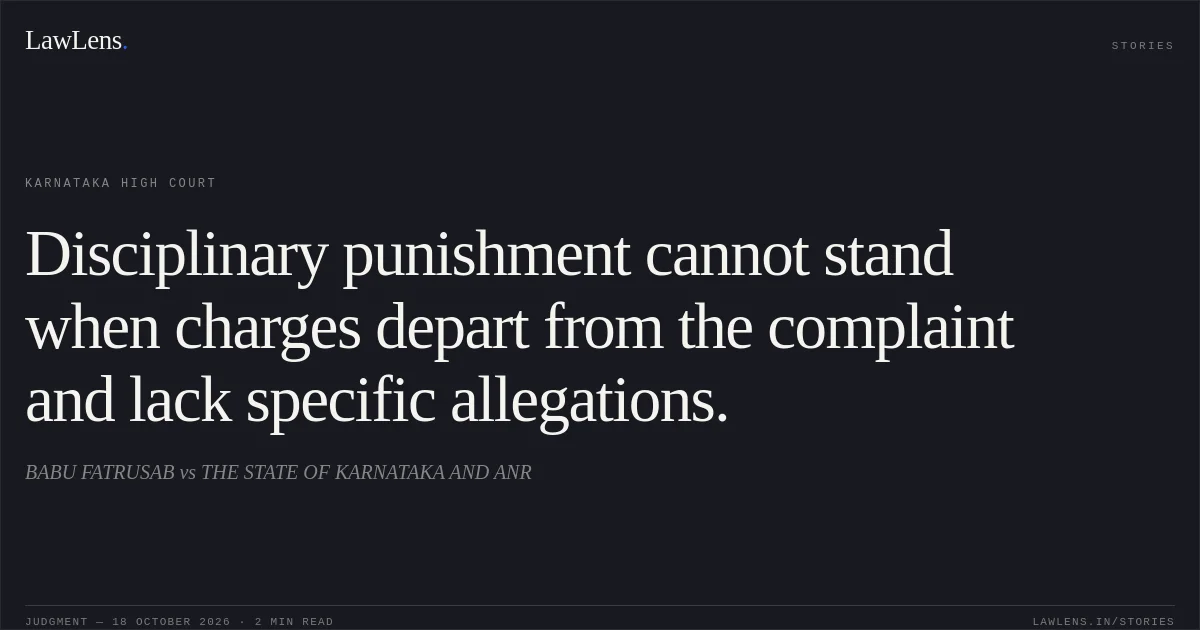
i.Whether the disciplinary proceedings and resulting penalty could stand where the complaint concerned the academic year 2011 but the articles of charge concerned 2012–13?
pp. 7–8ii.Whether the findings against the petitioner could stand when the complaint did not contain specific allegations against him?
p. 803Law Applied
The Court referred to Sections 8, 9, 12(3) and 12(4) of the Karnataka Lokayukta Act, 1984, concerning the Lokayukta’s inquiry and reporting process, and to Rule 3(i) of the Karnataka Civil Services (Conduct) Rules, 1966, concerning the alleged misconduct.
pp. 3–4, 6–7It also referred to Rule 14-A of the Karnataka Civil Services (Classification, Control and Appeal) Rules in recounting the entrustment of the inquiry.
p. 3, 7The Court’s decision rested on the requirement that disciplinary findings be supported by allegations relevant to the charges and specifically attributable to the employee; it cited no judicial precedents.
Provisions in the judgment · 3 · Linked ones open on LawLens
KARNATAKA LOKAYUKTA ACT, 1984 Section 8Section 9Section 12
04Reasoning
The Court found that the complaint related to 2011, whereas the articles of charge concerned the academic year 2012–13, and that the charges were not in terms of the complaint.
pp. 7–8It also found that the complaint contained no specific allegations against the petitioner.
p. 8Because the Tribunal had not addressed these matters and had affirmed the findings without properly considering the record, the High Court held its decision arbitrary and erroneous.
pp. 7–805Holding
The Court allowed the writ petition, set aside the Tribunal’s order dated 18 January 2024, and allowed the petitioner’s application before the Tribunal.
p. 8It also quashed the competent authority’s penalty order dated 31 January 2022 withholding 10% of the petitioner’s pension for five years.
p. 8Original Court PDF
BABU FATRUSABvsTHE STATE OF KARNATAKA AND ANR
Click to open original judgment
Original judgment, available to read, download and summarize on LawLens.in