Facts
The original petitioner, a government employee, was served with a charge-sheet on 3 November 1998. After considering his reply, the disciplinary authority appointed the SDO, Sujalpur, as Enquiry Officer. The Enquiry Officer submitted a report dated 31 December 1999 finding eight charges proved. A copy of the report was supplied to the petitioner, who submitted a detailed reply on 22 February 2002.
Source reference: p. 2Thereafter, the authorities remained inactive for several years and ultimately passed the punishment order dated 13 February 2013, reverting the petitioner from the pay scale of Rs. 8,000–13,500, in which his basic pay was Rs. 12,600, to the minimum of a lower pay scale.
Source reference: p. 2The petitioner contended that the order did not consider any part of his reply and was unreasoned and non-speaking.
Source reference: p. 2The State defended the punishment as proportionate and submitted that the departmental enquiry had complied with natural justice.
Source reference: p. 2–3During the pendency of the petition, the original petitioner died on 9 January 2025.
Source reference: p. 11Issues
1. Whether the disciplinary authority’s punishment order dated 13 February 2013 was invalid for failure to consider the petitioner’s reply and for being non-speaking and unreasoned.
Source reference: p. 4–52. Whether the petitioner was entitled to quashing of the punishment order and consequential service and monetary benefits.
Source reference: p. 11Law Applied
The Court exercised jurisdiction under Article 226 of the Constitution of India to review the legality of the disciplinary punishment order.
Source reference: p. 1It applied the Madhya Pradesh Civil Services (Classification, Control and Appeal) Rules, 1966, particularly Rule 10(vi), under which reduction to a lower stage or grade may be imposed as a major punishment.
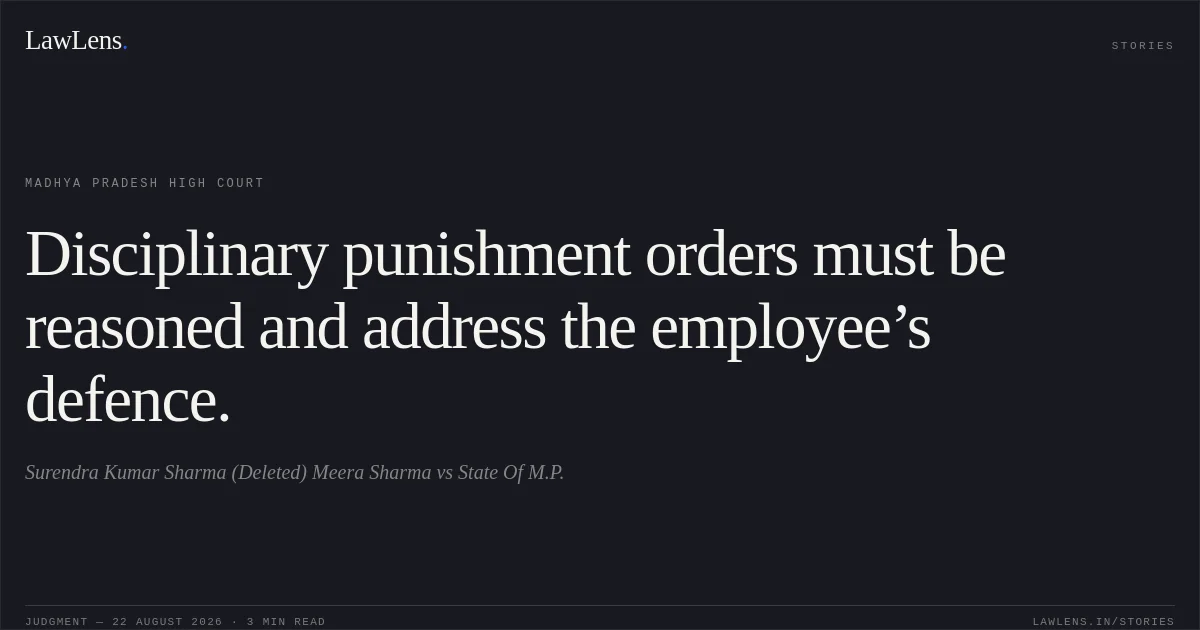
Source reference: p. 4The Court held that a disciplinary authority exercising quasi-judicial power must independently apply its mind to the enquiry report, the employee’s defence, and the surrounding facts, and must record cogent and intelligible reasons.
Source reference: p. 5–6Relying on State of Punjab v. Bandeep Singh, (2016) 1 SCC 724, it held that administrative decisions must be informed by reasons and cannot be arbitrary or capricious.
Source reference: p. 5–6Relying on Kranti Associates Pvt. Ltd. v. Masood Ahmed Khan, (2010) 9 SCC 496, and Oryx Fisheries Pvt. Ltd. v. Union of India, (2010) 13 SCC 427, the Court reiterated that reasons are essential to fairness, transparency, accountability, and effective judicial review, and that deficiencies in the original order cannot be cured by reasons supplied subsequently in appeal.
Source reference: p. 6–10Reasoning
The Court examined the punishment order and found that it merely recited the procedural history, the finding that the charges were proved, and the proposed punishment.
Source reference: p. 4–5It did not consider or address the petitioner’s detailed reply dated 22 February 2002, nor did it disclose the reasons for rejecting his defence or for imposing the particular punishment.
Source reference: p. 4–5Since the disciplinary authority was exercising quasi-judicial power, a mere reference to the enquiry report and approval by the Public Service Commission could not substitute for independent application of mind and a reasoned determination.
Source reference: p. 4–5The absence of reasons made the order non-speaking, arbitrary, and incapable of meaningful judicial review.
Source reference: p. 5–10Accordingly, the defect was not a mere irregularity but a violation of the requirement of fair and reasoned decision-making recognised in the cited precedents.
Source reference: p. 5–10Holding
The petition was allowed.
The punishment order dated 13 February 2013 was quashed.
Source reference: p. 11The respondents were directed to extend all consequential benefits, including pay revision, salary arrears, and revision of the PPO and GPO, with interest at 6% per annum within three months of receiving a certified copy of the order.
Source reference: p. 11If the benefits were not granted within that period, interest would accrue at 12% per annum.
Source reference: p. 11As the original petitioner had died on 9 January 2025, the Court granted no liberty to the respondents to initiate any further action against him.
Source reference: p. 11Original Court PDF
Surendra Kumar Sharma (Deleted) Meera SharmavsState Of M.P.
Click to open original judgment
Original judgment, available to read, download and summarize on LawLens.in