Facts
Nagarbhavi Club, a society registered under the Karnataka Societies Registration Act, 1960, challenged a Section 25 enquiry report dated 10 March 2026, the authorities’ recommendations, and the State Government’s order dated 14 May 2026 appointing an Administrator for six months.
Source reference: para. 2–4, 12.1–12.15, 13.25–13.26, 16.14–16.16, 17.4, 17.11The enquiry followed members’ complaints alleging financial and administrative irregularities.
Source reference: para. 2–4, 12.1–12.15, 13.25–13.26, 16.14–16.16, 17.4, 17.11The Club asserted that its documents had been refused and that the enquiry was unfair; the State maintained that the Club had received repeated opportunities to respond.
Source reference: para. 2–4, 12.1–12.15, 13.25–13.26, 16.14–16.16, 17.4, 17.11The Government issued a show-cause notice on 9 April 2026, furnished the enquiry report, and received the Club’s explanation dated 18 April 2026. The appointment order was published in the Official Gazette on 20 May 2026.
Source reference: para. 2–4, 12.1–12.15, 13.25–13.26, 16.14–16.16, 17.4, 17.11Issues
1. Whether the Section 25 enquiry and report were vitiated by non-compliance with Section 25 and Rule 8, including denial of an oral hearing or refusal to receive the Club’s material.
Source reference: para. 10(i)2. Whether the Registrar was required to independently consider the Enquiry Officer’s report and separately communicate its result, and whether furnishing the report with the Government’s show-cause notice satisfied that requirement.
Source reference: para. 10(ii)3. Whether the appointment was made under Section 27-A(1)(a), (b), or (c), and what requirements governed that exercise.
Source reference: para. 10(iii)4. Whether an enquiry and public-interest satisfaction were required under all three clauses of Section 27-A(1), or only under clause (c).
Source reference: para. 10(iv)5. If clause (c) applied, whether the State Government independently considered the material, afforded an effective opportunity, considered the Club’s response, and reached the required public-interest satisfaction.
Source reference: para. 10(v)6. Whether the appointment order was otherwise sustainable and the Club entitled to relief.
Source reference: para. 10(vi)Law Applied
Section 25 of the Karnataka Societies Registration Act, 1960 authorises an enquiry into a society’s constitution, working and financial condition; Section 25(2)(c)(iii) requires the result of the enquiry to be communicated to the society. Rule 8 of the Karnataka Societies Registration Rules, 1975 requires notice, an opportunity to explain, an oral hearing, and recorded findings.
Source reference: para. 12.17–12.24Under Section 27-A(1), clauses (a), (b) and (c) prescribe distinct grounds for appointing an Administrator; the enquiry and public-interest satisfaction expressly required by clause (c) do not apply uniformly to clauses (a) and (b).
Source reference: para. 14.15–14.24, 15.7–15.15In a clause (c) case, the State Government—not the Registrar—holds the appointment power and must independently consider the material, give the society an effective opportunity to respond, and satisfy itself that appointment is necessary in the public interest.
Source reference: para. 16.11–16.13The Court applied Sri Beereswara Devastana Seva Samiti, Madlere v. State of Karnataka on the recorded oral-hearing requirement; Gousemohammad v. District Registrar of Societies and Karnataka Roller Skating Association (R) v. State of Karnataka on the Registrar’s independent consideration of an authorised officer’s report; Bharata Ratna Mokshagundam Viswaswaraiah Education Society v. District Registrar and K.N. Rudrappa v. State of Karnataka on the State Government’s separate opportunity and decision-making role under clause (c); and K. Shivanna v. State of Karnataka on the distinction between clause (b) and clause (c).
Source reference: para. 12.17–12.24, 13.15–13.16, 13.28–13.38, 14.15–14.24, 15.7–15.15, 16.11–16.13Reasoning
The Court found that the order sheets recorded the Club’s office bearers appearing and making submissions on four dates, with adjournments granted; the assertion that approximately 1,700 pages of documents had been tendered and refused was not established with sufficient particulars. It therefore rejected the challenge to the enquiry for denial of an oral hearing or proven refusal to receive documents.
Source reference: para. 12.23–12.45The Court held that the Registrar had considered the report before recommending further action. Although Section 25(2)(c)(iii) required communication of the enquiry result, the report was furnished with the State Government’s show-cause notice before the final decision, and the Club was able to respond; the lack of separate prior communication by the Registrar did not, in these circumstances, establish prejudice or require a second hearing before him.
Source reference: para. 13.15–13.16, 13.28–13.52The proceedings were referable to Section 27-A(1)(c), not clauses (a) or (b), because the appointment rested on the complaints and Section 25 enquiry rather than failure to hold an AGM or expiry of the governing body’s term.
Source reference: para. 14.17–14.24The Government issued its own notice, received the Club’s explanation, and the appointment order recorded reasons concerning the AGM, audited financial statements and the unanswered allegations. The Court found that the Government had independently considered the material and reached the requisite public-interest satisfaction; it also held that proper administration of a registered society and protection of members’ funds could constitute public interest.
Source reference: para. 16.14–16.25Gazette publication was a statutory requirement, but publication on 20 May 2026—six days after the appointment order—did not invalidate the appointment absent demonstrated prejudice.
Source reference: para. 17.10–17.11Holding
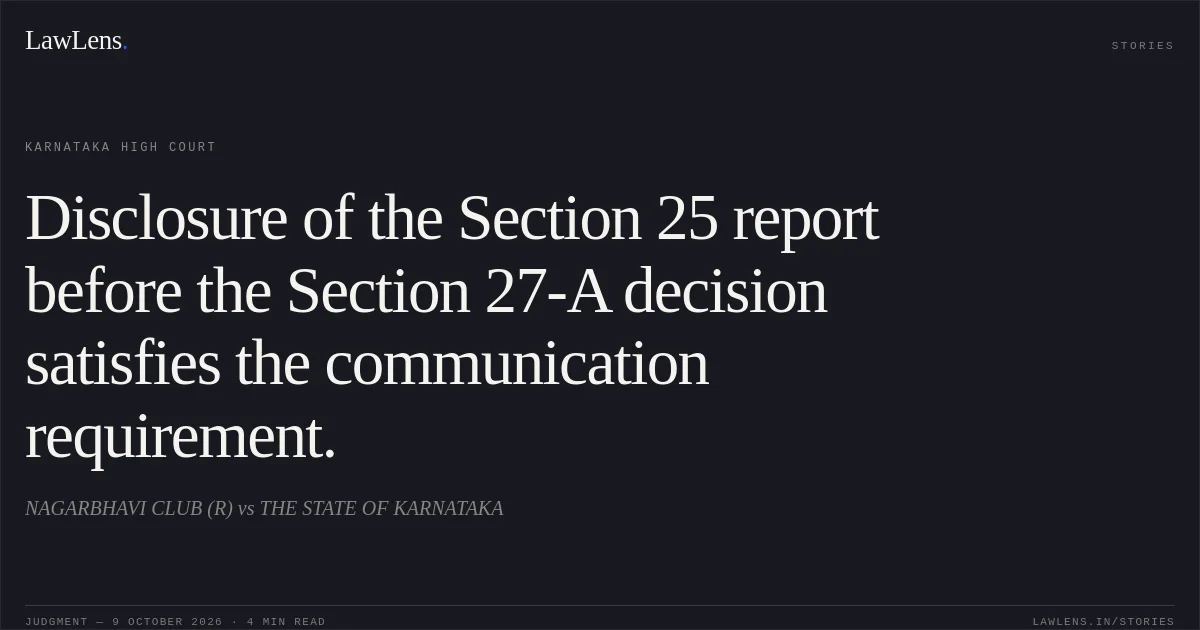
The Court answered the challenges to the Section 25 enquiry against the Club, held that the State Government’s appointment was made under Section 27-A(1)(c) and that the statutory requirements for that clause had been met.
It further held that subsequent Gazette publication satisfied the publication requirement and that the appointment order warranted no interference. The writ petition was dismissed.
Source reference: para. 17.21–18.1Acts & Sections Cited
6 provisions across 1 statute referred to in this judgment. Linked provisions open on LawLens.
Karnataka Societies Registration Act, 1960.6
Original Court PDF
NAGARBHAVI CLUB (R)vsTHE STATE OF KARNATAKA
Click to open original judgment
Original judgment, available to read, download and summarize on LawLens.in