Facts
The petitioner, a constable in the Bihar Military Police, was deputed for law-and-order duty during the visit of the Dalai Lama at Gaya.
Source reference: para. 3He was allegedly found absent from duty and was apprehended at Islampur, Nalanda, along with another constable, Bablu Kumar.
Source reference: para. 3Both were allegedly intoxicated, resulting in registration of Islampur P.S. Case No. 22 of 2018 under Section 37(b)(d) of the Bihar Prohibition and Excise Act, 2016.
Source reference: para. 3A medical examination allegedly recorded the smell of alcohol in the petitioner’s breath.
Source reference: para. 4The petitioner was served with a departmental charge-sheet alleging absence from duty and consumption of liquor.
Source reference: paras. 4–5The Enquiry Officer found the charges proved, and, after consideration of the petitioner’s second show-cause reply, the disciplinary authority dismissed him from service by Memo No. 1855 dated 28 July 2019.
Source reference: paras. 4–5His departmental appeal was rejected by the Deputy Inspector General of Police through Memo No. 1404 dated 6 December 2019.
Source reference: para. 2The petitioner challenged both orders, contending that the charge of alcohol consumption was unsupported by a breath-analyser, blood, or urine test and that neither the doctor nor the author of the FIR had been examined.
Source reference: paras. 6–7He also relied on the setting aside of the identical dismissal imposed on Bablu Kumar in C.W.J.C. No. 5086 of 2020.
Source reference: paras. 8, 12Issues
Whether the finding that the petitioner had consumed liquor was legally sustainable when the medical report and FIR were not proved through examination of their authors and no scientific test was produced?
Source reference: paras. 6–7, 12–13Whether the disciplinary and appellate orders were vitiated by violation of procedural fairness, failure to consider the petitioner’s defence, and absence of adequate reasons?
Source reference: para. 13, quoting paras. 35–38 of C.W.J.C. No. 5086 of 2020Whether the petitioner was entitled to relief on the ground of parity, since the dismissal of the co-accused constable arising from the same occurrence had already been set aside?
Source reference: paras. 8, 11–14Law Applied
In departmental proceedings, strict rules of the Indian Evidence Act do not ordinarily apply, and charges may be established on a preponderance of probabilities; however, findings must still be based on legally acceptable material and the procedure must comply with natural justice, fairness, and reasonableness.
Source reference: para. 9; para. 13, quoting paras. 35–36 of C.W.J.C. No. 5086 of 2020Mere production or tendering of a document does not, by itself, prove its contents, as recognised in Roop Singh Negi v. Punjab National Bank, (2009) 2 SCC 570.
Source reference: para. 7The Court also relied on State of Bihar v. Dharmraj Singh @ Dhamraj Singh, 2026 (5) PLJR 51, concerning proof of misconduct in departmental proceedings.
Source reference: para. 7Where a major penalty, particularly dismissal, is imposed, the disciplinary authority must independently consider the employee’s defence and give reasons for rejecting it; an order lacking reasons is legally infirm.
Source reference: para. 13, quoting para. 37 of C.W.J.C. No. 5086 of 2020Upon quashing an illegal dismissal, consequential benefits are governed by the principles stated in Deepali Gundu Surwase v. Kranti Junior Adhyapak Mahavidyalaya, (2013) 10 SCC 324.
Source reference: para. 15Reasoning
The Court found the petitioner’s case materially identical to that of Bablu Kumar, who had been apprehended in the same incident, faced the same departmental allegations, and received the same punishment.
Source reference: para. 12Although the medical report and FIR were relied upon, the doctor who conducted the medical examination and the author of the FIR were not examined, and there was no breath, blood, or urine test independently establishing alcohol consumption.
Source reference: paras. 6–7, 13The Court held that the allegation could not be treated as proved merely by relying on unproved documentary material, particularly where the petitioner disputed the charge.
Source reference: paras. 6–7, 13The disciplinary authority also failed to provide a reasoned consideration of the petitioner’s second show-cause reply, while the appellate authority failed to properly scrutinise the challenge.
Source reference: para. 13Since the dismissal of the similarly situated co-accused had already been quashed on the same evidentiary and procedural grounds, denial of equivalent relief to the petitioner would be unjustified.
Source reference: paras. 11–14Holding
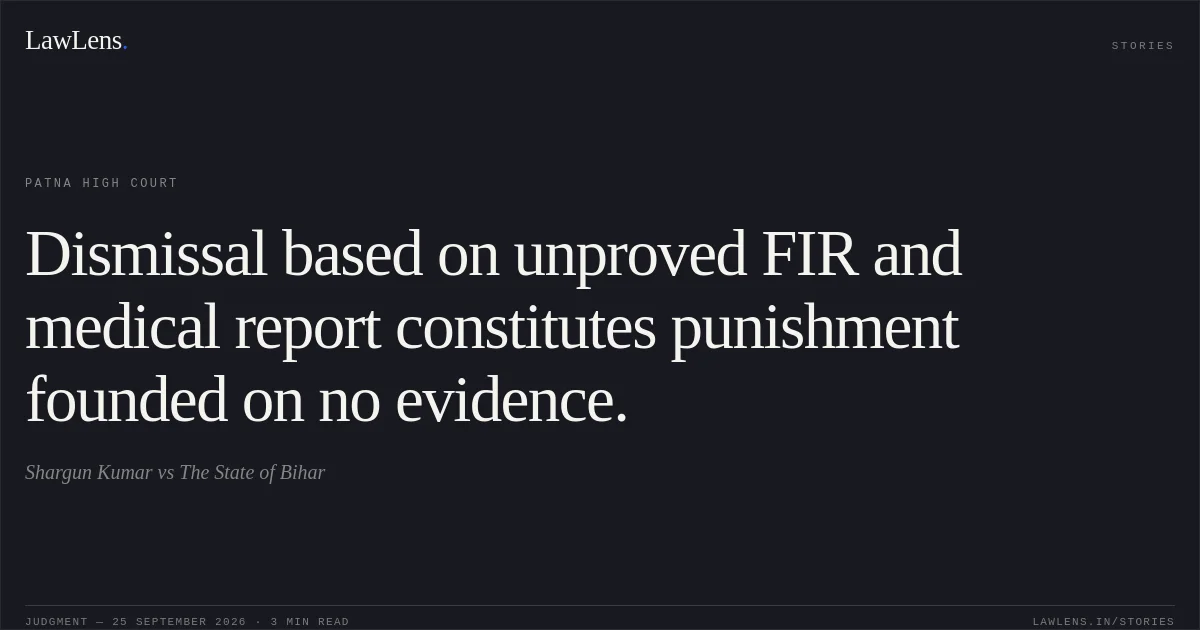
The High Court held that the dismissal was based on no legally sufficient evidence and that the departmental process suffered from procedural unfairness and inadequate consideration of the petitioner’s defence.
The Court accordingly set aside the Commandant’s dismissal order dated 28 July 2019 and the appellate order dated 6 December 2019.
Source reference: para. 14The petitioner was entitled to consequential benefits in accordance with Deepali Gundu Surwase.
Source reference: para. 15The writ petition was therefore allowed.
Source reference: para. 16Acts & Sections Cited
1 provisions across 1 statute referred to in this judgment. Each provision opens on LawLens.
BIHAR PROHIBITION AND EXCISE ACT, 20161
Original Court PDF
Shargun KumarvsThe State of Bihar
Click to open original judgment
Original judgment, available to read, download and summarize on LawLens.in