Facts
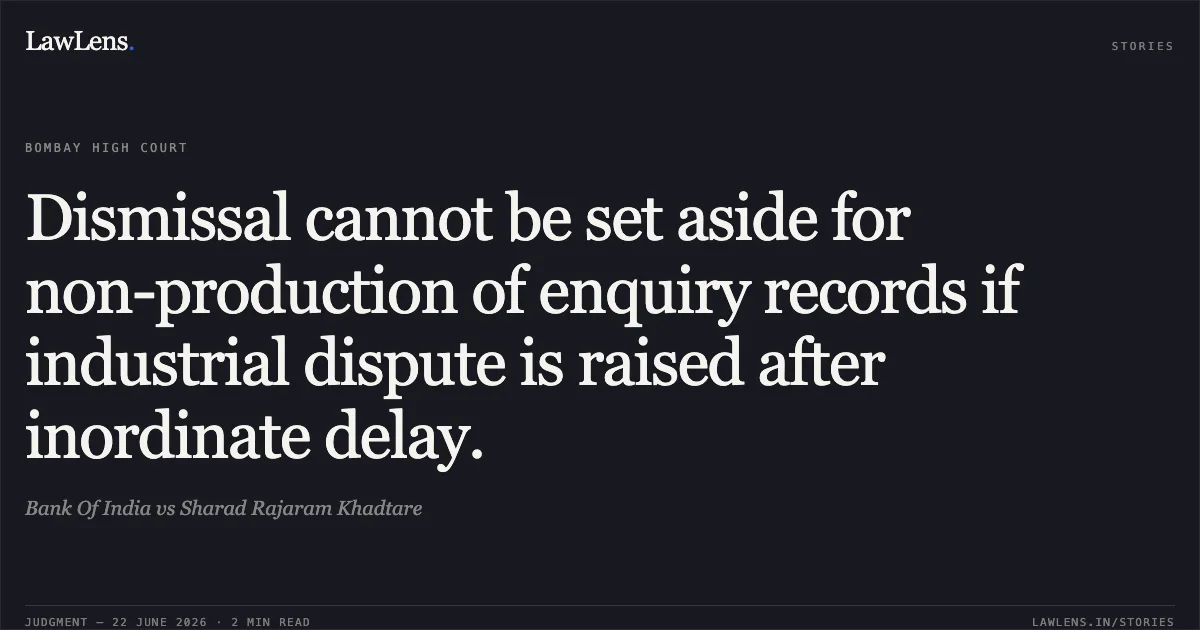
The Respondent, a clerk at the Petitioner-Bank, was dismissed on October 18, 2000, following a domestic inquiry into allegations of misappropriating customer funds
Source reference: para. 5-6Although the Respondent was later acquitted in a related criminal trial in 2013, he waited 13 years after his dismissal to raise an industrial dispute
Source reference: para. 7By the time the matter reached the Industrial Tribunal, the Bank had destroyed the inquiry records as per its standard document retention policy
Source reference: para. 2, 8The Tribunal held that while the inquiry was fair, the findings were perverse because the Bank could not produce the original witness depositions to support the Enquiry Officer’s conclusions
Source reference: para. 9The Tribunal subsequently set aside the dismissal and awarded full backwages and continuity of service
Source reference: para. 10Issues
1. Whether the Industrial Tribunal was justified in holding an inquiry's findings perverse solely due to the employer's inability to produce complete inquiry records caused by the employee's 13-year delay in raising the dispute
Source reference: para. 1, 172. Whether an acquittal in a criminal trial necessitates setting aside a dismissal based on a parallel domestic inquiry
Source reference: para. 32Law Applied
The court applied the equitable principles of laches and acquiescence as detailed in SBI v. M.J. James, which establish that while limitation may not strictly apply to industrial disputes, gross delay can obscure facts and cause incurable prejudice to the opposing party
Source reference: para. 12, 27It further cited Damoh Panna Sagar Rural Reg. Bank & Anr v. Munna Lal Jain to emphasize the high standard of integrity required of bank employees
Source reference: para. 31The court also reaffirmed the settled principle that domestic inquiries operate on the "preponderance of probabilities," whereas criminal trials require "proof beyond reasonable doubt," making them distinct legal processes
Source reference: para. 29, 32Reasoning
The Court reasoned that the Respondent’s 13-year delay in challenging his dismissal constituted "inactive acquiescence" that significantly prejudiced the Bank
Source reference: para. 19, 27Since the Respondent had participated in the original inquiry and received all documents at that time, the burden of producing those records shifted to him if he chose to litigate after the Bank’s records were naturally destroyed over time
Source reference: para. 22, 24The Court found that the Tribunal erred by "rewarding the Respondent for his own wrong"
Source reference: para. 25Furthermore, the Court noted that the Enquiry Officer’s report provided an elaborate 24-page discussion of the evidence, which the Tribunal ignored in favor of a technicality regarding the missing raw depositions
Source reference: para. 29-30Finally, the Court held that the Respondent’s criminal acquittal was irrelevant because the standards of proof and the objectives of the two proceedings are fundamentally different
Source reference: para. 32Holding
The Court allowed the Writ Petition and set aside both the preliminary and final awards of the Industrial Tribunal
It held that the findings of the Enquiry Officer were NOT perverse and that the dismissal was legal and justified given the serious nature of the misconduct
Source reference: para. 31, 34The Court concluded that a litigant cannot use self-created delays to prevent a fair adjudication or to penalize an employer for the non-preservation of decades-old documents
Source reference: para. 25, 28Acts & Sections Cited
1 provisions across 1 statute referred to in this judgment. Linked provisions open on LawLens.
Industrial Disputes Act, 19471
Original Court PDF
Bank Of IndiavsSharad Rajaram Khadtare
Click to open original judgment
Original judgment, available to read, download and summarize on LawLens.in