Facts
The petitioner, an A.B. Constable appointed in 2008, was serving in the 28th Assam Police Battalion.
Source reference: p.3His first wife, from whom he had been living separately since 2 September 2019 and with whom he had a minor son, complained that he had contracted a second marriage during the subsistence of their marriage without obtaining divorce or Government permission.
Source reference: p.3The Commandant issued a show-cause notice alleging that the second marriage constituted gross indiscipline.
Source reference: p.4A departmental proceeding was conducted, and the Enquiry Officer found the charge proved.
Source reference: p.4After considering the petitioner’s reply to the second show-cause notice, the Disciplinary Authority dismissed him from service on 6 March 2025. His appeal was rejected by the Appellate Authority on 29 July 2025.
Source reference: p.4Before the High Court, the petitioner primarily challenged the proportionality of the punishment, relying on his first wife’s desertion, his obligation to pay court-ordered maintenance, and the medical needs of his minor son and aged father.
Source reference: pp.6, 11–12He did not substantially challenge the departmental proceeding or the finding of misconduct.
Source reference: p.12Issues
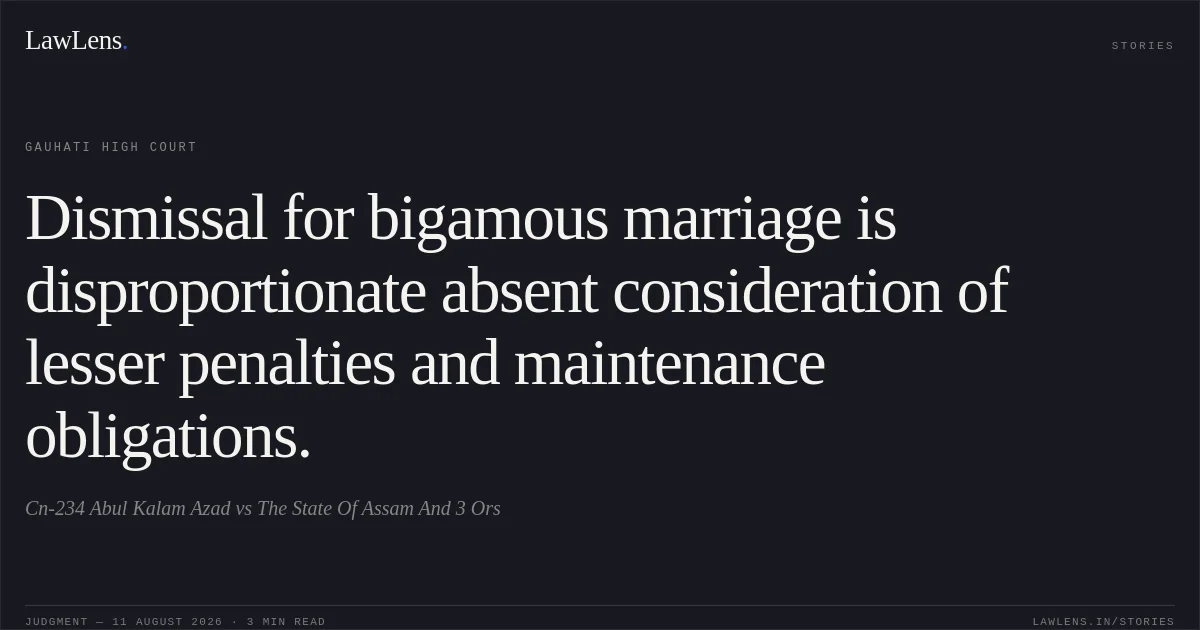
Whether the petitioner’s dismissal from service for contracting a second marriage during the subsistence of his first marriage was disproportionately harsh and liable to judicial interference
Source reference: paras. 13–17; pp.8–13Whether the matter should be remanded to the disciplinary authority for imposition of a lesser major penalty, after considering the petitioner’s family circumstances and court-ordered maintenance obligations
Source reference: para. 17; p.13Law Applied
The Court applied Rule 26 of the Assam Civil Services (Conduct) Rules, 1965, which prohibits a Government servant having a living wife from contracting another marriage without prior Government permission, even if the subsequent marriage is permissible under personal law.
Source reference: p.7The Court also considered the Assam Civil Services (Discipline and Appeal) Rules, 1964, particularly Rule 7, which prescribes various penalties, including major penalties other than dismissal.
Source reference: p.13The Office Memorandum dated 20 October 2023 authorises initiation of departmental proceedings for violation of Rule 26 and permits imposition of a major penalty, including compulsory retirement, but does not mandate dismissal.
Source reference: pp.5, 7, 13On proportionality, the Court relied on Trilok Singh Rawat v. Union of India, 2000 (3) GLT 558, and Union of India v. Pranab Kumar Nath, W.A. No. 357/2022, which hold that although a second marriage in violation of service rules constitutes indiscipline, dismissal may be disproportionately harsh where the misconduct is not of the gravest nature and dismissal would cause severe financial hardship to the employee and his dependants.
Source reference: pp.8–11Reasoning
The Court accepted that the petitioner had contracted a second marriage during the subsistence of his first marriage and that such conduct violated Rule 26 and constituted misconduct.
Source reference: no citationSince the petitioner had not challenged the departmental proceeding and had effectively admitted the second marriage, the Court found no occasion to re-examine the legality of the enquiry or the finding of guilt.
Source reference: para. 12; p.8However, dismissal is the extreme form of punishment and must be proportionate to the misconduct.
Source reference: no citationThe disciplinary and appellate orders did not explain why dismissal was necessary or why another penalty under Rule 7 would be inadequate.
Source reference: para. 17; p.13The authorities also failed to consider that the petitioner was required to pay maintenance to his first wife pursuant to a competent court’s order, and that his minor son and aged father allegedly depended on him; the respondents did not dispute these circumstances.
Source reference: para. 16; pp.11–12In light of the precedents and the absence of any direction in the 2023 Office Memorandum making dismissal compulsory, the Court held that the punishment was disproportionately harsh.
Source reference: paras. 15–17; pp.11–13Holding
The writ petition was allowed to the limited extent that the orders imposing and affirming dismissal from service were interfered with.
The matter was remanded to the competent authority to impose any other appropriate major penalty, excluding dismissal, after considering the petitioner’s obligation to pay maintenance to his first wife, Jesmina Ahmed, and the surrounding family circumstances.
Source reference: para. 17; p.13The authority was directed to pass a fresh order within 60 days from receipt of the certified copy of the judgment.
Source reference: no citationThe Court did not disturb the finding that the petitioner’s second marriage constituted misconduct and did not grant an express direction for reinstatement with back wages or other consequential benefits.
Source reference: paras. 17–20; p.13Original Court PDF
Cn-234 Abul Kalam AzadvsThe State Of Assam And 3 Ors
Click to open original judgment
Original judgment, available to read, download and summarize on LawLens.in