Facts
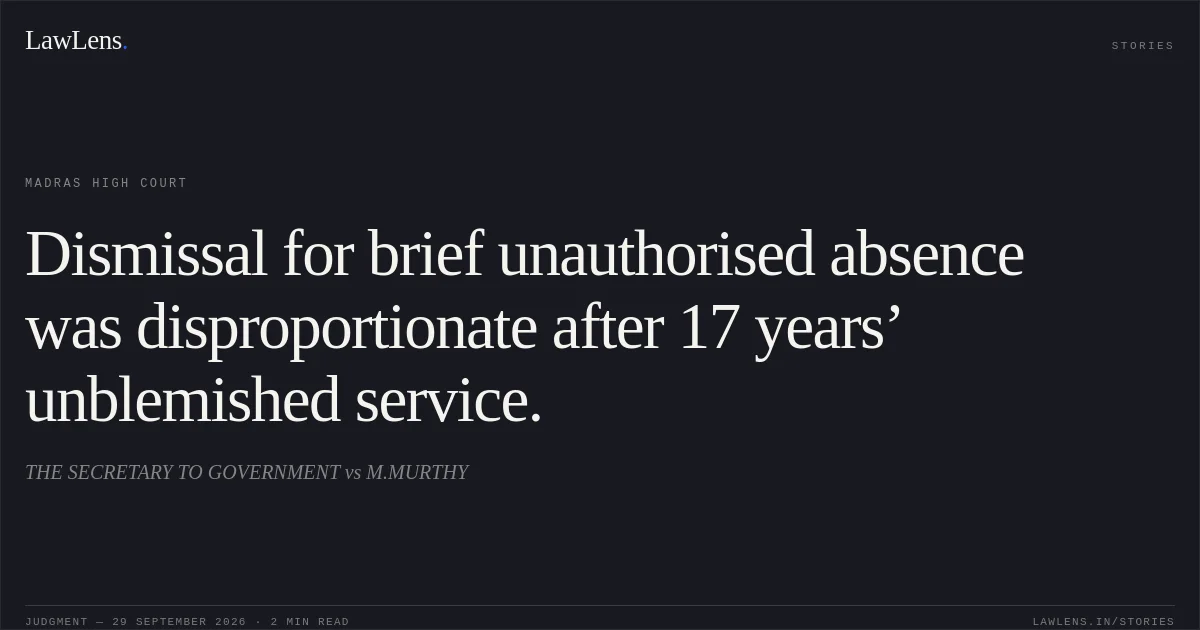
M. Murthy joined the Tamil Nadu Police as a Grade-II Police Constable on 1 May 1988. After approximately 17 years of service, he remained absent without prior permission for 21 days, from 24 June to 14 July 2006.
Source reference: p. 2Following disciplinary proceedings in which the charge of unauthorised absence was found proved, he was declared a deserter under Police Standing Order No. 95(2) and dismissed from service. His mercy petition was rejected. He challenged the dismissal and rejection of the mercy petition in a writ petition; the Single Judge directed reinstatement without back wages. The State appealed. By the time the appeal was heard, Murthy had reached superannuation.
Source reference: pp. 2–4Issues
1. Whether dismissal from service was disproportionate where the proved misconduct was 21 days’ unauthorised absence, in light of the employee’s 17 years of unblemished service and personal grounds.
Source reference: pp. 3–42. Whether, after Murthy had reached superannuation, he was entitled to reinstatement or to terminal and pensionary benefits for his qualifying service.
Source reference: p. 4Law Applied
Police Standing Order No. 95(2), Part I, provides for declaring uniformed personnel who remain unauthorisedly absent as deserters.
Source reference: pp. 2–3The Court applied the principle that a disciplinary punishment must be proportionate to the gravity of the misconduct, taking account of the employee’s service record and relevant mitigating circumstances.
Source reference: pp. 3–4It also directed that terminal and pensionary benefits be paid in accordance with the applicable Rules for qualifying service.
Source reference: p. 4Reasoning
The Court accepted that the disciplinary procedure had been followed and that the charge of unauthorised absence was proved.
Source reference: p. 3However, it considered the absence relatively short, noted that Murthy was not a habitual offender, and weighed the 21-day absence against his 17 years of unblemished service and the personal grounds raised in his explanation. It concluded that dismissal was disproportionate.
Source reference: pp. 3–4Since Murthy had reached superannuation, reinstatement was no longer available; the appropriate relief was payment of admissible terminal and pensionary benefits for his qualifying service, without back wages.
Source reference: p. 4Holding
He was held not entitled to reinstatement or back wages.
The writ appeal was disposed of with a direction to the appellants to settle Murthy’s terminal and pensionary benefits, as admissible under the Rules, for his qualifying service of approximately 17 years, within four months of receiving the order.
Source reference: pp. 4–5Original Court PDF
THE SECRETARY TO GOVERNMENTvsM.MURTHY
Click to open original judgment
Original judgment, available to read, download and summarize on LawLens.in