Facts
The petitioner, a former Branch Manager of the Central Bank of India, was proceeded against for alleged irregularities in sanctioning and monitoring loans during his tenure at the Barrackpore Branch.
Source reference: paras. 2–5The charge-sheet contained six charges concerning improper sanction and monitoring of loan accounts, alleged personal benefit through a borrower’s account, irregular creation of an equitable mortgage, unauthorised overdraft facilities, and inadequate supervision of housing loans.
Source reference: paras. 2–5The Enquiry Officer found several charges proved, some partly proved, and others not proved.
Source reference: paras. 6–7The Disciplinary Authority disagreed with the Enquiry Officer and originally dismissed the petitioner from service in 2007.
Source reference: paras. 6–7The petitioner successfully challenged the initial dismissal before the High Court, but the Supreme Court directed that the disciplinary proceedings be resumed from the stage of the enquiry report, with appropriate notice of disagreement and consideration by a different authority.
Source reference: para. 9Subsequent orders were again set aside for breach of natural justice, following which the Division Bench directed that the petitioner be given notice of the tentative reasons for disagreement and an opportunity to respond.
Source reference: paras. 10–12After issuing such notice and affording a personal hearing, the Disciplinary Authority again dismissed the petitioner with effect from 3 December 2007.
Source reference: para. 13The Appellate Authority affirmed the dismissal on 16 July 2016.
Source reference: para. 14The petitioner challenged the disciplinary orders and sought reinstatement-related consequential benefits, including pension, gratuity, leave encashment and arrears of salary.
Source reference: paras. 16–22The Bank opposed the petition, contending that the enquiry was procedurally valid, the misconduct was serious, and the petitioner was not entitled to pension under the applicable scheme.
Source reference: paras. 16–22Issues
Whether the disciplinary proceedings and the final orders of the Disciplinary Authority and Appellate Authority suffered from procedural illegality, violation of natural justice, or failure to comply with the directions of the Supreme Court and the Division Bench?
Source reference: paras. 36–40Whether the findings of misconduct were based on no evidence, were perverse, or were otherwise liable to interference in judicial review?
Source reference: paras. 37, 40Whether dismissal from service was shockingly disproportionate to the proved misconduct, particularly in the absence of established personal pecuniary gain or loss in every loan account?
Source reference: paras. 41–47Whether the petitioner was entitled to pension, gratuity, leave encashment, arrears of salary, or other retiral benefits notwithstanding the dismissal order?
Source reference: paras. 15–18, 22, 26–27, 49–50Law Applied
The Court applied the principles governing judicial review of disciplinary proceedings: review is confined primarily to illegality, irrationality, perversity, Wednesbury unreasonableness, procedural impropriety, breach of natural justice and, in appropriate cases, disproportionality of punishment.
Source reference: paras. 36–38A writ court cannot reappreciate evidence as an appellate court, but may interfere where the findings are based on no evidence or are such that no reasonable person could reach them.
Source reference: para. 37Under B.C. Chaturvedi v. Union of India, the choice of punishment lies primarily with the Disciplinary and Appellate Authorities; judicial substitution of punishment is permissible only in exceptional cases where the penalty shocks the conscience of the Court.
Source reference: para. 42The Court also relied on State of U.P. v. Nand Kishore Shukla for the limited scope of judicial review over disciplinary findings, and Municipal Committee, Bahadurgarh v. Krishnan Behari for the principle that financial irregularities warrant strict treatment and do not ordinarily invite sympathy.
Source reference: paras. 33, 46It further applied the settled principle that bank employees occupy positions of trust and are required to maintain high standards of integrity, honesty, diligence and financial discipline; absence of actual pecuniary loss does not necessarily preclude dismissal for established misconduct.
Source reference: paras. 44–47Regulation 4(j) of the Central Bank of India Officer Employees’ (Discipline & Appeal) Regulations, 1976 was the provision under which dismissal was imposed, while Regulation 31 of the Central Bank of India (Employees’) Pension Regulations, 1995 permits consideration of compassionate allowance in appropriate cases.
Source reference: paras. 13, 50Reasoning
The Court held that the procedural defects identified in the earlier rounds of litigation had been cured.
Source reference: para. 39The petitioner received notice of the Disciplinary Authority’s tentative disagreement, an opportunity to submit his response, and a personal hearing before the final order was passed.
Source reference: paras. 39–40The Disciplinary and Appellate Authorities recorded separate findings on the charges and passed reasoned orders; consequently, no violation of natural justice or the Supreme Court’s directions was established.
Source reference: paras. 39–40The Court declined to reassess the evidence or substitute its view for that of the departmental authorities.
Source reference: paras. 37, 40The findings concerning irregular loan sanctions, inadequate monitoring, NPAs, involvement of persons connected with the borrowers, and absence of genuine business activity were considered relevant and supported by the disciplinary record.
Source reference: paras. 45–46On proportionality, the Court emphasised the petitioner’s responsible position as a bank officer and the heightened duty of integrity attached to handling public money.
Source reference: paras. 41–47The fact that some accounts were subsequently adjusted or closed, or that personal pecuniary gain was not established in every charge, did not neutralise the seriousness of the proved financial and procedural irregularities.
Source reference: paras. 41–47Since the penalty of dismissal was not irrational, arbitrary or so disproportionate as to shock the judicial conscience, no interference was warranted.
Source reference: paras. 41–47The petitioner’s claims to consequential retiral benefits therefore could not succeed on the basis of setting aside the dismissal.
Source reference: paras. 49–50However, the Court clarified that he remained at liberty to seek compassionate allowance under Regulation 31, subject to applicable law.
Source reference: paras. 49–50Holding
The writ petition was dismissed without costs.
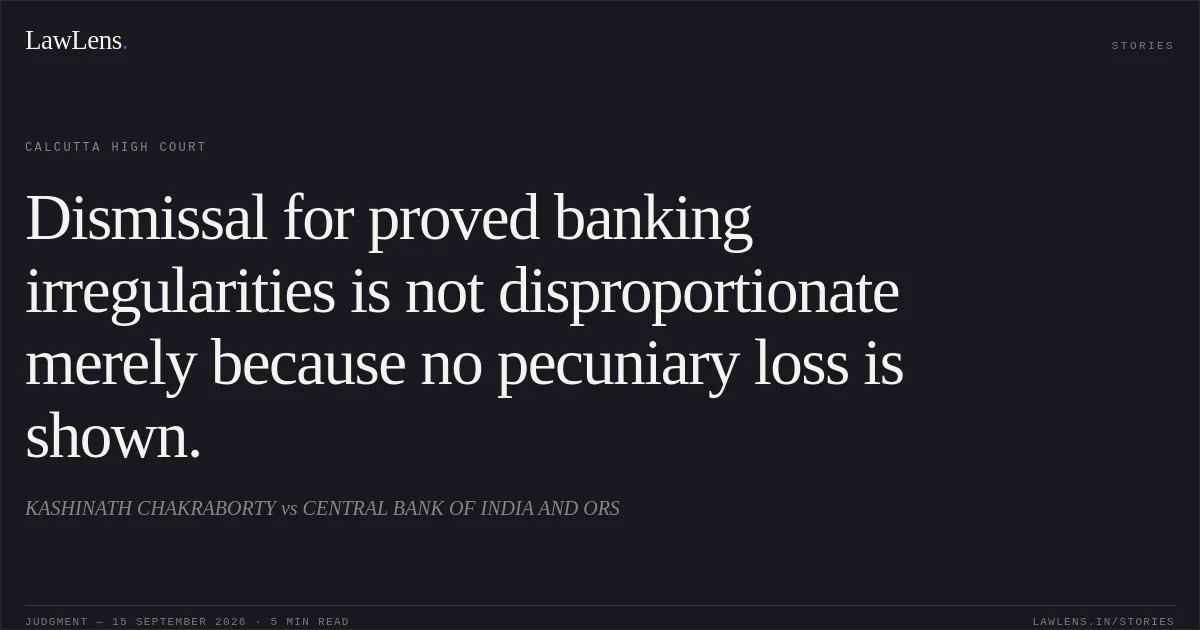
The Court upheld the disciplinary and appellate orders imposing dismissal from service, finding no procedural illegality, perversity, violation of natural justice or shockingly disproportionate punishment.
Source reference: paras. 40, 47, 49The petitioner was not granted the claimed pension, leave encashment, arrears of salary or other consequential benefits.
Source reference: paras. 49–50Nevertheless, the dismissal of the writ petition was expressly stated not to prevent him from applying to the competent authority for compassionate allowance under Regulation 31 of the applicable Pension Regulations, which the authority must consider in accordance with law.
Source reference: para. 50Original Court PDF
KASHINATH CHAKRABORTYvsCENTRAL BANK OF INDIA AND ORS
Click to open original judgment
Original judgment, available to read, download and summarize on LawLens.in