Facts
The petitioner, while serving as Senior Manager of Cuttack Gramin Bank, was a member of the Bank’s Investment Committee.
Source reference: pp. 3–5Disciplinary proceedings were initiated against him by charge-sheet dated 19 August 2002, alleging that he had failed to ensure compliance with RBI guidelines and the Bank’s investment policy, had recommended investments through brokers without verifying their credentials, and had failed to ensure delivery of securities and proper follow-up in transactions involving substantial sums.
Source reference: pp. 3–5The Enquiry Officer found him guilty of the charges, following which the Disciplinary Authority dismissed him from service by order dated 22 April 2003; his appeal was rejected by order dated 23 July 2003.
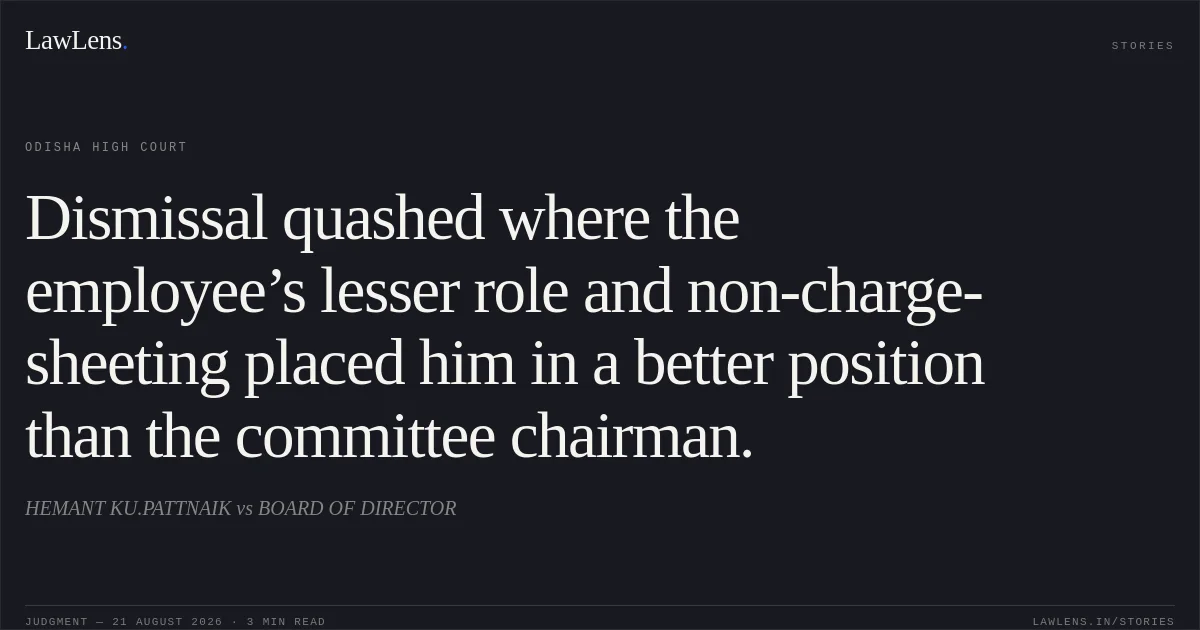
Source reference: pp. 10–13The petitioner contended that the Chairman of the Investment Committee, an officer of the sponsoring UCO Bank, had faced disciplinary action arising out of the same investment irregularities, but the punishment of demotion imposed on him was set aside by the High Court in Netrananda Pattnaik v. UCO Bank, W.P.(C) No. 972 of 2007, and the decision was upheld by the Supreme Court in Civil Appeal No. 1451 of 2015, subject to denial of financial benefits for the relevant period.
Source reference: pp. 6–7, 13–14The petitioner also relied on the Bank’s admission that he had not been charge-sheeted in the CBI proceedings concerning the investment irregularities.
Source reference: pp. 2, 11–12Issues
Whether the petitioner’s dismissal from service and the appellate order confirming it should be quashed on the ground that, as a member of the Investment Committee, he was similarly situated—or stood in a better position—than its Chairman, whose punishment had been set aside?
Source reference: pp. 6–9, 13–15Whether, upon quashing the dismissal after the petitioner had attained superannuation, the period from dismissal until superannuation should be regularised notionally and his retiral benefits released?
Source reference: pp. 8–9, 15–16Law Applied
The Court exercised its constitutional jurisdiction under Articles 226 and 227 of the Constitution to examine the legality of the disciplinary and appellate orders.
Source reference: p. 2The principal legal principle applied was that similarly situated employees should receive comparable treatment and that disciplinary punishment may be interfered with where the surrounding circumstances demonstrate that the employee is in a position no worse than another participant whose punishment has already been set aside.
Source reference: pp. 13–15The Court also relied on the effect of the decision in Netrananda Pattnaik v. UCO Bank, as affirmed by the Supreme Court in Civil Appeal No. 1451 of 2015, under which the employee continued to hold the relevant post for service purposes, but was denied financial benefits for the intervening period.
Source reference: pp. 6–7, 13–14Reasoning
Although the petitioner had been proceeded against on specific charges and had been found guilty after an enquiry, the Court focused on the comparative treatment of the persons involved in the Investment Committee’s decisions.
Source reference: pp. 10–13The petitioner was only a member of the Committee, whereas the Chairman had also participated in the decision-making process concerning the disputed investments.
Source reference: pp. 13–15Since the Chairman’s punishment had been set aside by the High Court and the decision had been upheld by the Supreme Court, the Court held that the petitioner could not be treated less favourably; indeed, his position was considered better because he was only a member of the Committee and had not been charge-sheeted in the CBI proceedings.
Source reference: pp. 13–15On that basis, the Court found that the dismissal order and the appellate order required interference, notwithstanding the Bank’s contention that the petitioner had faced specific charges and had been found guilty in the departmental enquiry.
Source reference: pp. 10–12, 14–15Holding
The Court quashed the petitioner’s dismissal order dated 22 April 2003 and the appellate order dated 23 July 2003.
As the petitioner had attained superannuation on 31 March 2010, the Bank was directed to regularise, on a notional basis, the period from dismissal until superannuation.
Source reference: pp. 15–16The petitioner was denied financial benefits for that period and was also held not entitled to interest on delayed retiral benefits.
Source reference: pp. 15–16The Bank was directed to release all retiral benefits due and admissible, preferably within four months from receipt of the judgment.
Source reference: p. 16The writ petition was accordingly disposed of.
Source reference: p. 16Original Court PDF
HEMANT KU.PATTNAIKvsBOARD OF DIRECTOR
Click to open original judgment
Original judgment, available to read, download and summarize on LawLens.in