Facts
The original petitioner, an Additional Executive Engineer, was charge-sheeted in departmental proceedings and suspended on 19 August 1999. An Enquiry Officer was appointed, and the petitioner remained under suspension until its revocation on 27 February 2002, one day before his retirement on 28 February 2002.
Source reference: p.2, para.2After completion of the enquiry, the petitioner submitted his representation against the enquiry findings on 2 April 2002. The Disciplinary Authority thereafter passed an order dated 17 September 2002 conveying the punishment of “displeasure”. The petitioner’s appeal was rejected by order dated 21 May 2003. During the pendency of the proceedings, the original petitioner retired and died, and the petition was prosecuted by his legal representatives.
Source reference: p.2, para.2; p.6, para.8; p.7, para.10; p.11, para.16Issues
Whether the punishment of “displeasure,” not being one of the penalties prescribed under Rule 10 of the M.P. Civil Services (Classification, Control and Appeal) Rules, 1966, could validly be imposed on the petitioner?
Source reference: p.3, paras.2–3; p.5, para.5Whether the Disciplinary Authority’s punishment order dated 17 September 2002 and the Appellate Authority’s order dated 21 May 2003 were invalid for being non-speaking and unreasoned orders?
Source reference: p.6, paras.8–9; p.8, para.11Whether the petitioner was entitled to full salary and allowances for the period of suspension under F.R. 54-B, notwithstanding the imposition of “displeasure”?
Source reference: p.5, para.5; p.6, para.7Law Applied
The Court applied Rule 10 of the M.P. Civil Services (Classification, Control and Appeal) Rules, 1966, which exhaustively specifies the minor and major penalties that may be imposed on a Government servant; “displeasure” is not included among them.
Source reference: p.3, para.5–p.5The Court further applied F.R. 54-B concerning determination of pay and allowances for the period of suspension, holding that where departmental proceedings initiated for a major penalty culminate in a minor or substantially light punishment, the suspension may be treated as wholly unjustified and full pay and allowances may be directed to be paid.
Source reference: p.5, para.5; p.6, para.7It relied on Y.S. Sachan v. State of Madhya Pradesh, 2004 (1) M.P.H.T. 22, which held that an employee should not be deprived of salary for the suspension period when only a minor and light punishment has ultimately been imposed.
Source reference: p.5, para.6The Court also applied the settled principle that quasi-judicial and administrative orders affecting rights must record clear, cogent and reasoned conclusions, relying on State of Punjab v. Bandip Singh, (2016) 1 SCC 724, and Kranti Associates Pvt. Ltd. v. Masood Ahmed Khan, (2010) 9 SCC 496, which held that reasons are essential for fairness, transparency, accountability and effective judicial review.
Source reference: p.8, paras.12–14; p.9, para.15Reasoning
The Court found that the order merely stated that, after considering the petitioner’s representation and the overall circumstances, the Board had decided to convey its “displeasure,” without recording any findings or reasons dealing with the charges or the petitioner’s defence.
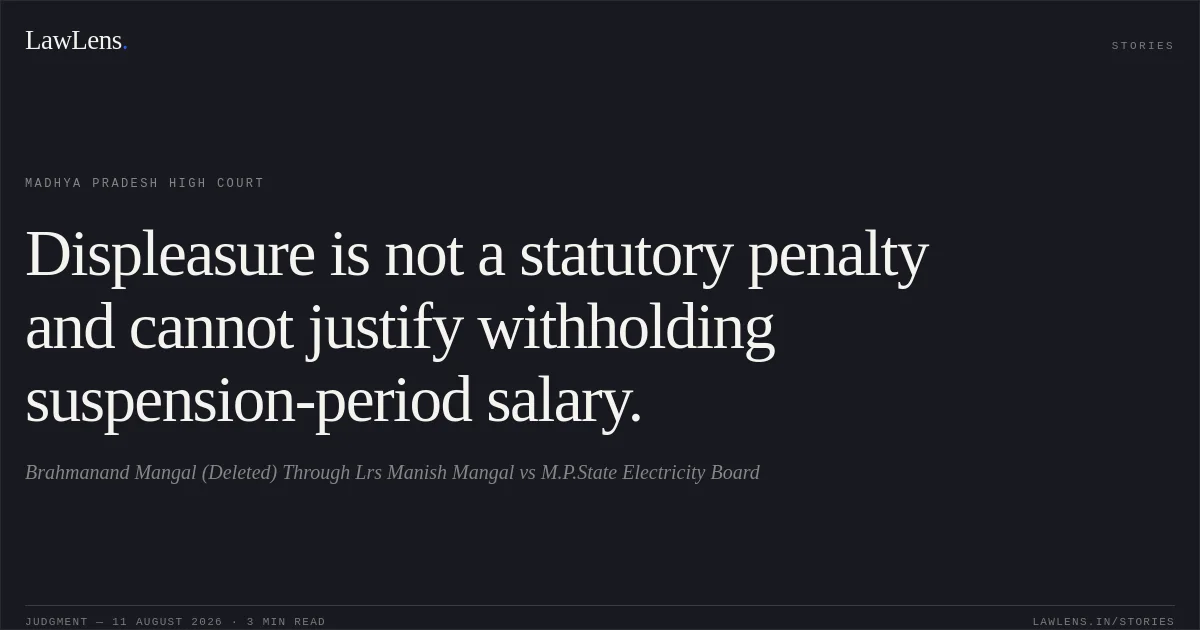
Source reference: p.6, para.8Since “displeasure” was not a penalty enumerated in Rule 10, the punishment was not even a prescribed minor penalty. The Court therefore held that the respondents could not impose the substantially heavier consequence of withholding salary for the suspension period when the disciplinary proceedings had resulted only in such an unrecognised and very light censure-like action.
Source reference: p.5, para.5; p.6, para.7The appellate order was likewise held to be non-speaking because it merely affirmed the earlier decision without independently considering the petitioner’s grounds of appeal or supplying reasons.
Source reference: p.7–p.8, paras.10–11Applying F.R. 54-B and the principle in Y.S. Sachan, the Court concluded that the petitioner was entitled to full salary and allowances for the period of suspension.
Source reference: no citationHolding
The petition was disposed of by setting aside the Disciplinary Authority’s punishment order dated 17 September 2002 and the Appellate Authority’s order dated 21 May 2003.
The respondents were directed to pay the petitioner’s legal representatives the salary and allowances for the suspension period from 19 August 1999 to 26 February 2002, with interest at 6% per annum, within three months of receiving the certified copy of the judgment. If payment was not made within that period, the amount would carry interest at 12% per annum from the date of entitlement until actual payment.
Source reference: p.12, para.16(ii)Original Court PDF
Brahmanand Mangal (Deleted) Through Lrs Manish MangalvsM.P.State Electricity Board
Click to open original judgment
Original judgment, available to read, download and summarize on LawLens.in