Facts
The appellants, who were third parties to W.P.(MD) No.7365 of 2009, obtained leave to file the present writ appeal.
Source reference: para. 2The original writ petition challenged the Tahsildar’s order dated 18.06.2009 and sought issuance of patta in favour of the writ petitioners for 2.75 acres in Survey Nos.367/1 and 376, Unjampatty Village, pursuant to the Revenue Divisional Officer’s order dated 24.10.2008.
Source reference: para. 3Before the learned Single Judge, the parties recorded a compromise under which patta would be issued after collection of arrears payable to the Government under the Land Improvement Scheme, and the writ petitioners undertook to execute a sale deed for 1 acre and 37.5 cents in favour of the fourth respondent.
Source reference: para. 4The amount payable was crystallised at Rs.2,50,000/-, which the learned Single Judge directed to be deposited before the Tahsildar.
Source reference: para. 5The appellants contended that they also had shares in the deposited amount and that the original writ petition had been filed without impleading them.
Source reference: para. 6The learned Single Judge quashed the Tahsildar’s order and directed the parties to approach the Civil Court regarding their claims.
Source reference: para. 7Issues
1. Whether the appellants and other persons claiming an interest in the deposited amount were entitled to be impleaded and granted the benefit sought under Revenue Standing Order 45 through the writ appeal?
Source reference: paras. 2, 6–82. Whether the High Court, exercising writ jurisdiction, could determine and apportion the respective shares of the parties in the sum of Rs.2,50,000/- deposited before the Tahsildar?
Source reference: paras. 5–73. Whether the order of the learned Single Judge directing the parties to approach the Civil Court suffered from any legal infirmity?
Source reference: para. 7Law Applied
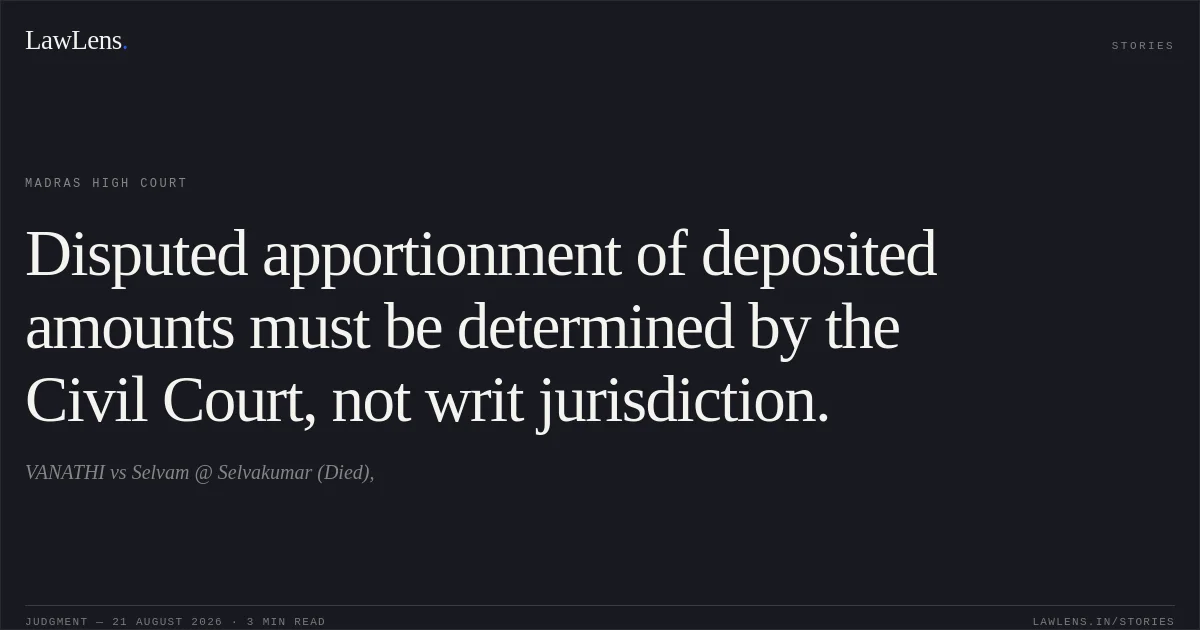
The Court applied the principle that disputed questions concerning title, entitlement, and apportionment of money requiring examination of evidence must be adjudicated by a competent Civil Court and not determined in writ proceedings.
Source reference: para. 7Although the appeal was filed under Clause 15 of the Letters Patent and the appellants relied on the benefit under Revenue Standing Order 45, the Court did not undertake any substantive interpretation of that Standing Order.
Source reference: prayer; para. 8The Court further accepted that the writ court could not decide the respective shares of private parties in the crystallised amount of Rs.2,50,000/- and that the parties were required to seek appropriate relief before the Civil Court.
Source reference: para. 7Reasoning
The Court held that the appellants’ claim was essentially a dispute regarding their respective shares in the amount deposited pursuant to the compromise and the order of the learned Single Judge.
Source reference: paras. 5–6Determining that claim would require the parties to establish their respective rights by adducing evidence, which could not appropriately be undertaken in the writ jurisdiction of either the learned Single Judge or the appellate Bench.
Source reference: para. 7Since the learned Single Judge had already directed the parties to approach the Civil Court for such adjudication, and since the Court found no infirmity in that direction, the appellants were not entitled to modification of the order in the writ appeal.
Source reference: para. 7Holding
The Writ Appeal was dismissed.
The Court declined to include the appellants and the other claiming respondents as beneficiaries under Revenue Standing Order 45 in the writ proceedings and directed the parties to approach the Civil Court in accordance with law for determination and division of the deposited amount of Rs.2,50,000/-.
Source reference: para. 8No costs were awarded, and the connected miscellaneous petition was closed.
Source reference: para. 8Original Court PDF
VANATHIvsSelvam @ Selvakumar (Died),
Click to open original judgment
Original judgment, available to read, download and summarize on LawLens.in