Facts
Respondent No. 2 complained to the Anti-Corruption Bureau (later transferred to the Lokayuktha) that the petitioner, a Village Administrative Officer, had delayed processing her application and demanded illegal gratification
Source reference: para. 3, pp. 4–5After registering the case, the investigating agency conducted an entrustment mahazar and recorded a conversation between the petitioner and Respondent No. 2; no trap followed
Source reference: para. 3, p. 5The petitioner sought to quash the complaint, FIR in Crime No. 2/2022 under Section 7(a) of the Prevention of Corruption Act, 1988, and all consequential proceedings, contending that demand and acceptance were not established
Source reference: paras. 2, 4, pp. 3, 5Issues
1. Whether the complaint and FIR under Section 7(a) of the Prevention of Corruption Act, 1988, should be quashed for want of demand and acceptance
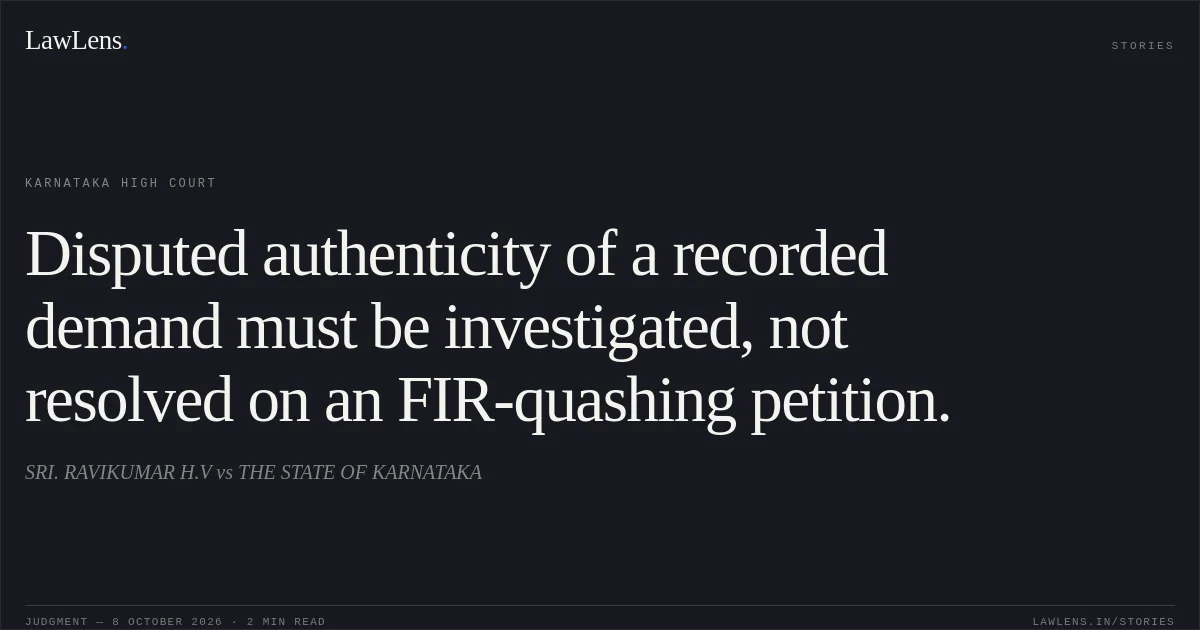
Source reference: paras. 2, 4, pp. 3, 52. Whether the recorded conversation and other material warranted continuation of the investigation, or raised disputed matters that could not be determined in writ jurisdiction
Source reference: paras. 6–9, pp. 6–7Law Applied
The petition invoked Articles 226 and 227 of the Constitution of India, read with Section 482 of the Code of Criminal Procedure, and sought to quash proceedings for an alleged offence under Section 7(a) of the Prevention of Corruption Act, 1988
Source reference: para. 2, p. 3The Court relied on State of Karnataka v. Prabhu Shankar, 2026 SCC OnLine SC 1446, stating that the decision calls for zero tolerance towards corruption and a “hands off approach” by High Courts when asked to quash an FIR
Source reference: paras. 10–12, p. 7It also treated the authenticity of the conversation and the identity of the speaker as matters for investigation
Source reference: paras. 7–8, p. 6Reasoning
The Court considered the recorded conversation in the entrustment mahazar and found that the material warranted further investigation and an appropriate report by the investigating agency
Source reference: paras. 6, 9, pp. 6–7It declined to decide at this stage whether the conversation was genuine or whether the voice was the petitioner’s, holding those matters to be investigative questions and disputed aspects unsuitable for determination in writ jurisdiction
Source reference: paras. 7–8, p. 6Applying its stated approach to quashing an FIR in a corruption case, the Court found the petitioner’s grounds insufficient to terminate the proceedings
Source reference: paras. 10–12, p. 7The order’s description of the offence as a “myth” following the failed trap
Source reference: para. 6, p. 6Holding
The High Court dismissed the writ petition and declined to quash the complaint, FIR, or consequential proceedings
It left the petitioner at liberty to challenge any adverse report filed against him in accordance with law
Source reference: para. 13, p. 8Acts & Sections Cited
2 provisions across 2 statutes referred to in this judgment. Each provision opens on LawLens.
Code of Criminal Procedure, 19731
Prevention of Corruption Act, 19881
Original Court PDF
SRI. RAVIKUMAR H.VvsTHE STATE OF KARNATAKA
Click to open original judgment
Original judgment, available to read, download and summarize on LawLens.in