01Facts
The appellant challenged an order disposing of his writ petition, which sought restoration of possession over a passage/property allegedly owned by him and encroached upon and constructed on by the Maheshtala Municipality.
¶ 1A civil court, in a pending partition suit in which the Municipality had been impleaded, had passed an order of status quo. The appellant alleged that the Municipality subsequently undertook further construction in violation of that order and filed an application under Order XXXIX Rule 2A of the Code of Civil Procedure, 1908.
¶ 2In an earlier writ petition, WPA 5157 of 2021, the Municipality had submitted that no further construction was taking place and had undertaken not to make further construction on the narrow passage or claim equity over it if the passage was ultimately found to fall within the appellant’s share.
¶ 3, 6The appellant contended that the learned Single Judge failed to consider the alleged breach of that undertaking and did not direct restoration or demolition.
¶ 402Issues
i.1. Whether the learned Single Judge erred in failing to consider the Municipality’s undertaking not to make further construction on the passage and in disposing of the writ petition without directing restoration of possession or demolition.
¶ 4, 7–8ii.2. Whether the writ court could adjudicate the alleged post-order construction and direct restoration or demolition when the issue involved disputed questions of fact requiring evidence.
¶ 10–13iii.3. Whether the appellant should be granted liberty to seek appropriate relief before the civil court in the pending partition suit.
¶ 12–1503Law Applied
The Court applied Order XXXIX Rule 2A of the Code of Civil Procedure, 1908, which provides a mechanism for addressing disobedience of an injunction or breach of an order of the civil court.
¶ 2It applied the principle that a party cannot contravene or resile from an undertaking given to a court of law; the Municipality’s undertaking not to make further construction could not be interpreted as permitting construction merely because it also agreed not to claim equity over the property.
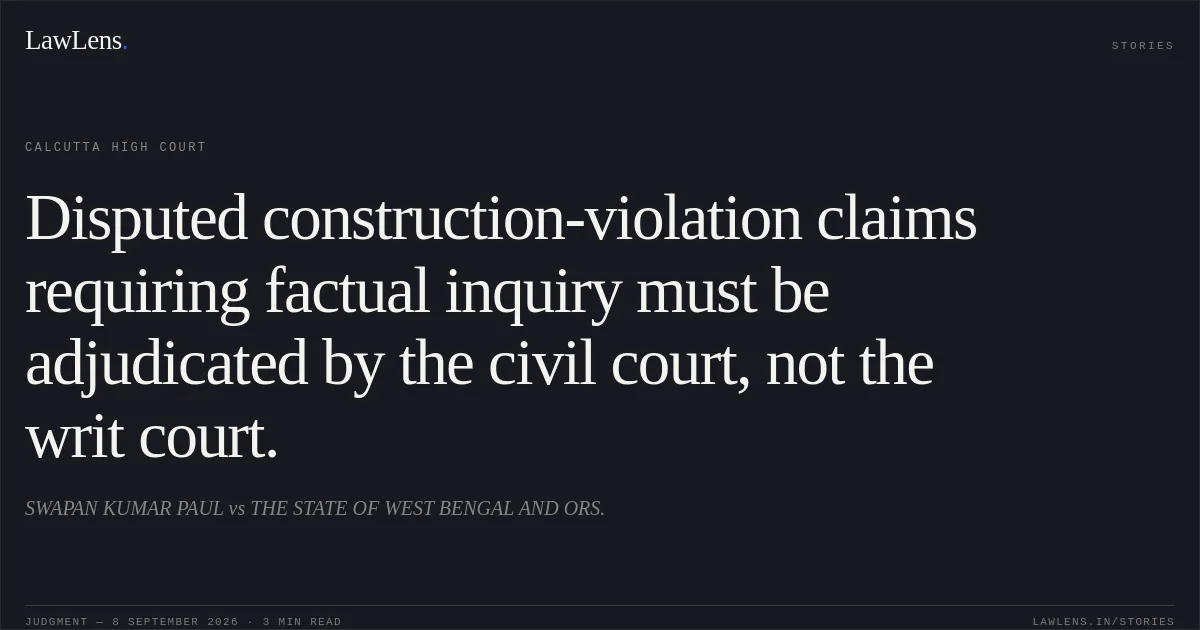
¶ 7The Court further applied the settled rule that a writ court ordinarily should not adjudicate disputed questions of fact requiring detailed evidence, and that such disputes are appropriately determined by the civil court.
¶ 10–11Since the partition suit was already pending before the civil court and the Municipality was a party to it, that court was the appropriate forum to determine the alleged violation and grant consequential relief, if warranted.
¶ 12–1504Reasoning
The Division Bench held that the learned Single Judge ought to have considered the Municipality’s undertaking, particularly because the Municipality had accepted the earlier order dated 19 May 2022.
¶ 8The undertaking prohibited further construction and could not be neutralised by the Municipality’s separate assurance that it would not claim equity in the event the passage was ultimately allotted to the appellant.
¶ 7However, the Court concluded that deciding whether any additional construction had in fact been made after the order of status quo or after 19 May 2022 would require determination of the property’s physical condition at the relevant dates and examination of evidence regarding subsequent construction or alteration.
¶ 10Such an evidentiary inquiry was unsuitable for writ jurisdiction, especially when the same parties were already before the civil court in the pending partition suit and the appellant had alleged violation there.
¶ 11–13Accordingly, the Court preserved the appellant’s remedy by directing him to seek restoration or demolition before the trial court, without expressing any opinion on the merits.
¶ 13–1505Holding
The appeal was disposed of by granting the appellant liberty to approach the trial court in the pending partition suit with an appropriate application, if not already filed, seeking restoration of possession and/or demolition of any construction made by the Municipality after the status quo order and after 19 May 2022 in violation of the court orders or the Municipality’s undertaking.
¶ 14The civil court was requested to decide the application on merits and in accordance with law, after permitting the Municipality and other parties to file written objections, preferably within six weeks from the date of filing or from the date of judgment, whichever was later.
¶ 14–15The Division Bench clarified that it had not adjudicated the merits of the parties’ claims.
¶ 15–17CAN 1 of 2026 was also disposed of, with no order as to costs.
¶ 15–17Original Court PDF
SWAPAN KUMAR PAULvsTHE STATE OF WEST BENGAL AND ORS.
Click to open original judgment
Original judgment, available to read, download and summarize on LawLens.in