01Facts
The petitioner, a senior citizen, owns land bearing Khasra No. 297/2 (0.324 ha) and Khasra No. 297/3 (0.202 ha) at Patwari Halka No. 53, Village Kumhari, Tahsil Dhamdha, District Durg.
¶ 1She alleges that respondent No. 8 (Ramalu Rao) is constructing on land encroached from her holding, and that respondent No. 9 (Usha Devi) sold land in excess of her lawful entitlement.
¶ 2She claims the Naib Tehsildar, by order dated 03.06.2017, directed status quo, but construction continued, as shown by a Panchnama dated 14.01.2020.
¶ 2She further alleges that respondent No. 8 failed to appear in demarcation proceedings and that an Anganwadi centre is being attached to her adjoining land to give access to respondent No. 8.
¶ 2The petitioner sought removal of the encroachment, demarcation, fines and action against private respondents and officials, and an investigation into alleged tampering of revenue records in Khasra No. 296/2.
¶ 1The State and respondents 8 to 10 opposed the petition.
¶ 3The Court relied on the report of the Sub-Divisional Officer (SDO), Bhilai (formerly Patan).
¶ 502Issues
i.1. Whether the High Court, in exercise of writ jurisdiction under Article 226 of the Constitution, can adjudicate disputed questions of fact concerning the nature, extent and possession of the land, and the alleged encroachment, so as to grant the reliefs sought.
¶ 5ii.2. Whether the petitioner's grievances, including the prayers for removal of encroachment, demarcation, imposition of fines, action against officials and investigation of revenue record tampering, can be granted in the present proceedings, or whether the petitioner must be relegated to a civil remedy.
¶ 503Law Applied
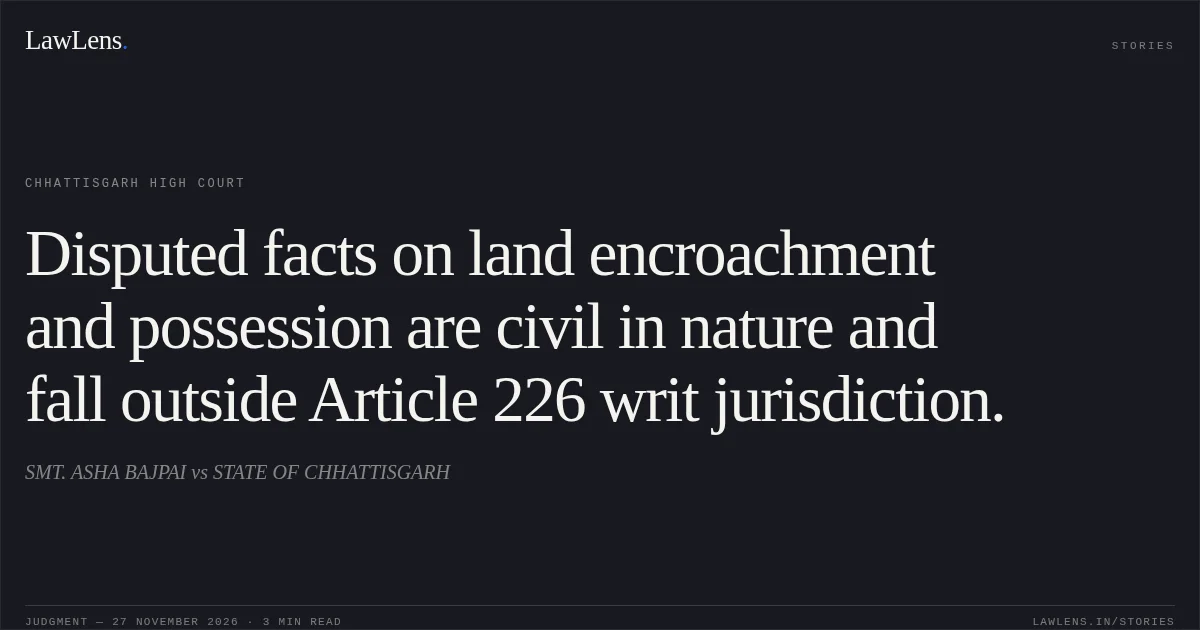
The Court relied on Article 226 of the Constitution of India as the source of its writ jurisdiction and held that it does not extend to disputes requiring determination of disputed questions of fact through oral and documentary evidence.
¶ 5Disputes concerning the nature, extent and possession of land are "essentially civil in nature" and must be adjudicated by a civil court.
¶ 5A party may be relegated to a civil suit, the SDO's report may be relied upon in such proceedings, and the civil court must decide the matter independently on its merits without being influenced by the High Court's observations.
¶ 504Reasoning
On the material, including the SDO report, the Court prima facie found that respondent No. 8 had encroached on a portion of the petitioner's land.
¶ 5The Court held that the petitioner's claim turned on contested questions of fact about the extent, nature and possession of the land, which required evidentiary adjudication. Because such questions fall outside the scope of writ jurisdiction under Article 226, the Court declined to grant the reliefs sought.
¶ 5To preserve the petitioner's remedy, the Court granted liberty to file a civil suit and permitted reliance on the SDO's report, while expressly directing that the civil court decide the matter afresh and independently.
¶ 5The order does not separately discuss the prayers for fines, action against officials or investigation of record tampering; these were implicitly rejected as part of the same factual dispute.
¶ 505Holding
The reliefs claimed cannot be granted in writ proceedings because the dispute involves disputed questions of fact that are civil in nature and beyond the scope of Article 226.
¶ 5The writ petition is disposed of with liberty to the petitioner to institute a civil suit before the competent court for appropriate relief, with leave to rely on the SDO's report. No direct relief, including removal of encroachment, demarcation, fines, or investigation, was granted.
¶ 5, 6Original Court PDF
SMT. ASHA BAJPAIvsSTATE OF CHHATTISGARH
Click to open original judgment
Original judgment, available to read, download and summarize on LawLens.in