Facts
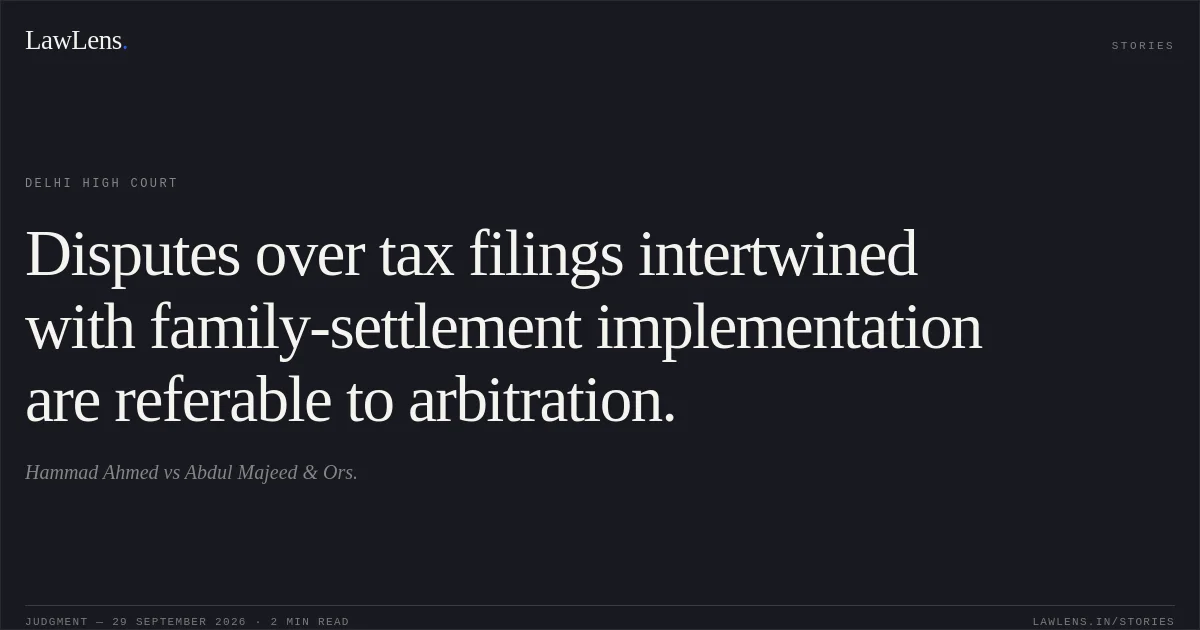
The parties’ Family Settlement Deed (FSD), decreed on 13 December 2019, provided for separate management of HLI’s medicines and food businesses while preserving its charitable mandate.
Source reference: p. 2–3, paras 2.1–2.3The Decree Holder (DH) alleged that Judgment Debtors 1 and 2 (JDs 1 and 2) had unilaterally filed Form 10AB for renewal of HLI’s tax-exempt registration and appointed Ellahi Goyal & Co. as statutory auditor.
Source reference: p. 2–5, paras 1, 2.4–2.12The DH sought, among other reliefs, a declaration that the auditor’s appointment was illegal and appointment of an independent auditor.
Source reference: p. 2–5, paras 1, 2.4–2.12The tax authorities had rejected the earlier Form 10AB with liberty to refile, and issued a show-cause notice concerning discrepancies in the properties listed in the subsequent application.
Source reference: p. 4, 13–16, paras 2.7–2.9, 11Disputes concerning implementation of the FSD, including property segregation, were already referred to arbitration, where applications concerning HLI’s assets and related information had been filed.
Source reference: p. 16–24, paras 13–14Issues
1. Whether the execution court should appoint an independent statutory auditor and grant related interim directions concerning HLI’s statutory filings.
Source reference: p. 2, 12, paras 1, 82. Whether the dispute concerning Form 10AB and the properties disclosed in it should be addressed by the execution court or referred to the arbitral tribunal.
Source reference: p. 21–24, paras 14–15Law Applied
Section 12A(ac) of the Income Tax Act, 1961, was relevant to the periodic renewal of registration and the time for applying.
Source reference: p. 3, para 2.4Clause 45 of the FSD contained an arbitration agreement; earlier orders had referred disputes under the FSD to a sole arbitrator and permitted the parties to seek interim measures under Section 17 of the Arbitration and Conciliation Act, 1996.
Source reference: p. 16–18, 21–22, paras 13–14The Court proceeded on the basis that the arbitral tribunal could consider the interim directions sought in relation to matters connected with the pending arbitration.
Source reference: p. 21, para 13The Court did not decide whether the consent decree or particular FSD clauses were executable; it expressly left those questions open.
Source reference: p. 24, para 16Reasoning
The Court found no urgency warranting immediate relief concerning Form 10AB, noting that the application for renewal had already been filed and that the DH’s objections turned substantially on whether properties had been segregated or transferred under the FSD.
Source reference: p. 12, paras 7–9Because property segregation was disputed and intertwined with matters already before the arbitrator, the Court considered the requested relief referable to arbitration.
Source reference: p. 21–24, paras 14–15It also declined to appoint an independent auditor at that stage, reasoning that doing so at the eleventh hour could prejudice both parties.
Source reference: p. 24, para 15Holding
The Court disposed of the application without appointing an independent auditor or granting the other requested interim directions.
The DH was permitted to apply to the arbitral tribunal for appropriate interim or other directions, to be decided on their merits and without being influenced by observations in this order.
Source reference: p. 24, paras 15, 18–19Questions concerning executability of the consent decree and the relevant FSD clauses were left open.
Source reference: p. 24, para 16Acts & Sections Cited
5 provisions across 3 statutes referred to in this judgment. Each provision opens on LawLens.
Code of Civil Procedure, 19082
Arbitration and Conciliation Act, 19962
Indian Trust Act, 18821
Original Court PDF
Hammad AhmedvsAbdul Majeed & Ors.
Click to open original judgment
Original judgment, available to read, download and summarize on LawLens.in