Facts
The complainant alleged that her husband, accused No. 1, subjected her to physical and mental harassment, including assault and restricting her access to her salary.
Source reference: p. 4–6She also alleged that accused No. 2, a relative living in Hyderabad, visited the couple’s home and urged accused No. 1 to divorce her.
Source reference: p. 4–6Police filed a charge sheet against both accused under Sections 498A read with 34 of the IPC, and the Magistrate took cognizance.
Source reference: p. 6Accused No. 1 sought quashing of the proceedings, while accused No. 2 separately challenged the cognizance order and sought quashing of the proceedings against him.
Source reference: p. 7–8Issues
1. Whether the allegations and materials against accused No. 1 disclosed a basis to quash the Section 498A IPC proceedings at the pre-trial stage
Source reference: paras. 5, 10; pp. 7, 9–102. Whether the general allegations that accused No. 2 urged accused No. 1 to divorce the complainant were sufficient to continue the Section 498A IPC proceedings against him
Source reference: paras. 6, 11, 15; pp. 8, 10, 13Law Applied
Section 498A IPC criminalises specified forms of cruelty by a husband or his relatives; the proceedings here were brought under that provision read with Section 34 IPC.
Source reference: pp. 4, 14In exercising its inherent jurisdiction under Section 482 CrPC, the Court may quash proceedings where, even taking the allegations at face value, they do not make out a prima facie case or continuation would amount to abuse of process.
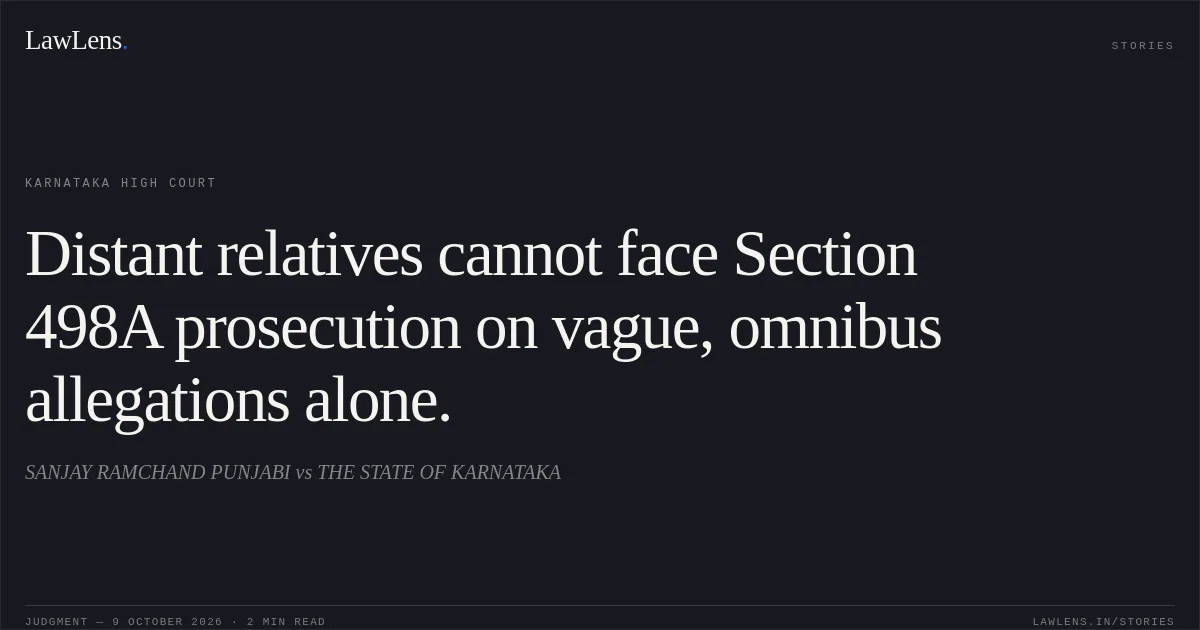
Source reference: pp. 4, 13–14Relying on K. Subba Rao v. State of Telangana, 2024 INSC 960, and Dara Lakshmi Narayan v. State of Telangana, (2025) 3 SCC 735, the Court stated that distant relatives should not be prosecuted on omnibus allegations absent specific instances of their involvement.
Source reference: paras. 12–14; pp. 11–13Reasoning
As to accused No. 1, the complaint described incidents of abuse and assault, and the Court considered those allegations to be supported by witness statements.
Source reference: para. 10; p. 9Their truth and whether they amounted to cruelty under Section 498A were matters for trial; therefore, quashing was not warranted at that stage.
Source reference: para. 10; p. 9As to accused No. 2, the allegations were that he visited the home and urged accused No. 1 to divorce the complainant, but the complaint and witness statements identified no specific date, place, manner, or particular act of harassment.
Source reference: paras. 11, 15–16, 19; pp. 10–14The Court held that these general allegations did not establish a prima facie case and that continuing the prosecution would constitute an abuse of process.
Source reference: paras. 11, 15–16, 19; pp. 10–14Holding
The Court dismissed Crl.P. No. 7701/2024, leaving the proceedings against accused No. 1 to continue.
It allowed Crl.P. No. 11704/2024 and quashed the proceedings against accused No. 2 in C.C. No. 18727/2024 for offences under Sections 498A read with 34 IPC.
Source reference: para. 19; pp. 14–15Acts & Sections Cited
3 provisions across 3 statutes referred to in this judgment. Each provision opens on LawLens.
Code of Criminal Procedure, 19731
Bharatiya Nagarik Suraksha Sanhita, 20231
Indian Penal Code, 18601
Original Court PDF
SANJAY RAMCHAND PUNJABIvsTHE STATE OF KARNATAKA
Click to open original judgment
Original judgment, available to read, download and summarize on LawLens.in