Facts
The appellant, belonging to the Kunjda community classified as Other Backward Class (OBC), contested and won the election from OBC-reserved Ward No. 35, Sharda Para, Municipal Corporation, Bhilai; an election certificate was issued in his favour on 23 December 2021.
Source reference: para. 3The Divisional Commissioner, by order dated 6 May 2024, removed the appellant from the office of Councillor under Section 19(1)(a-1) of the Chhattisgarh Municipal Corporations Act, 1956. The State appellate authority affirmed that order on 4 September 2024.
Source reference: para. 3During its pendency, the High Court stayed the operation and effect of the removal orders on 28 January 2025, following which the appellant resumed charge.
Source reference: para. 3Although the State Election Commission initially stayed the proposed bye-election, the election was subsequently conducted and Respondent No. 5, Chandan Yadav, was declared elected from the ward.
Source reference: para. 3The learned Single Judge, by a common judgment dated 3 August 2026, dismissed the appellant’s writ petition and allowed the connected petition filed by Respondent No. 5.
Source reference: para. 8Issues
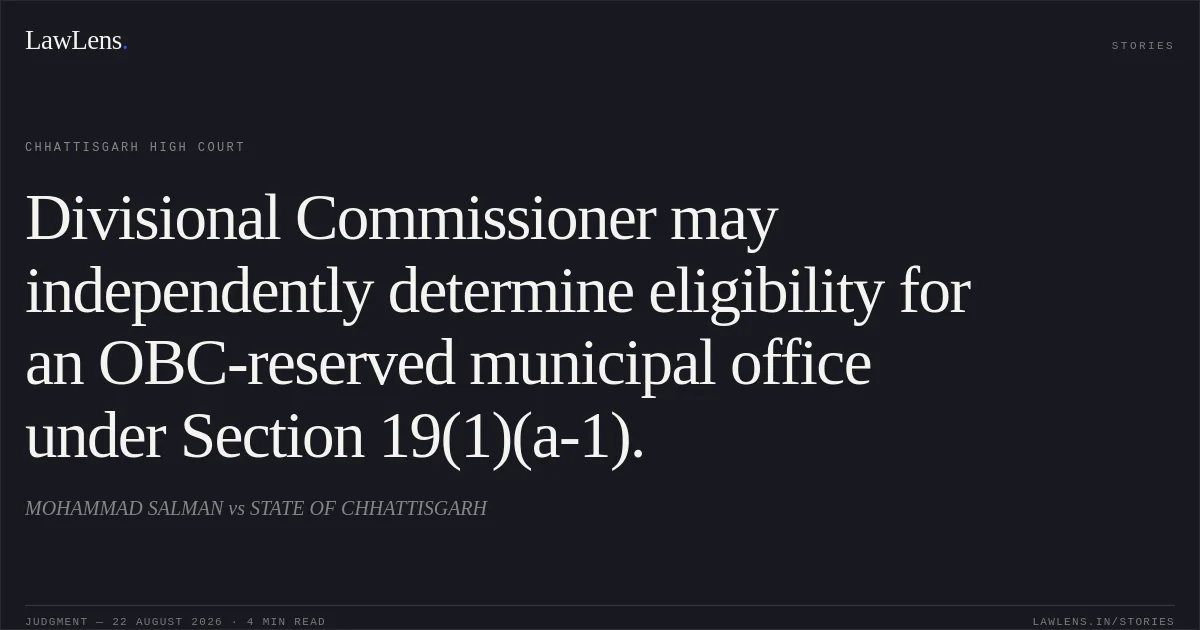
Whether the Divisional Commissioner had jurisdiction under Section 19(1)(a-1) of the Chhattisgarh Municipal Corporations Act, 1956, to determine the appellant’s eligibility to hold an OBC-reserved councillor’s office, notwithstanding the statutory mechanism for challenging municipal elections under Section 441 of the Act and Article 243-ZG of the Constitution?
Source reference: paras. 4–5, 8Whether the determination that the appellant’s Social Status Certificate was not genuine could be made by the Divisional Commissioner without a declaration by the competent Caste Scrutiny Committee under the Chhattisgarh Scheduled Castes, Scheduled Tribes and Other Backward Classes (Regulation of Social Status Certification) Act, 2013?
Source reference: paras. 4, 8Whether reliance on the Sub-Divisional Officer’s report, allegedly without furnishing it to the appellant or permitting effective rebuttal, violated principles of natural justice?
Source reference: para. 4Whether the subsequent bye-election and election of Respondent No. 5 were legally sustainable despite the interim order dated 28 January 2025 staying the removal orders and the appellant’s resumption of office?
Source reference: paras. 3, 5, 8Law Applied
The Court applied Section 19(1)(a-1) of the Chhattisgarh Municipal Corporations Act, 1956, as conferring independent jurisdiction to examine whether an elected councillor possessed the requisite eligibility to occupy a reserved seat.
Source reference: para. 8It considered Section 441 of the Act and Article 243-ZG of the Constitution, which provide for and protect the statutory election-petition mechanism for questioning municipal elections; however, the Single Judge treated the statutory disqualification inquiry as distinct from an election petition.
Source reference: paras. 5, 8The Court also considered the Chhattisgarh Scheduled Castes, Scheduled Tribes and Other Backward Classes (Regulation of Social Status Certification) Act, 2013 and the principles in Kumari Madhuri Patil, but accepted the view that reference to the Caste Scrutiny Committee was unnecessary where the document relied upon was found not to be a genuine certificate issued by the competent authority.
Source reference: para. 8The Court further applied the limited scope of an intra-court appeal, under which interference is unwarranted absent a palpable infirmity, perversity, jurisdictional error, or comparable defect in the Single Judge’s decision.
Source reference: para. 9Reasoning
The Division Bench found that the Single Judge had given cogent and justifiable reasons for holding that the Divisional Commissioner could independently examine the appellant’s eligibility under Section 19(1)(a-1), notwithstanding the separate election-petition remedy under Section 441.
Source reference: paras. 8–9The finding that the appellant’s Social Status Certificate was not genuine was based on the Sub-Divisional Officer’s report that the relevant revenue case number related to another person and that no such certificate had been issued in the appellant’s favour.
Source reference: para. 8On that basis, the matter was treated not as a disputed caste determination requiring reference to the Caste Scrutiny Committee, but as a case involving an allegedly non-genuine certificate.
Source reference: para. 8The Bench did not identify any palpable perversity, jurisdictional infirmity, or other error warranting appellate interference.
Source reference: para. 9It also accepted the Single Judge’s view that the interim order staying the removal orders did not prohibit the election authorities from conducting the bye-election and that the election process, once commenced, could not be interdicted in writ jurisdiction.
Source reference: para. 8Holding
The Division Bench held that no palpable infirmity or perversity was demonstrated in the common judgment dated 3 August 2026.
It therefore declined to interfere with the findings upholding the Divisional Commissioner’s order dated 6 May 2024 and the appellate order dated 4 September 2024, which removed the appellant from the office of Councillor.
Source reference: para. 10The validity of the subsequent election of Respondent No. 5 was also left undisturbed.
Source reference: para. 10The writ appeal was accordingly dismissed, with no order as to costs.
Source reference: para. 10Acts & Sections Cited
2 provisions across 1 statute referred to in this judgment. Each provision opens on LawLens.
Chhattisgarh Municipal Corporation Act, 19562
Original Court PDF
MOHAMMAD SALMANvsSTATE OF CHHATTISGARH
Click to open original judgment
Original judgment, available to read, download and summarize on LawLens.in