Facts
The Appellant filed Indian Patent Application No. 201918048639 on 27.11.2019.
Source reference: p. 1-2This was a divisional application derived from Parent Application No. 8479/DELNP/2015 (Patent No. 328705). The parent application concerned a process for an "apoptosis-inducing agent".
Source reference: p. 2During the examination of the parent application, the Controller raised a "unity of invention" objection, asserting that the process for preparing an intermediate (Compound C) was a distinct invention. Consequently, the Appellant filed the subject divisional application for the intermediate process.
Source reference: p. 4-5On 30.03.2024, the Respondent refused the application on two grounds: (i) non-maintainability under Section 16 because the claims allegedly overlapped with the granted parent patent, and (ii) lack of inventive step under Section 2(1)(ja) in view of prior art documents D1-D4.
Source reference: p. 4Issues
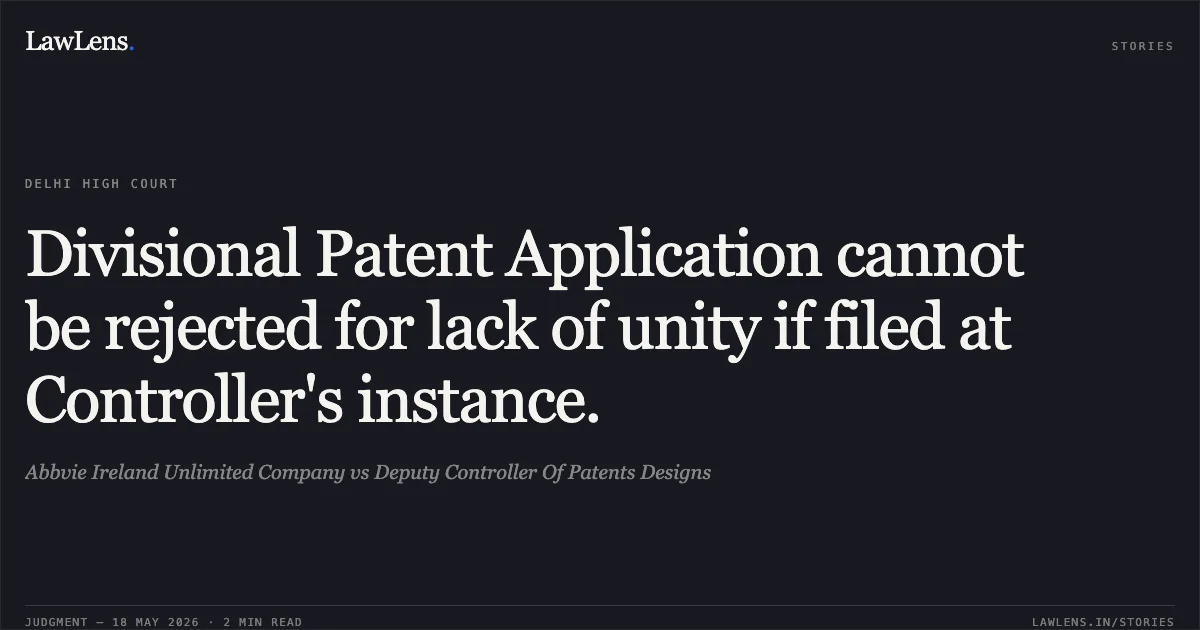
1. Whether a divisional application filed pursuant to an objection by the Controller can be rejected as non-maintainable under Section 16 of the Patents Act.
Source reference: p. 5 / para. 72. Whether the Respondent's finding on lack of inventive step was sustainable given the lack of detailed analysis regarding the Appellant's technical submissions.
Source reference: p. 9 / para. 11Law Applied
Section 16 of the Patents Act, 1970, which governs the filing of divisional applications, and Section 2(1)(ja), which defines "inventive step".
Source reference: p. 2, 4An applicant cannot be denied the right to file a divisional application if it is filed to remedy an objection of "unity of invention" raised by the Patent Office itself, as established in Milliken & Company v. Union of India, Syntonix Pharmaceuticals v. Controller, and National Institute of Immunology v. Assistant Controller.
Source reference: p. 5Principles of "claim construction" noting that dependent claims incorporate parent claims but add specific limitations as laid down in F. Hoffmann-La Roche Ltd. v. Cipla Ltd.
Source reference: p. 7Reasoning
The Court found the Respondent’s rejection on maintainability legally flawed. It noted that since the divisional application was filed specifically because the Controller had previously objected to the parent application for lack of unity of invention, the Appellant could not be "left in a lurch" by having that same divisional application deemed non-maintainable.
Source reference: p. 5, 13The Court observed that the Respondent failed to analyze the Appellant’s contention that the parent claims related to a multi-step process for a final product (A1), whereas the divisional claims targeted a single-step process for an intermediate (C).
Source reference: p. 8, 13-14Regarding the inventive step, the Court criticized the impugned order for being "unreasoned and non-speaking". It noted that the Respondent merely "copied and pasted" abstracts from prior arts D1-D4 without addressing the Appellant's technical arguments regarding structural differences and distinct reaction schemes.
Source reference: p. 9-10, 15The Court emphasized that refusing a patent is a serious matter requiring a thorough analysis of similarities and differences, which was absent here.
Source reference: p. 15Holding
The divisional application could not be rejected on maintainability under Section 16 as it was born out of the Patent Office's own objection.
The Court set aside the impugned order dated 30.03.2024 and remanded the matter to the Respondent to conduct a fresh assessment specifically on the "lack of inventive step" under Section 2(1)(ja) within four months.
Source reference: p. 15 / para. 20Acts & Sections Cited
3 provisions across 2 statutes referred to in this judgment. Each provision opens on LawLens.
Patents Act, 19702
Code of Civil Procedure, 19081
Original Court PDF
Abbvie Ireland Unlimited CompanyvsDeputy Controller Of Patents Designs
Click to open original judgment
Original judgment, available to read, download and summarize on LawLens.in