Facts
The petitioners challenged a trial court order dated 14.02.2025, which rejected their application under Section 151 of the CPC for a DNA test of Defendant No. 1
Source reference: para 1The petitioners alleged that Defendant No. 1 could not be the biological son of the deceased, Sajan Singh, because he was born on 06.07.1995—nearly 12 months after Sajan Singh and Defendant No. 2 (the mother) purportedly ceased cohabitation upon executing a Farkatinama (relinquishment deed) on 12.07.1994
Source reference: para 1-2The respondents argued the application was inconsistent with the plaint and contrary to settled law regarding the presumption of legitimacy
Source reference: para 3Issues
1. Whether a DNA test can be legally ordered to determine the paternity and legitimacy of a child born during the subsistence of a marriage
Source reference: para 1, 82. Whether an unregistered Farkatinama and allegations of non-cohabitation are sufficient to rebut the statutory presumption of legitimacy under Section 112 of the Indian Evidence Act
Source reference: para 5-7Law Applied
The Court primarily applied Section 112 of the Indian Evidence Act, 1872, which mandates that birth during a valid marriage is "conclusive proof" of legitimacy unless it is shown that the parties had "no access" to each other at the time of conception
Source reference: para 6, 9The Court followed the principles in Ivan Rathinam v. Milan Joseph (2025), establishing that "non-access" implies the impossibility, not just the inability, of marital relations
Source reference: para 11It further relied on Dipanwita Roy v. Ronobroto Roy (2015) and Aparna Ajinkya Firodia (2024), which clarify that DNA tests should be avoided to protect a child's legitimacy unless there is an "eminent need" and the issue of legitimacy is merely incidental to a primary claim like adultery
Source reference: para 9-11Finally, it noted that under Hindu Law, divorce cannot be effected solely via a private deed
Source reference: para 5Reasoning
The Court held that the Farkatinama was inadmissible in evidence because it was neither stamped nor registered as required by law
Source reference: para 5The Court observed that since there was no valid divorce decree, the marriage between Sajan Singh and Defendant No. 2 was legally subsisting at the time of Defendant No. 1’s birth
Source reference: para 6Under Section 112, this creates a rigorous presumption of legitimacy that can only be displaced by proving the impossibility of access within the 280-day gestational window
Source reference: para 7, 11The Court distinguished this case from precedents where DNA tests were allowed, noting that the petitioners’ primary goal was to challenge the child's legitimacy rather than prove a separate ground like adultery
Source reference: para 12-14It concluded that a DNA test cannot be used as a shortcut to bypass the requirement of proving non-access through regular evidence
Source reference: para 11, 15Holding
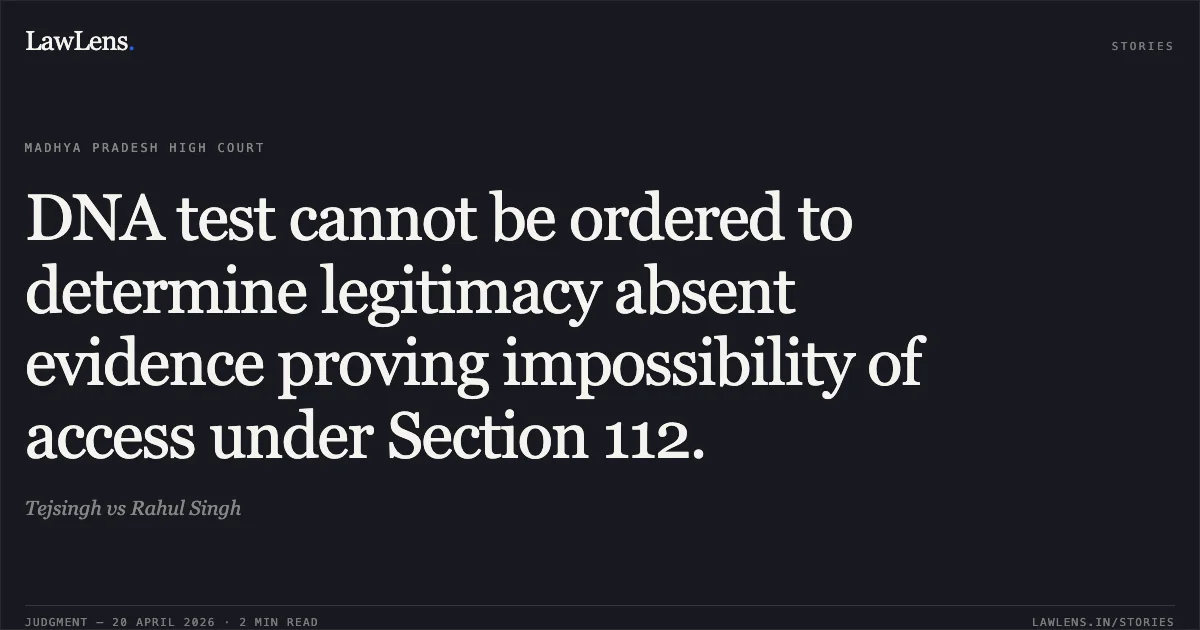
The Court held that a DNA test cannot be ordered solely to adjudge paternity where a statutory presumption of legitimacy exists
The High Court dismissed the petition, finding no jurisdictional error in the trial court's refusal to order a DNA test. The petitioners were granted the liberty to attempt to rebut the presumption under Section 112 of the Evidence Act by leading appropriate evidence regarding non-access during the trial
Source reference: para 15-16Acts & Sections Cited
2 provisions across 2 statutes referred to in this judgment. Each provision opens on LawLens.
Code of Civil Procedure, 19081
Hindu Marriage Act, 19551
Original Court PDF
TejsinghvsRahul Singh
Click to open original judgment
Original judgment, available to read, download and summarize on LawLens.in