01Facts
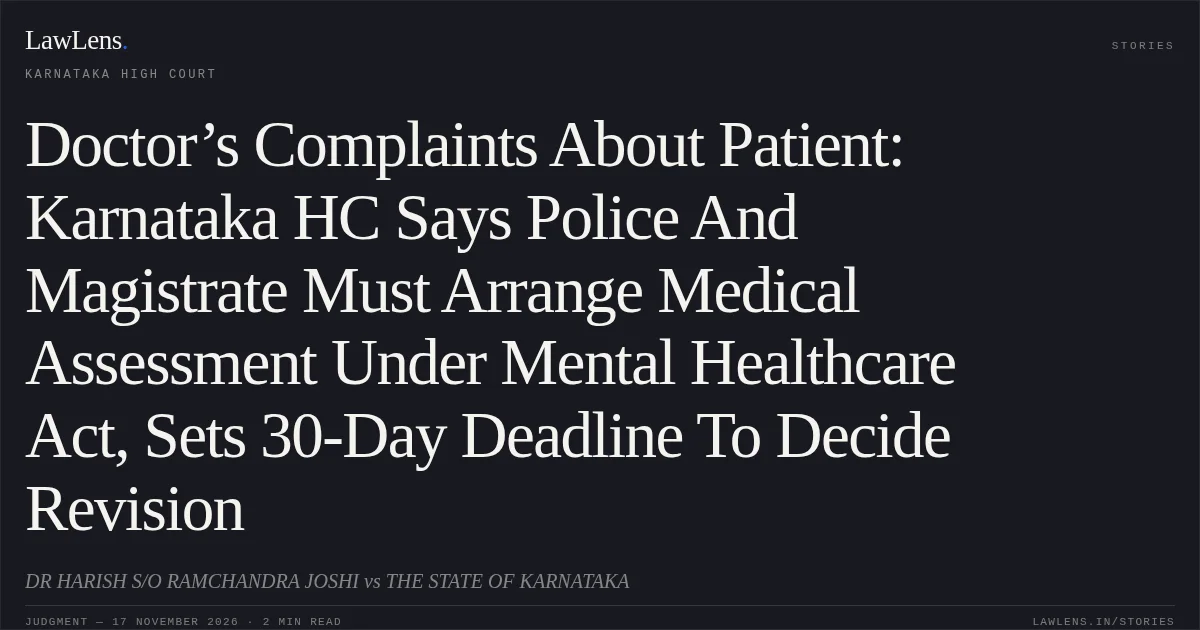
The petitioner, a doctor, complained to the police about the conduct of Tejaswini Kulkarni, a patient whom he believed might have a mental illness and who, he said, had repeatedly visited his clinic and created difficulties.
pp. 2–7, 9–10The police initiated proceedings before the jurisdictional Magistrate under the Mental Healthcare Act, 2017.
pp. 2–7, 9–10After interacting with Kulkarni, the Magistrate found her able to speak normally and declined to refer her to the Department of Psychiatry at DIMHANS; the record disclosed no medical assessment.
pp. 2–7, 9–10The petitioner, who was not a party to those proceedings, filed a criminal revision, which remained pending amid a vacancy in the Sessions Court.
pp. 2, 4, 11–12He then sought police protection and expedition of the revision.
pp. 2, 4, 11–1202Issues
i.1. Whether the police and Magistrate, on the facts presented, could conclude that no further action was required without arranging a medical assessment of the person concerned under the Mental Healthcare Act, 2017.
pp. 7–11ii.2. Whether the pending criminal revision should be taken up on priority and decided within a specified period.
pp. 4, 11–1203Law Applied
Sections 100–102 of the Mental Healthcare Act, 2017 govern police protection, reporting to a Magistrate, and assessment of a person who has or may have a mental illness.
pp. 8–11Under Section 100, a person taken into protection must be taken promptly to a public health establishment for assessment, and the medical officer or mental health professional is responsible for assessing the person’s healthcare needs.
pp. 8–11Under Sections 101 and 102, a Magistrate may act on a report or other information and may direct that the person be conveyed to a public mental health establishment for assessment and treatment, if necessary.
pp. 8–11The Court held that the statutory process required assessment by an appropriate medical officer; a Magistrate’s personal interaction with the person did not constitute that medical assessment.
pp. 8–11Provisions in the judgment · 3 · Linked ones open on LawLens
Mental Healthcare Act, 2017 Section 100Section 101Section 102
04Reasoning
The Magistrate had received the patient’s brother’s statement that he could not provide her necessary treatment, and the petitioner had repeatedly raised concerns.
pp. 5–7, 9–11Although the Magistrate interacted with the patient and considered her behaviour and speech normal, the record showed no assessment by a medical officer or mental health professional.
pp. 5–7, 9–11The Court considered that omission contrary to the statutory assessment framework and found that the police and Magistrate had failed to discharge their responsibilities under the Act.
pp. 11–12Given the pending revision and the delay caused by the absence of the presiding officer, the Court directed the revision court to hear the matter on priority.
pp. 11–1205Holding
The High Court allowed the petition and directed the Additional District and Sessions Judge, Dharwad, sitting at Hubballi—or the In-charge Court—to take up Cr.R.P. No. 5045/2026 on priority and pass appropriate orders within 30 days of receiving a certified copy of the High Court’s order.
pp. 11–12It further directed the police to provide all necessary assistance in implementing the Act, with the patient’s best interests as the central consideration.
pp. 11–12The Court did not itself order police protection for the petitioner or determine the revision’s merits.
pp. 11–12Original Court PDF
DR HARISH S/O RAMCHANDRA JOSHIvsTHE STATE OF KARNATAKA
Click to open original judgment
Original judgment, available to read, download and summarize on LawLens.in