01Facts
The respondent was appointed as an Assistant Kannada Teacher on 24 September 1982 and served until 1999.
pp. 3–5She thereafter remained absent, with medical-leave materials before the Tribunal said to cover a period up to 2001.
pp. 3–5Following a show-cause notice issued in 2011 and a departmental inquiry, the State dismissed her for unauthorised absence.
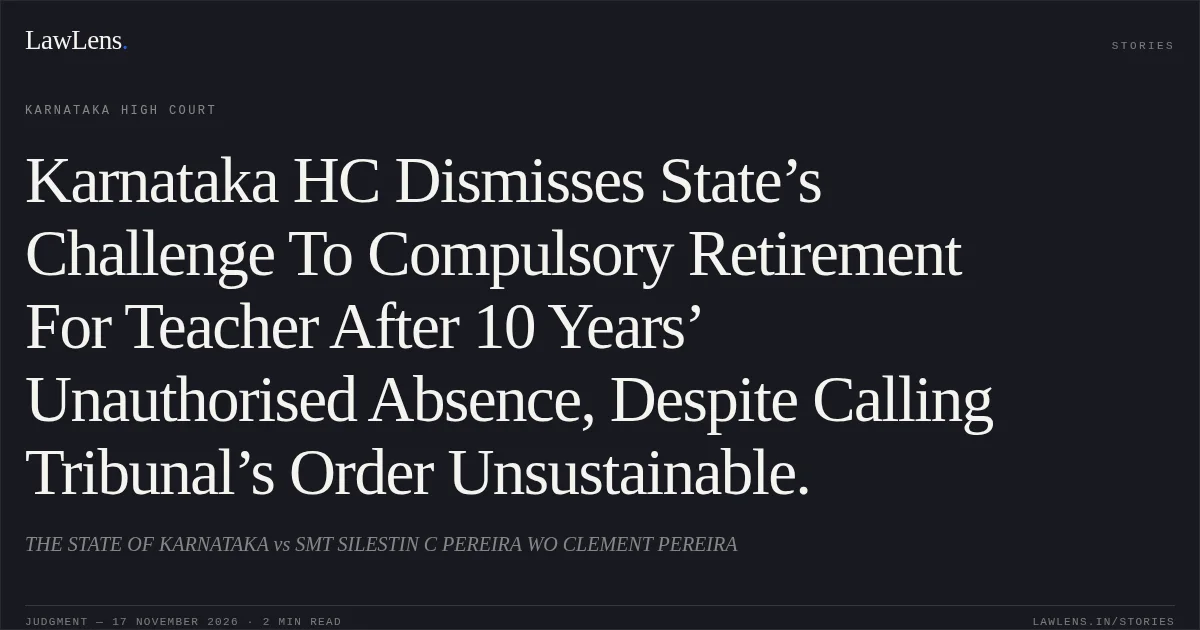
pp. 3–5The Tribunal upheld the finding of misconduct but substituted compulsory retirement, effective from 8 June 2001, for dismissal, directing payment of pensionary benefits.
pp. 3–5The State challenged that order under Articles 226 and 227; the respondent was served but did not appear.
pp. 8–10The State filed its writ petition approximately 24 months after the Tribunal’s order.
pp. 5, 8–1002Issues
i.Whether the Tribunal was justified in substituting compulsory retirement for dismissal despite finding that the respondent had committed prolonged unauthorised absence
pp. 8–10ii.Whether the State’s approximately 24-month delay in approaching the High Court should affect the relief sought and attract costs
p. 5, 1203Law Applied
The Court relied on the principle that unauthorised absence, where established and unsupported by adequate evidence or proper leave, may warrant disciplinary consequences; it cited Rifilis Engineering Pvt. Ltd. v. Arjun Gupta, 2026 SCC OnLine SC 1780, concerning the consequences of unsupported claims explaining unauthorised absence.
pp. 10–12On delay, it relied on State of Odisha v. Managing Committee of Namatara Girls High School, 2026 SCC OnLine SC 191; Israr Ahmad Khan v. Amarnath Prasad, 2026 SCC OnLine SC 322; and State of Madhya Pradesh v. Ramkumar Choudhary, 2024 SCC OnLine SC 3612, for the principles that the State has no automatic entitlement to indulgence for delay, must explain it, and may be subject to costs for lethargic or negligent litigation conduct.
pp. 13–23Provisions in the judgment · 1 · Linked ones open on LawLens
Limitation Act, 1963 Section 5
04Reasoning
The Court considered the unauthorised absence to be established and found that the respondent had not produced adequate supporting leave or medical documentation for the period after 2001.
pp. 7–12It held that the Tribunal’s reliance on the respondent’s earlier 17 years of service to reduce the penalty was misplaced in light of the prolonged absence, and described the Tribunal’s order as contrary to the cited law.
pp. 7–12Separately, the Court criticised the State for taking approximately 24 months to file the writ petition and, relying on the authorities concerning delayed State litigation, imposed costs.
pp. 12–2305Holding
The Court’s reasoning states that the Tribunal’s substitution of compulsory retirement for dismissal was unsustainable.
pp. 12–13However, its formal operative order dismisses the writ petition, without expressly setting aside the Tribunal’s order.
pp. 12–13The Court directed the State to pay ₹25,000 to the Karnataka State Legal Services Authority within eight weeks.
pp. 12–13Original Court PDF
THE STATE OF KARNATAKAvsSMT SILESTIN C PEREIRA WO CLEMENT PEREIRA
Click to open original judgment
Original judgment, available to read, download and summarize on LawLens.in