01Facts
The petitioner, an Electrical Inspector, was dismissed under Rule 14 of the Karnataka Civil Services (Classification, Control and Appeal) Rules, 1957, following his conviction in a corruption case.
¶ 2–3, 10The High Court set aside the conviction on 16 September 2014 for lack of sanction, and the petitioner was reinstated on 25 March 2015.
¶ 2–3, 10The State denied backwages for the period he was out of service.
¶ 2–3, 10After an earlier Tribunal order set aside the State’s initial decision and permitted fresh consideration under Rule 99(4) of the Karnataka Civil Services Rules, the State again treated the period as not spent on duty.
¶ 2–3, 10The Tribunal dismissed the petitioner’s challenge to that decision, leading to this writ petition.
¶ 2–3, 1002Issues
i.1. Whether an employee reinstated after his criminal conviction is set aside is automatically entitled to backwages for the period during which the conviction remained in force.
¶ 9, 16ii.2. Whether the petitioner was entitled to backwages for any part of the period between dismissal and reinstatement, and, if so, from what date.
¶ 12, 1703Law Applied
Rule 103 of the Karnataka Civil Services Rules provides for appropriate action when a government servant is judicially convicted, while Rule 14(i) of the Karnataka Civil Services (Classification, Control and Appeal) Rules permits a penalty based on conduct leading to conviction without the ordinary disciplinary procedure.
pp. 16–18, 20–21Reinstatement following acquittal does not, by itself, create an automatic right to backwages; entitlement depends on the applicable law and the circumstances of the case.
pp. 18–20In State Bank of India v. Mohammed Abdul Rahim, (2013) 11 SCC 67, the Supreme Court held that subsequent acquittal does not retrospectively erase the legal consequences of a conviction for the period it remained in force, including where law prohibited continued employment.
pp. 11–15Banshi Dhar v. State of Rajasthan, (2007) 1 SCC 324, establishes that backwages are not automatic and must be assessed in light of the facts and circumstances.
pp. 18–20Provisions in the judgment · 5 · Linked ones open on LawLens
Prevention of Corruption Act, 1988 Section 7Section 13Section 10
Indian Penal Code, 1860 Section 161
Dowry Prohibition Act, 1961 Section 4
04Reasoning
The petitioner’s dismissal resulted from his conviction, not from a departmental inquiry.
¶ 11–12, 17While the conviction remained in force, the authorities could not continue him in service; its later reversal did not retrospectively remove that consequence so as to entitle him to salary for that period.
¶ 11–12, 17The Court therefore rejected backwages for the period before the conviction was set aside.
¶ 11–12, 17Once the conviction was set aside on 16 September 2014, however, the basis for excluding the petitioner from service ceased, and the Court held that he was entitled to backwages from that date.
¶ 11–12, 1705Holding
The writ petition was partly allowed.
¶ 18The Tribunal’s order dated 7 February 2020 and the Government order dated 22 March 2018 were modified.
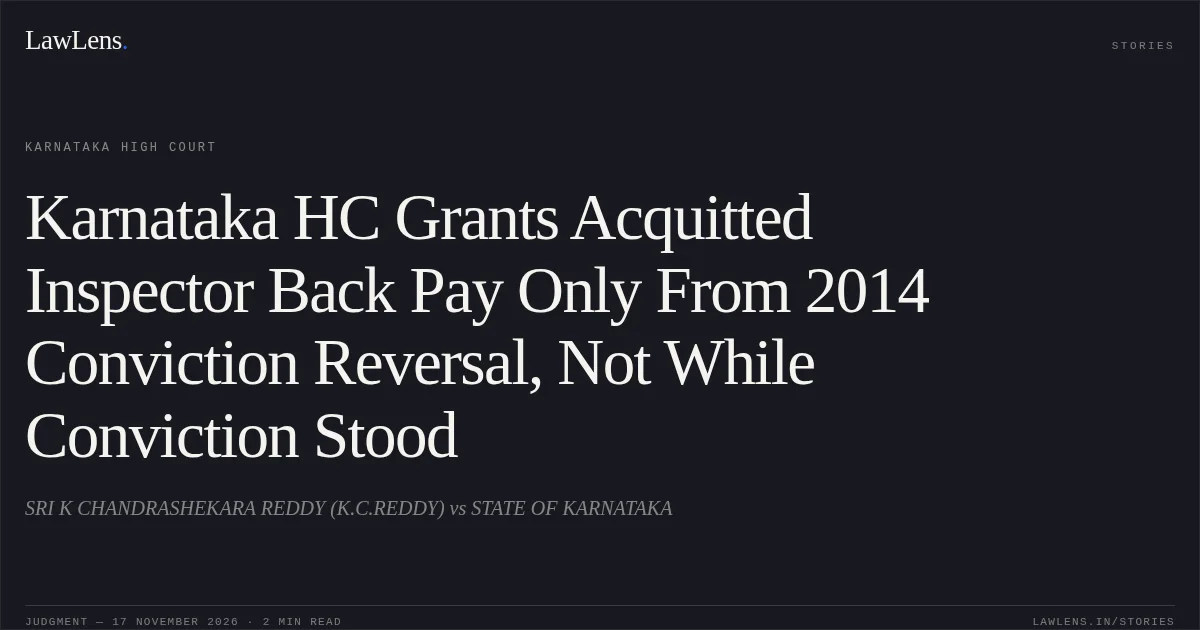
¶ 18The petitioner was held entitled to backwages/full salary from 16 September 2014, the date his conviction was set aside; his claim for backwages for the earlier period was not allowed.
¶ 18Original Court PDF
SRI K CHANDRASHEKARA REDDY (K.C.REDDY)vsSTATE OF KARNATAKA
Click to open original judgment
Original judgment, available to read, download and summarize on LawLens.in