01Facts
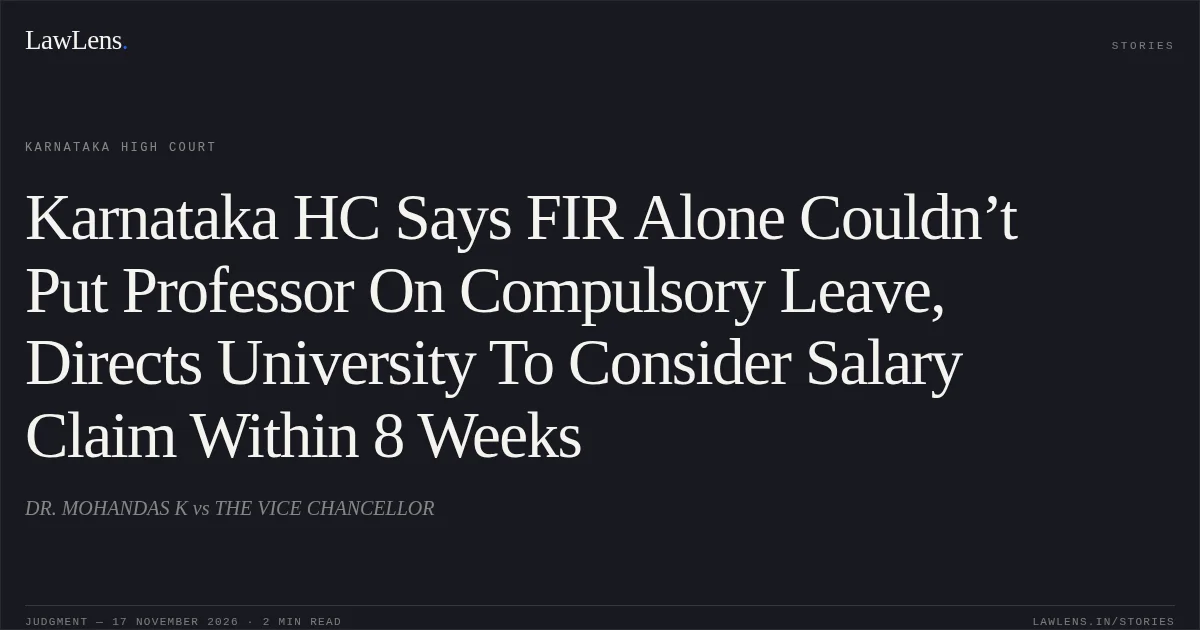
The petitioner, an Assistant Professor at Vijayanagara Sri Krishnadevaraya University, was placed on compulsory leave on 16 January 2025 after an FIR was registered alleging that he had abetted a laboratory attendant’s suicide.
pp. 3–8The police filed a ‘B’ report, which was accepted, and the criminal proceedings were closed.
pp. 3–8The University withdrew the compulsory-leave action, and the petitioner resumed duty on 17 June 2026.
pp. 3–8He claimed unpaid salary for the intervening period and thereafter, and relied on a representation dated 28 July 2026 seeking salary arrears and consideration of his pending Career Advancement Scheme promotion.
pp. 3–8The University disputed that salary remained unpaid after his return and asked that his representation concerning the earlier period be considered.
p. 502Issues
i.1. Whether the University could place the petitioner on compulsory leave merely because an FIR had been registered against him
pp. 5–6ii.2. Whether the petitioner was entitled to salary and consequential benefits for the period of compulsory leave, including where he claimed to have continued working
pp. 4–5, 8–9iii.3. Whether requiring the petitioner to work without salary, if established, could amount to “begar” or forced labour prohibited by Article 23 of the Constitution
pp. 9, 20–2103Law Applied
Article 23 of the Constitution prohibits begar and other forms of forced labour; the Supreme Court in People’s Union for Democratic Rights v. Union of India, (1982) 3 SCC 235, held that “force” may include economic compulsion and that work extracted without lawful remuneration may fall within the prohibition.
pp. 9–20The Court also observed that, following registration of the FIR, the petitioner could at most have been placed under suspension pending a departmental enquiry; an FIR alone did not justify placing him on compulsory leave.
pp. 5–6The judgment did not identify a specific service regulation governing suspension or salary treatment.
pp. 5–6Provisions in the judgment · 2 · Linked ones open on LawLens
Bharatiya Nyaya Sanhita, 2023 Section 108Section 3
04Reasoning
The compulsory-leave action had been withdrawn, so the Court considered it unnecessary to determine whether the impugned order should be quashed.
p. 5It nevertheless stated that placing the petitioner on compulsory leave solely because an FIR had been registered was unsustainable, particularly given the subsequent closure of the criminal proceedings.
pp. 5–6As the parties disputed whether salary remained unpaid after the petitioner resumed duty, and the petitioner’s claim for the earlier period required consideration, the Court directed the University to consider his representation and any supporting evidence that he had worked during that period.
pp. 8–9It cautioned that, if he had been made to work without salary, that could amount to begar under Article 23.
pp. 8–9, 20–2105Holding
The writ petition was disposed of; the Court did not quash the withdrawn compulsory-leave order or directly award salary arrears.
pp. 21–22It directed the University to consider the petitioner’s representation dated 28 July 2026 in accordance with law, taking account of the Court’s observations, including the Article 23 concern if the petitioner had worked without pay.
pp. 21–22The University was directed to decide the representation within eight weeks of receiving the order.
pp. 21–22The petitioner’s request for CAS promotion was included in his representation but was not separately adjudicated.
pp. 7–8Original Court PDF
DR. MOHANDAS KvsTHE VICE CHANCELLOR
Click to open original judgment
Original judgment, available to read, download and summarize on LawLens.in