Facts
The Appellant (CWC) and Respondent (Indo Arya) entered into a warehousing agreement on 20.12.2006 for three godowns.
Source reference: p. 2On 18.12.2008, a major fire broke out in Godown No. 1-ABC, causing extensive structural damage.
Source reference: p. 2The Appellant demanded that the Respondent repair the premises or pay for reconstruction, citing the Respondent’s poor housekeeping and negligence.
Source reference: p. 2When the Respondent denied liability, the Appellant reconstructed the godown at a cost of ₹69,80,229 and raised a demand for the same, along with storage charges.
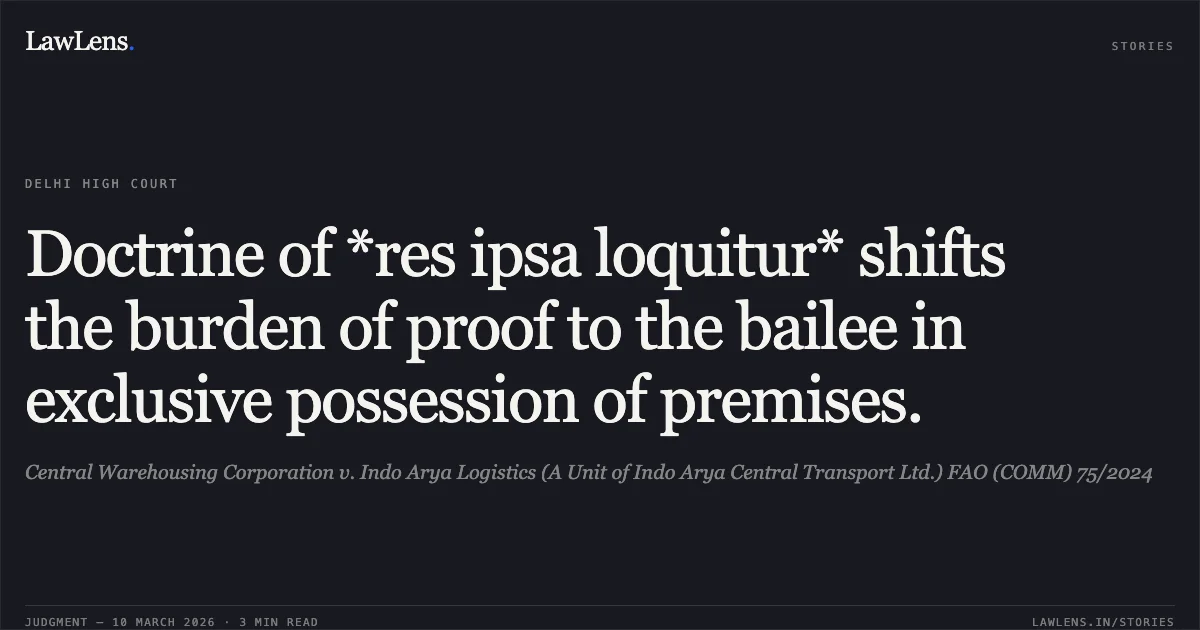
Source reference: p. 3The dispute was referred to a Sole Arbitrator, who, on 17.09.2018, partly allowed the Appellant’s claim by applying the doctrine of *res ipsa loquitur* to hold the Respondent negligent.
Source reference: p. 4, 12The Respondent challenged the award under Section 34 of the Arbitration and Conciliation Act, 1996.
Source reference: no citationThe District Judge set aside the award, holding that the Appellant failed to prove negligence and that the Arbitrator's application of *res ipsa loquitur* was patently illegal.
Source reference: p. 4, 17This is an appeal under Section 37 against the District Judge's order.
Source reference: no citationIssues
Whether the learned District Judge was justified in setting aside the Arbitral Award on the ground of patent illegality regarding the findings on negligence.
Source reference: p. 10 / para. 30Whether the doctrine of *res ipsa loquitur* was correctly applied by the Arbitrator given that the cause of fire was unknown but the premises were in the Respondent's exclusive control.
Source reference: p. 33 / para. 52Law Applied
The court applied Section 34 of the Arbitration and Conciliation Act, 1996, which limits judicial interference to cases of patent illegality or conflict with public policy.
Source reference: p. 15, 40It relied on the evidentiary principle of *res ipsa loquitur* (the thing speaks for itself), as discussed in *Shyam Sunder v. State of Rajasthan* and *State of Punjab v. Modern Cultivators*, which shifts the burden of proof to the defendant when an accident occurs in a "res" under their exclusive management which wouldn't ordinarily happen without negligence.
Source reference: p. 23, 21, 24Furthermore, it applied the standards for "patent illegality" established in *Delhi Airport Metro Express Pvt. Ltd. v. DMRC*, emphasizing that a court cannot re-appreciate evidence or substitute an arbitrator's plausible view with its own.
Source reference: p. 15, 39Reasoning
The High Court observed that the Arbitrator had scrutinized the agreement (specifically Clauses 5, 8, and 11) to conclude that the Respondent had exclusive control and management of the godown.
Source reference: p. 34Under Clause 11, the Respondent was responsible for maintaining the interior, exterior, and electrical fittings in good condition.
Source reference: p. 35The Arbitrator found that the fire was an "unusual" event and, since the Respondent withheld evidence regarding the stored goods and failed to explain the cause, a presumption of negligence was raised.
Source reference: p. 13-14The High Court held that the District Judge erred by acting as an appellate court and re-evaluating the evidence under the guise of "patent illegality".
Source reference: p. 38The Court noted that the Arbitrator’s application of *res ipsa loquitur* was a plausible legal view based on the Respondent’s exclusive possession and the nature of the accident.
Source reference: p. 37, 41The District Judge’s requirement for the Appellant to prove the installation of fire safety measures was found to be outside the scope of the original dispute, as the Respondent had never raised such a defense during arbitration.
Source reference: p. 38Holding
The High Court allowed the appeal and set aside the District Judge’s order dated 22.02.2024.
It held that the Arbitrator’s award did not suffer from patent illegality or contravention of public policy under Section 34.
Source reference: p. 40The Arbitral Award dated 17.09.2018 was restored in its entirety, confirming the Respondent's liability for reconstruction costs and storage charges based on the justified application of *res ipsa loquitur*.
Source reference: p. 41Acts & Sections Cited
4 provisions across 1 statute referred to in this judgment. Each provision opens on LawLens.
Arbitration and Conciliation Act, 19964
Original Court PDF
Central Warehousing Corporation v. Indo Arya Logistics (A Unit of Indo Arya Central Transport Ltd.) FAO (COMM) 75/2024
Click to open original judgment
Original judgment, available to read, download and summarize on LawLens.in