Facts
On August 27, 2019, the appellant (Rizwan) approached the informant at a shop and demanded money.
Source reference: para. 3When the informant refused, the appellant fired a pistol at him.
Source reference: para. 3The first shot missed; however, a second shot struck and killed Shakir, a nearby laborer.
Source reference: para. 3The appellant was apprehended by a crowd and subsequently convicted in Session Trial No. 658 of 2019 for offenses under Sections 302, 307, and 506 of the IPC, and Section 3/25 of the Arms Act.
Source reference: para. 2-3The appellant filed an application under Section 389 of the Cr.P.C. for suspension of sentence and bail pending appeal, asserting he had no intention to kill the deceased and had no prior criminal record.
Source reference: para. 2, 4Issues
1. Whether a conviction under Section 302 IPC is sustainable when the fatal shot was intended for a different individual but struck the deceased by mistake
Source reference: para. 4, 72. Whether the appellant is entitled to suspension of sentence and bail based on his period of incarceration and alleged lack of criminal history
Source reference: para. 4, 10Law Applied
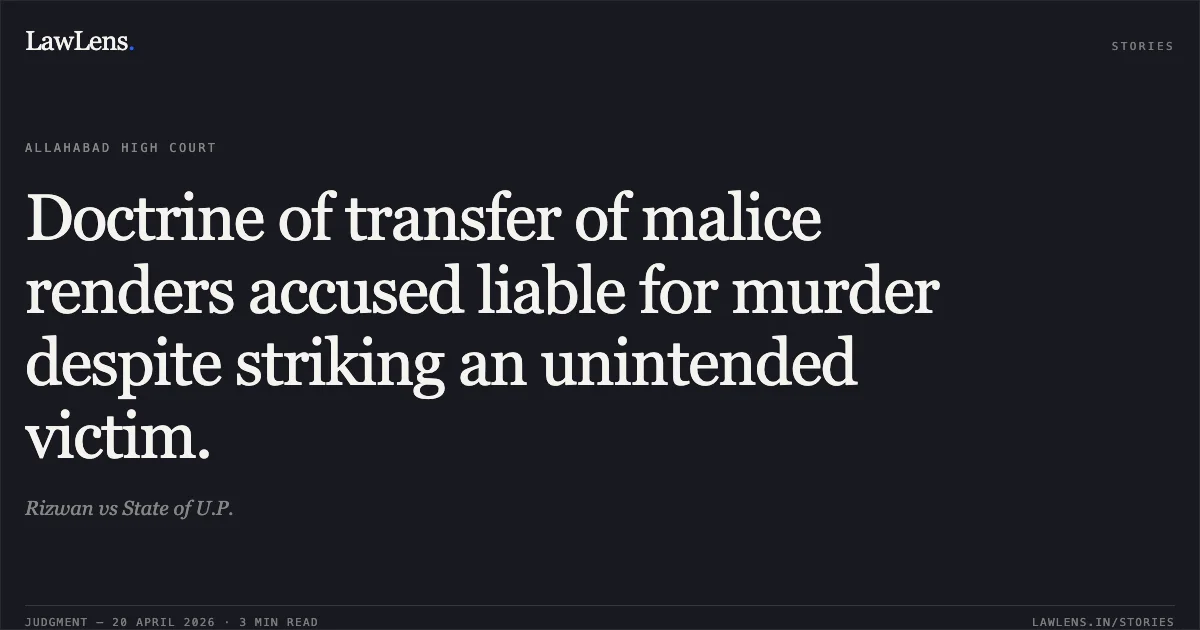
The court primarily applied Section 301 of the IPC, which governs culpable homicide by causing the death of a person other than the person whose death was intended.
Source reference: para. 7This section incorporates the "Doctrine of Transfer of Malice" or "Transmigration of Motive," establishing that if a person intends to cause death but kills an unintended victim, the offense remains the same as if the intended victim had died.
Source reference: para. 7The court relied on the precedent in Nanhe vs. State of Uttar Pradesh (2024) 13 SCC 765, which affirmed that the intention to kill the specific deceased person is immaterial if the general mens rea to commit murder exists.
Source reference: para. 7It further referenced Shankerlal Kacharabhai v. State of Gujarat (1965) and Rajbir Singh v. State of U.P. (2006) to reinforce that accidental injury to a third party during an intentional attack does not mitigate the offense.
Source reference: para. 7Reasoning
The court dismissed the appellant's argument that the offense should be downgraded to Section 304 IPC (culpable homicide not amounting to murder).
Source reference: para. 7-8It reasoned that under Section 301 IPC, the law attributes the intent to kill the informant to the death of the bystander, Shakir.
Source reference: para. 7-8Applying the "Doctrine of Transfer of Malice," the court found that the appellant’s act of firing a second shot after the first missed demonstrated a clear intention to kill, which legally transfers to the actual victim.
Source reference: para. 7Regarding the plea for bail, the court observed a discrepancy in the appellant's claims; while he asserted no criminal history, the State produced records of 27 pending cases against him, including charges of murder, attempt to murder, and dacoity.
Source reference: para. 5, 9The court found the appellant’s explanation of this history insufficient and characterized him as a "man of criminal character"
Source reference: para. 9-10Holding
The court held that the appellant’s intent to kill a different person was sufficient to sustain a murder conviction under Section 302 IPC by virtue of the Doctrine of Transfer of Malice
Given the severity of the offense and the appellant's extensive criminal antecedents, the court rejected the application for suspension of sentence and bail
Source reference: para. 10The court directed the office to prepare the paper book and listed the main appeal for hearing on July 6, 2026
Source reference: para. 11-12Acts & Sections Cited
26 provisions across 3 statutes referred to in this judgment. Each provision opens on LawLens.
Indian Penal Code, 1860
Code of Criminal Procedure, 19731
Arms Act, 19594
Original Court PDF
RizwanvsState of U.P.
Click to open original judgment
Original judgment, available to read, download and summarize on LawLens.in