Facts
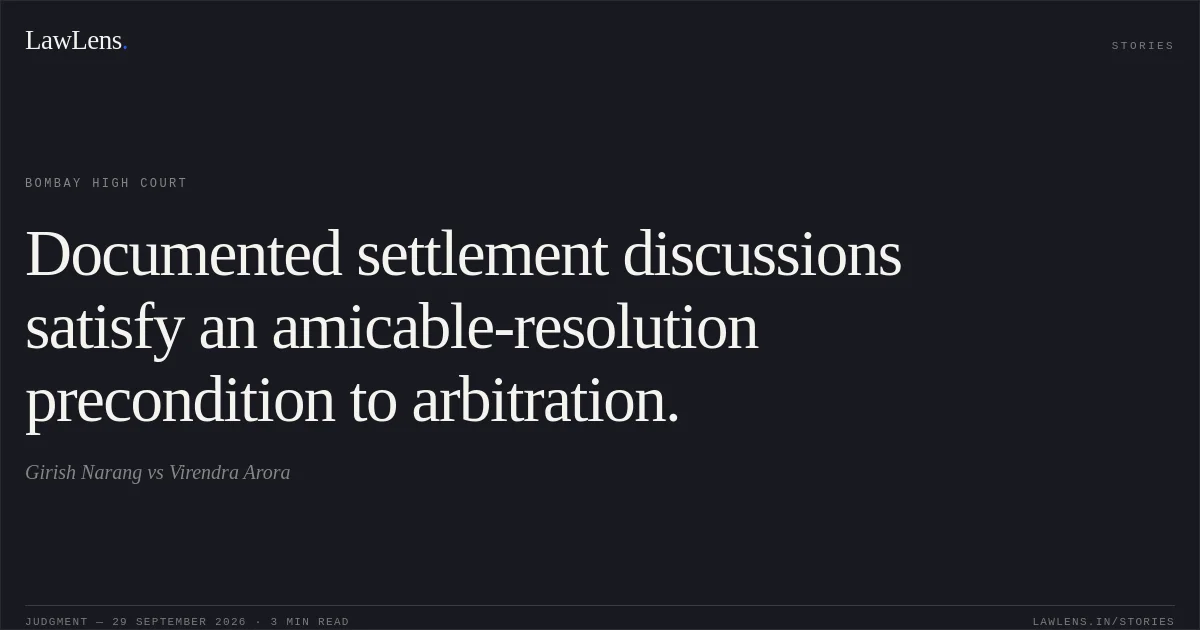
The Applicant and Respondents entered into a Deed of Partnership dated 1 April 2025 for the production and commercial exploitation of the film JATADHARA.
Source reference: para. 2Clause 11 provided for an attempt at amicable resolution and, failing resolution, arbitration; it also contemplated appointment under the Arbitration and Conciliation Act, 1996 if the parties could not mutually appoint an arbitrator within 30 days.
Source reference: para. 9–10After the film’s release, disputes arose over the Partnership’s accounts, financial records, liabilities and statutory compliance.
Source reference: para. 3The Applicant issued a notice under Section 21 seeking appointment of a sole arbitrator and later a final notice, but the disputes remained unresolved and no arbitrator was appointed.
Source reference: para. 14–15, 24The Applicant therefore applied under Section 11 for appointment of an arbitrator.
Source reference: para. 1, 3Issues
1. Whether Clause 11 constituted a valid arbitration agreement and the disputes raised fell within its scope
Source reference: para. 8–12, 17–182. Whether the parties’ failure to resolve the dispute amicably prevented referral to arbitration
Source reference: para. 14–163. Whether the parties’ failure to appoint an arbitrator entitled the Applicant to seek appointment under Section 11, notwithstanding disputes about proof, accounts and liability
Source reference: para. 19–25Law Applied
Section 11(6) of the Arbitration and Conciliation Act, 1996 permits the Court to take necessary steps where a party fails to act in accordance with the agreed appointment procedure; Section 21 concerns commencement of arbitral proceedings and limitation, but the claims described in a notice do not necessarily confine the claims that may be raised before the tribunal if they fall within the arbitration agreement.
Source reference: para. 18, 24Under Jagdish Chander v. Ramesh Chander, (2007) 5 SCC 719, wording that arbitration will occur only “if the parties so determine” may require a further decision to arbitrate; a clause providing that unresolved disputes “shall be referred” to arbitration expresses a binding agreement to arbitrate.
Source reference: para. 12Powertech World Wide Ltd. v. Delvin International General Trading LLC, (2012) 1 SCC 361, supports consideration of the clause and parties’ conduct when assessing an amicable-settlement requirement.
Source reference: para. 13Adavya Projects Pvt. Ltd. v. M/s Vishal Structurals Pvt. Ltd. & Ors., 2025 INSC 507, and ASF Buildtech Pvt. Ltd. v. Shapoorji Pallonji and Company Pvt. Ltd., 2025 INSC 616, establish that the referral court’s examination is limited and prima facie; it should not conduct a mini-trial on disputed facts or merits, which may be considered by the tribunal, including under its jurisdictional competence recognised by Section 16.
Source reference: para. 18, 20, 25Reasoning
Clause 11 used mandatory language—unresolved disputes “shall be referred to arbitration”—and supplied a fallback where the parties failed to appoint an arbitrator within 30 days; no fresh consent was therefore required.
Source reference: para. 11–12The record described meetings, correspondence, assurances after the Section 21 notice, partial production of records and a subsequent final notice, which the Court held demonstrated an unsuccessful attempt at amicable resolution.
Source reference: para. 14–16The accounting, disclosure, liability and compliance disputes arose from the Partnership’s operation and fell prima facie within Clause 11; the additional detail in the Section 11 application did not take them outside the clause.
Source reference: para. 17–18Whether the accounts were proved, which party was liable for particular periods, and whether an auditor should be appointed were merits questions for the tribunal, not grounds to refuse appointment.
Source reference: para. 19–23, 25–26As the parties had not mutually appointed an arbitrator, the agreed appointment procedure had failed.
Source reference: para. 24Holding
The Court allowed the Section 11 application and appointed Mr. Harsh Moorjani as Sole Arbitrator to adjudicate disputes and differences arising out of and in terms of Clause 11 of the Partnership Deed dated 1 April 2025.
The Court left all issues on the merits—including the accounts, amounts claimed and parties’ respective liabilities—open for determination by the tribunal.
Source reference: para. 26, 29The order also set out directions concerning communication of the appointment, disclosure, the parties’ appearance and initial sharing of arbitral costs.
Source reference: para. 28(B)–(F)Acts & Sections Cited
4 provisions across 1 statute referred to in this judgment. Each provision opens on LawLens.
Arbitration and Conciliation Act, 19964
Original Court PDF
Girish NarangvsVirendra Arora
Click to open original judgment
Original judgment, available to read, download and summarize on LawLens.in