Facts
On 16 January 2014, the Drug Inspector collected a sample of the drug “Amzone”, Batch No. MLI-386, manufactured by Maxmed Life Sciences Pvt. Ltd., from Chest and Disease Hospital, Jammu. The Government Analyst reported on 11 February 2014 that the sample was “Not of Standard Quality” because it failed the test for particulate matter.
Source reference: paras. 2–3The petitioner-company received notice under Section 25(2) of the Drugs and Cosmetics Act, 1940, and, within the prescribed period, disputed the Government Analyst’s report and expressed its intention to adduce evidence in controversion and seek re-analysis. In its communication, the company referred to testing by an NABL-accredited laboratory.
Source reference: paras. 4–6, 29Although prosecution permission was granted and re-analysis under Section 25(4) was contemplated, the sample was not sent to the Central Drugs Laboratory.
Source reference: para. 7The complaint under Section 18(a)(i) read with Section 27(d) of the Act was filed before the Chief Judicial Magistrate, Jammu, and summons were issued. The petitioners received summons only in November 2016, after the drug’s shelf life had expired in November 2015.
Source reference: paras. 43–45Petitioner No. 3 died during the proceedings and was deleted from the array; the petition consequently survived only against petitioner Nos. 1 and 2.
Source reference: para. 1Issues
Whether a person who, within 28 days, disputes a Government Analyst’s report and communicates an intention to adduce evidence in controversion is deprived of the statutory right under Section 25(3)–(4) merely because the communication refers to an NABL-accredited laboratory rather than expressly naming the Central Drugs Laboratory.
Source reference: paras. 25, 30–31Whether the prosecution could continue on the basis of the Government Analyst’s report after the sample’s shelf life had expired without being re-analysed by the Central Drugs Laboratory, thereby making the statutory safeguard under Section 25(4) practically unavailable.
Source reference: paras. 42–49, 59–67Law Applied
The Court applied Sections 25(3) and 25(4) of the Drugs and Cosmetics Act, 1940. Under Section 25(3), a Government Analyst’s report is ordinarily conclusive unless the person concerned, within 28 days of receiving it, notifies the Inspector or the Court of an intention to adduce evidence in controversion; such timely notification removes the report’s conclusiveness.
Source reference: paras. 26–28, 62Section 25(4) provides the mechanism for sending the sample produced before the Magistrate to the Central Drugs Laboratory, whose report is conclusive evidence; in the context of the statutory right under Section 25(3), the word “may” assumes a mandatory character where necessary to preserve that right.
Source reference: paras. 33–38Relying on Northern Mineral Ltd. v. Union of India, (2010) 7 SCC 726, the Court held that no specific request naming the Central Drugs Laboratory is necessary once the intention to controvert is communicated.
Source reference: paras. 32, 54–55It further relied on M/s Medicamen Biotech Ltd. v. Rubina Bose, (2008) 7 SCC 196; State of Haryana v. Unique Farmaid (P) Ltd., (1999) 8 SCC 190; M/s Gupta Chemicals Pvt. Ltd. v. State of Rajasthan, (2010) 7 SCC 735; and Municipal Corporation of Delhi v. Ghisa Ram, AIR 1967 SC 970, for the principle that denial of the opportunity for timely re-analysis, particularly after expiry of the sample’s shelf life, causes substantive prejudice and may justify quashing the prosecution.
Source reference: paras. 39–47, 63Reasoning
The petitioners had clearly disputed the Government Analyst’s report and communicated their intention to controvert it within the statutory 28-day period. That communication fulfilled the substantive requirement of Section 25(3); the reference to an NABL-accredited laboratory was, at most, an imperfection in form and did not amount to waiver or abandonment of the statutory right.
Source reference: paras. 29–31, 50–55Once the right was invoked, the statutory procedure under Section 25(4) had to be pursued so that the sample could be tested by the Central Drugs Laboratory. The respondent was aware of the petitioners’ position, and the competent authority had itself permitted re-analysis, but the sample was not sent for analysis before expiry of its shelf life.
Source reference: paras. 52–53, 60Since the petitioners received summons only after the sample had expired, they could no longer obtain a meaningful statutory re-analysis. Treating the disputed Government Analyst’s report as conclusive in those circumstances would effectively restore conclusiveness to a report whose evidentiary status had already been displaced under Section 25(3), and would deprive the petitioners of a valuable defence right.
Source reference: paras. 61, 64–67Holding
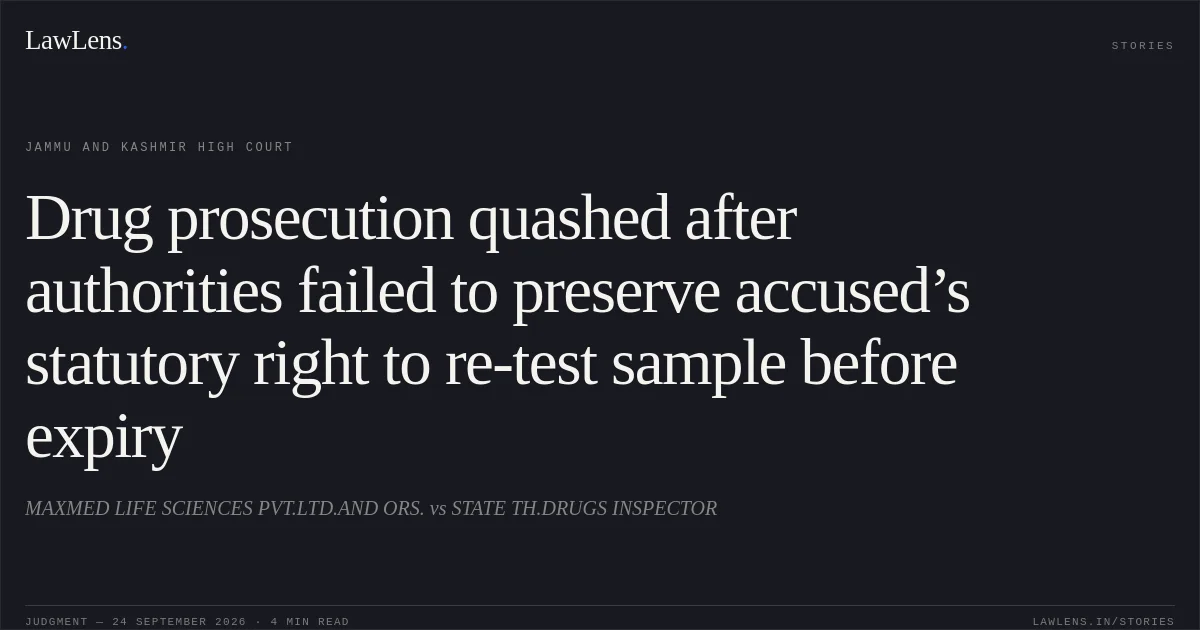
The Court held that the petitioners’ timely communication of their intention to controvert the Government Analyst’s report activated the safeguard under Sections 25(3) and 25(4), and that the reference to an NABL-accredited laboratory did not forfeit that right.
Because the sample was not sent to the Central Drugs Laboratory before expiry of its shelf life, the petitioners were deprived of a meaningful opportunity of re-analysis, and the Government Analyst’s report could not sustain the prosecution. The petition was allowed, and the complaint titled State through Drug Inspector, Jammu v. Hussain Brothers and Ors., together with all consequential proceedings, was quashed insofar as petitioner Nos. 1 and 2 were concerned.
Source reference: para. 72Acts & Sections Cited
7 provisions across 4 statutes referred to in this judgment. Each provision opens on LawLens.
Drugs and Cosmetics Act, 19404
Bharatiya Nagarik Suraksha Sanhita, 20231
Code of Criminal Procedure, 19731
Insecticides Act, 19681
Original Court PDF
MAXMED LIFE SCIENCES PVT.LTD.AND ORS.vsSTATE TH.DRUGS INSPECTOR
Click to open original judgment
Original judgment, available to read, download and summarize on LawLens.in