01Facts
Rajesh Tukaram Masurkar was riding a Kinetic scooter on the Parel flyover at about midnight when he lost control, came into contact with the road divider, and was thrown towards the opposite side of the road. A dumper owned and operated by the Municipal Corporation, driven by Machindra Kondiba Bagate, subsequently ran over him, causing fatal injuries.
¶ 1, 6–7His widow, father, and two minor children instituted a motor accident claim. The Motor Accident Claims Tribunal, Mumbai, held the Corporation liable and awarded ₹5,00,000 with interest by its award dated 14 February 2002. The Corporation preferred the present appeal, disputing the dumper driver’s negligence and the Tribunal’s assessment of the deceased’s future income.
¶ 1–302Issues
i.Whether the Tribunal was correct in accepting the evidence of PSI Vijay Sitaram Ghag and rejecting the version of dumper driver Machindra Kondiba Bagate regarding the manner of the accident.
¶ 2 · ¶ 5–12ii.Whether the deceased and the dumper driver were negligent, and, if so, in what proportion their negligence contributed to the accident.
¶ 8–12iii.Whether the deceased’s future prospects could be considered by enhancing his established monthly income of ₹2,024, notwithstanding the possibility that the projected promotion depended on passing a departmental examination.
¶ 13iv.Whether the compensation and rate of interest awarded by the Tribunal required modification.
¶ 13–1803Law Applied
The Court applied the principles governing proof of negligence and assessment of compensation under the Motor Vehicles Act, including the Tribunal’s duty to award just compensation.
It relied on Haji Zainullah Khan (Dead) by LRs v. Nagar Mahapalika, Allahabad, (1994) 5 SCC 667, for treating an independent eyewitness’s evidence as preferable to that of interested employees.
¶ 4(i)N.K.V. Bros. (P) Ltd. v. M. Karumai Ammal, (1980) 3 SCC 457, for the principle that claims tribunals must protect innocent accident victims while ensuring that drivers and owners do not escape liability on doubtful or obscure grounds.
¶ 4(ii)Shakuntla Shridhar Shetty v. State of Maharashtra, 1976 ACJ 368, for the rule that every road user owes a duty of reasonable care, particularly a driver who must avoid reasonably foreseeable acts or omissions likely to injure others.
¶ 4(iii)The Court also relied on Prakash Chandra Swain v. Bikash Gadanaik, 2026 ACJ 164, and United India Insurance Co. Ltd. v. Kunti Binod Pande, 2020 ACJ 2714, regarding award of just compensation beyond the Tribunal’s calculation where legally justified, even without a cross-objection.
¶ 15, 18Kirti v. Oriental Insurance Co. Ltd., 2021 ACJ 1, was applied to hold that dependency is assessed with reference to the circumstances at the time of the accident and is not automatically reduced merely because a dependent subsequently dies.
¶ 1604Reasoning
The Court preferred PSI Ghag’s account because he was an independent eyewitness and his version was corroborated by the contemporaneous FIR and spot panchnama.
¶ 5–7The physical evidence—flesh embedded in the dumper’s front cleaner-side wheel, the deceased’s position, and scratches on the road divider—was inconsistent with the driver’s assertion that the scooter had struck the dumper from behind.
¶ 7, 10Although the deceased’s contact with the divider contributed to his being thrown into the dumper’s path, the driver had seen the scooterist from approximately 35 feet away and was required to maintain a moderate and controllable speed, particularly on a sloping flyover at night.
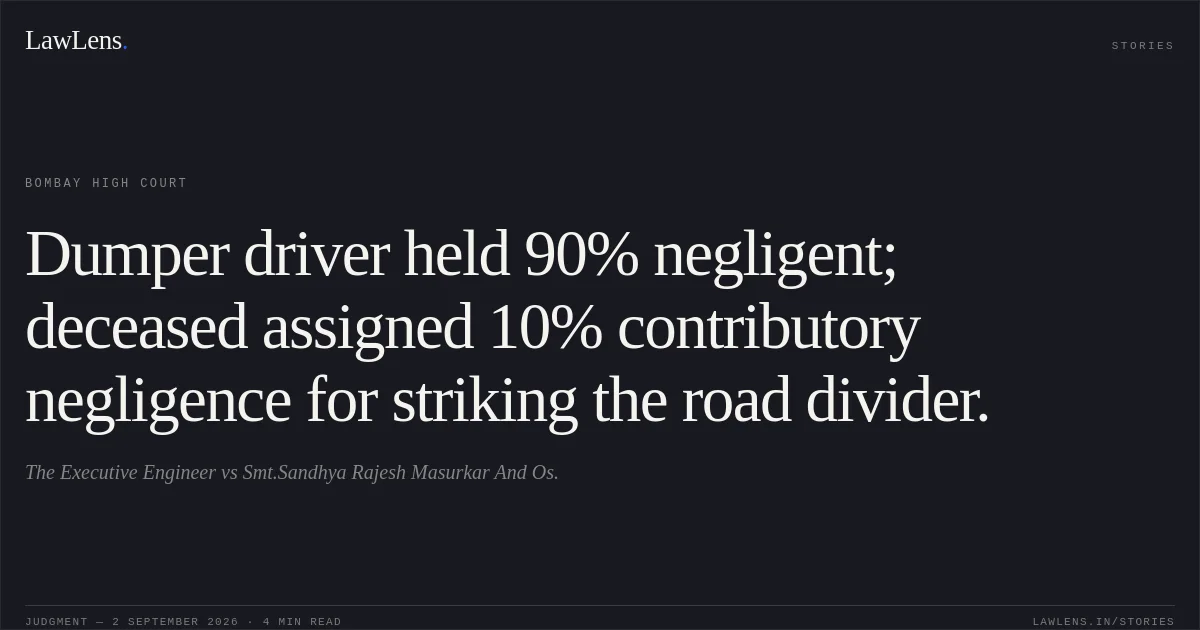
¶ 6, 8–11The Court therefore apportioned negligence at 10% to the deceased and 90% to the dumper driver.
¶ 12On quantum, the Court rejected the Tribunal’s effective doubling of the deceased’s salary to ₹5,450 and instead added 50% towards future prospects to his established income of ₹2,024 per month.
¶ 13Applying a three-fourths dependency ratio and a multiplier of 17, together with amounts for funeral expenses, loss of estate, and consortium, it calculated total compensation at ₹6,92,508.
¶ 13Since the Corporation was liable for 90%, its liability came to ₹6,23,257.20, after accounting for the amount already deposited.
¶ 14The Court retained interest at 9% per annum from 1 November 1994.
¶ 17–1805Holding
The appeal was partly allowed. The Court held the dumper driver/Corporation responsible for 90% of the accident and the deceased responsible for 10% contributory negligence.
¶ 12The total just compensation was revised to ₹6,92,508, of which the Appellant’s 90% share was ₹6,23,257.20.
¶ 13–14After giving credit for the amount already deposited, the Appellant was directed to deposit and pay an additional ₹1,92,508 with interest at 9% per annum from 1 November 1994 until payment, within eight weeks, before the Motor Accident Claims Tribunal, Mumbai.
¶ 18(i)The Tribunal was directed to apportion the amount among the claimants, and the deposited amount was to be transferred to it for disbursement.
¶ 18(ii)–(iv)Original Court PDF
The Executive EngineervsSmt.Sandhya Rajesh Masurkar And Os.
Click to open original judgment
Original judgment, available to read, download and summarize on LawLens.in