Facts
The Petitioners operated duty-free shops at the International Departure Terminal of Chhatrapati Shivaji Maharaj International Airport, Mumbai, and sold imported tobacco-free nicotine pouches under the brands “ZYN” and “FOX”.
Source reference: paras. 2–4The products were stored in customs warehouses under Section 58-A of the Customs Act, 1962. The Petitioners did not possess an import licence or Registration Certificate under the Drugs and Cosmetics Act, 1940, contending that the products were sold only to outbound international passengers within the customs barrier and were therefore effectively meant for re-export.
Source reference: para. 4Following a complaint by “Mothers Against Vaping”, the Customs authorities sought details regarding the legality and authorisation of the products.
Source reference: para. 5After inspection, the Assistant Drugs Controller issued a communication dated 2 April 2026 stating that the nicotine pouches were “drugs” under Section 3(b) of the Drugs and Cosmetics Act and that their import and sale required a valid Registration Certificate and import licence. The Customs authorities consequently directed that their sale be stopped.
Source reference: para. 5; pp. 7–9The Petitioners challenged the communications, asserting that the Drugs and Cosmetics Act and Rules did not apply to transactions conducted in duty-free shops beyond the customs frontier.
Source reference: paras. 7–8An ad-interim order dated 24 June 2026 restrained coercive action against the existing stock, although further imports remained suspended.
Source reference: para. 6Issues
Whether goods imported into India and sold in a duty-free shop beyond the customs barrier enjoy complete immunity from domestic regulatory laws, or whether the exemption is confined to fiscal levies such as customs duty and indirect taxes?
Source reference: para. 15(I)Whether nicotine pouches fall within the definition of “drug” under Section 3(b) of the Drugs and Cosmetics Act, 1940, thereby requiring an import licence and/or Registration Certificate even when dealt with in a duty-free shop at an international airport?
Source reference: para. 15(II)Law Applied
The Court applied Sections 2(23), 2(25), 2(27), 2(33), 11 and 111(d) of the Customs Act, 1962, holding that “import” occurs when goods are brought into India, including its territorial waters, and that goods prohibited under any other law may constitute “prohibited goods” under the Customs Act.
Source reference: paras. 17, 25Under Sections 10(c) and 18 of the Drugs and Cosmetics Act, 1940, drugs requiring a licence cannot be imported, sold, stocked or exhibited without compliance with the statutory licensing regime.
Source reference: para. 18Section 3(b) defines “drug” to include substances intended for diagnosis, treatment, mitigation or prevention of disease or disorder, substances affecting the structure or function of the human body as notified, substances used as components of a drug, and specified medical devices.
Source reference: para. 18Rule 43 read with Schedule D and Rule 123 read with Schedule K provide limited, conditional exemptions; Schedule K’s nicotine-specific exemption applies to nicotine gum and lozenges containing up to 2 mg nicotine, not expressly to nicotine pouches.
Source reference: paras. 18, 35–39The Court followed Glamstone Cosmetics Pvt. Ltd. v. Union of India & Ors., 2026 SCC OnLine Bom 1861, which held that warehousing or intended re-export does not immunise imported goods from domestic regulatory laws.
Source reference: paras. 22–27The Court distinguished Garden Silk Mills Ltd. v. Union of India, (1999) 8 SCC 744, and M/s Hotel Ashoka (Indian Tour Dev. Corpn. Ltd.) v. Assistant Commissioner of Commercial Taxes, (2012) 3 SCC 204, as decisions concerned primarily with customs duty and sales tax/VAT consequences.
Source reference: paras. 19–22The Court also relied on Chimanlal Jagjivandas Sheth v. State of Maharashtra, AIR 1963 SC 665, and State of Andhra Pradesh v. Linde India Ltd., (2020) 16 SCC 335, for the principle that a substance may qualify as a drug where it has the requisite connection with diagnosis, treatment, mitigation or prevention of disease or disorder.
Source reference: para. 32Reasoning
The Court rejected the Petitioners’ contention that the customs-barrier fiction created blanket immunity from Indian regulatory law.
Source reference: paras. 25–27It held that the Customs Act treats goods as imported once they enter India, including its territorial waters, irrespective of whether they are cleared for home consumption or placed in a warehouse for re-export.
Source reference: paras. 25–27Accordingly, the duty-free character of a sale may exempt the transaction from fiscal levies, but it does not exclude the operation of public-health and regulatory statutes.
Source reference: paras. 26–27However, the Court declined to conclusively determine whether the particular nicotine pouches were “drugs” under Section 3(b).
Source reference: paras. 33–43A recreational nicotine pouch without therapeutic or cessation claims would not automatically qualify as a drug merely because nicotine has physiological effects; classification depends on the product’s composition, intended use and applicable exemptions.
Source reference: paras. 33–43The Assistant Drugs Controller’s communication merely stated that the products were drugs, without identifying the applicable clause of Section 3(b), establishing their therapeutic use, or examining their composition and product specifications.
Source reference: paras. 44–47Since the Petitioners had also not furnished complete product specifications, the issue required factual and technical examination unsuitable for adjudication in the writ proceedings.
Source reference: paras. 48–50Holding
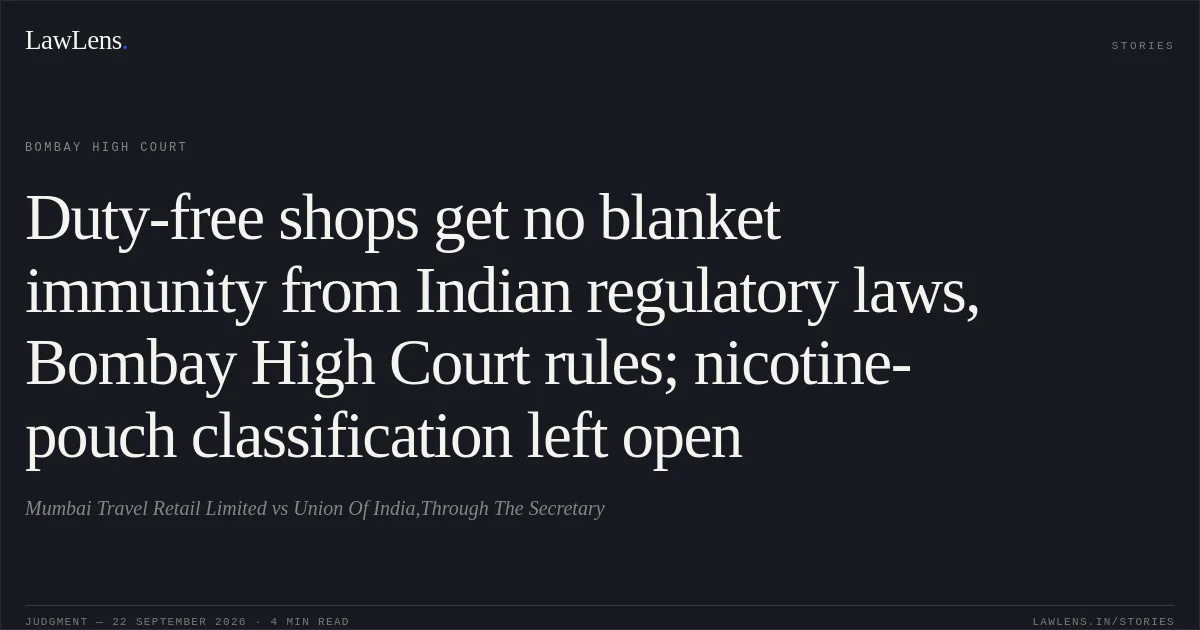
The Court held that goods imported for warehousing, re-export or sale in a duty-free shop do not enjoy immunity from domestic regulatory laws; any exemption is confined principally to fiscal measures such as customs duty and indirect taxes.
It left open the question whether the specific nicotine pouches were “drugs” under Section 3(b) and whether any Schedule D or Schedule K exemption applied.
Source reference: paras. 48–50The Petitioners were permitted to submit representations to the appropriate authority, including CDSCO, with supporting product specifications and material demonstrating either that the products were not “drugs” or that an exemption applied.
Source reference: para. 52(a)Any representation filed within four weeks was to be considered on its merits, with a reasoned order and, if necessary, a personal hearing, within thirty days of receipt.
Source reference: para. 52(b)–(c)The writ petitions were accordingly disposed of without an order as to costs.
Source reference: para. 52(d)–(e)Acts & Sections Cited
13 provisions across 4 statutes referred to in this judgment. Each provision opens on LawLens.
Drugs and Cosmetics Act, 19403
Central Sales Tax Act, 19561
Territorial Waters, Continental Shelf, Exclusive Economic Zone and Other Maritime Zones Act, 19761
Original Court PDF
Mumbai Travel Retail LimitedvsUnion Of India,Through The Secretary
Click to open original judgment
Original judgment, available to read, download and summarize on LawLens.in