Facts
Opposite Party No. 2, Kumari Arunima, initiated Domestic Violence Case No. 650 of 2020 before the Chief Judicial Magistrate, Munger, alleging harassment, atrocities and misappropriation of her stridhan by the petitioners and other relatives of her deceased husband.
Source reference: p.2, para. 2–3Petitioner Nos. 1, 3 and 5 were the complainant’s sisters-in-law, while Petitioner Nos. 2, 4 and 6 were her brothers-in-law. The petitioners contended that they had married before the complainant’s marriage, maintained separate residences and households, and had never lived with the complainant in a shared household.
Source reference: pp.2–4, paras. 4–6The complainant’s husband died on 27 April 2020; an FIR under Section 498-A IPC was lodged four days thereafter, followed by the domestic-violence proceedings on 20 September 2020. The petitioners sought quashing of the proceedings under the Court’s inherent jurisdiction.
Source reference: pp.3–4, para. 6Issues
Whether proceedings under the Protection of Women from Domestic Violence Act, 2005 are maintainable against relatives of the husband who allegedly never lived with the aggrieved woman in a shared household or domestic relationship?
Source reference: pp.5–6, paras. 9–10Whether the allegations and materials on record justified exercise of the High Court’s inherent jurisdiction to quash the proceedings under Section 482 CrPC/Section 528 BNSS?
Source reference: pp.14–16, paras. 18–21Law Applied
The Court applied Sections 2(a), 2(f) and 2(s) of the Protection of Women from Domestic Violence Act, 2005, under which an aggrieved person must have been in a “domestic relationship” with the respondent, involving living or having lived together in a “shared household”.
Source reference: pp.5–6, para. 9Relying on Satish Chander Ahuja v. Sneha Ahuja, (2021) 1 SCC 414, the Court held that shared-household living must possess some permanency and cannot be based on fleeting or casual residence; however, the shared household may belong to a relative of the husband if the aggrieved woman lived there in a domestic relationship.
Source reference: pp.6–11, paras. 11–12Prabha Tyagi v. Kamlesh Devi, AIR 2022 SC 2331, and Hemant Gagan Singh v. State of Bihar, Cr. Misc. No. 14545 of 2015, were relied upon for the principle that the aggrieved woman must have lived with the concerned respondent in a shared household.
Source reference: pp.7–13, paras. 12–13The Court also applied State of Haryana v. Bhajan Lal, 1992 Supp (1) SCC 335, particularly categories 1, 3 and 7, permitting quashing where the allegations do not disclose an offence or where proceedings are manifestly malicious.
Source reference: p.14–15, paras. 18–19It further relied on Saurav Kumar Tripathi v. Vidhi Rawal, 2025 SCC OnLine SC 1158, for the proposition that the High Court may exercise inherent powers to quash proceedings arising from an application under Section 12 of the DV Act.
Source reference: p.16, para. 20Reasoning
The Court examined the statutory definitions of “domestic relationship” and “shared household” and held that their existence was a prerequisite to maintaining proceedings under the DV Act.
Source reference: pp.5–6, paras. 9–10Although the statute receives a broad and purposive interpretation, the materials showed that all petitioners had been married and residing separately well before the complainant’s marriage; their names and addresses in the complaint also reflected separate residences.
Source reference: pp.13–14, paras. 14 and 17The Court found no material establishing that the petitioners had ever lived with the complainant in a joint family or shared household. Consequently, the allegations of harassment and stridhan-related conduct, without the foundational domestic relationship required by the Act, could not sustain proceedings against these petitioners.
Source reference: pp.14–16, paras. 17–20The Court also considered the earlier quashing of the Section 498-A proceedings against them and concluded that their implication, despite separate residence and absence of specific foundational facts, attracted the principles in Bhajan Lal.
Source reference: p.14, para. 15; pp.14–16, paras. 18–20Holding
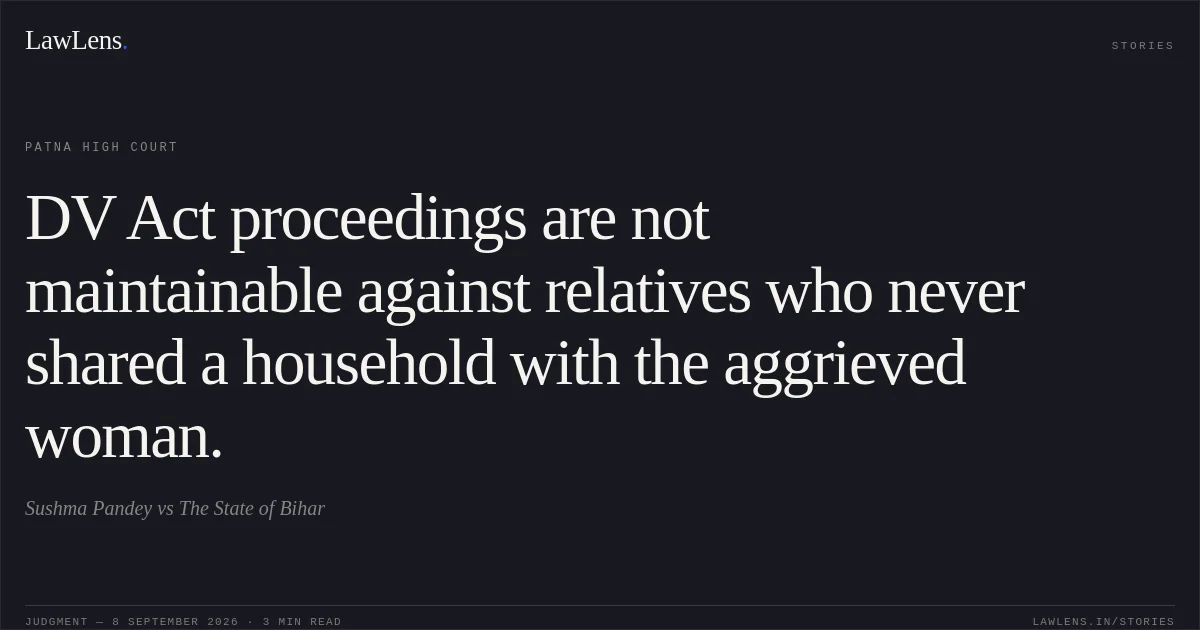
The Court held that the petitioners had never lived with Opposite Party No. 2 in a shared household and therefore had not shared a domestic relationship with her. The proceedings under the DV Act were consequently held not maintainable against them.
Exercising inherent jurisdiction under Section 482 CrPC/Section 528 BNSS, the Court quashed the entire proceedings in Domestic Violence Case No. 650 of 2020 insofar as they related to the six petitioners and allowed the application.
Source reference: p.16, paras. 20–22Acts & Sections Cited
6 provisions across 3 statutes referred to in this judgment. Each provision opens on LawLens.
Protection of Women from Domestic Violence Act, 20054
Bharatiya Nyaya Sanhita, 20231
Code of Criminal Procedure, 19731
Original Court PDF
Sushma PandeyvsThe State of Bihar
Click to open original judgment
Original judgment, available to read, download and summarize on LawLens.in