Facts
Paltu Ram Sahu, aged about 46, died in a road accident on 11 August 2019 when a truck driven by respondent Diwakar Jain struck him.
Source reference: para. 1–5, 12His wife and three daughters sought compensation under Section 166 of the Motor Vehicles Act, 1988.
Source reference: para. 1–5, 12The Motor Accident Claims Tribunal awarded ₹12,92,672 and directed the insurer to pay the compensation and recover it from the owner and driver because the truck lacked a valid permit.
Source reference: para. 1–5, 12The claimants appealed for enhancement; the insurer appealed against the award and the pay-and-recover direction.
Source reference: para. 1–5, 12Issues
1. Whether the compensation awarded by the Tribunal required enhancement, including on the grounds of the deceased’s income and consortium for the claimants.
Source reference: para. 4, 7–102. Whether the Tribunal’s pay-and-recover direction was sustainable despite the absence of a valid permit.
Source reference: para. 5, 12–13Law Applied
Under Sections 166 and 173 of the Motor Vehicles Act, 1988, a claimant may seek compensation for death in a motor accident and appeal the Tribunal’s award.
Source reference: no citationThe Court applied Sarla Verma v. Delhi Transport Corporation (2009) 6 SCC 121 and National Insurance Co. Ltd. v. Pranay Sethi (2017) 16 SCC 680 in assessing dependency compensation, including the multiplier, personal-expense deduction and future prospects.
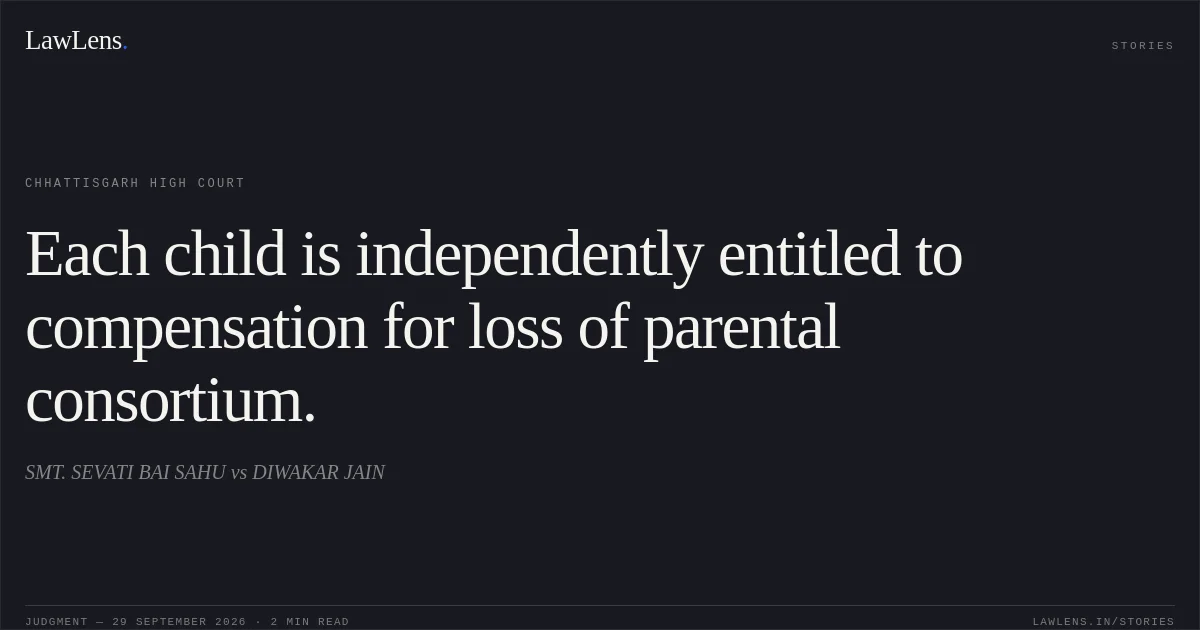
Source reference: para. 8, 10It relied on Magma General Insurance Co. Ltd. v. Nanu Ram @ Chuhru Ram (2018) 18 SCC 130 for consortium, recognising separate parental-consortium compensation for each child.
Source reference: para. 9–10On breach of policy conditions, it applied National Insurance Co. v. Swaran Singh (2004) 3 SCC 297 and Amrit Paul Singh v. Tata AIG General Insurance Co. Ltd. (2018) 7 SCC 558 in upholding the insurer’s obligation to pay the claimants first and recover the amount from the owner and driver.
Source reference: para. 12–13Reasoning
The Tribunal’s monthly income assessment of ₹7,800 was considered too low.
Source reference: para. 7–10In the absence of evidence establishing the claimed earnings or nature of employment, the Court assessed the deceased’s monthly income at ₹8,400, treating him as an unskilled labourer by reference to applicable minimum-wage notifications.
Source reference: para. 7–10It retained the Tribunal’s 25% addition for future prospects, one-fourth deduction for personal expenses and multiplier of 13, resulting in dependency compensation of ₹12,28,500.
Source reference: para. 7–10It also awarded ₹44,000 consortium to each of the wife and three daughters, rather than the lower joint amount allowed for the daughters, bringing total compensation to ₹14,37,500.
Source reference: para. 7–10Although the absence of a valid permit established a policy breach, the Court found no basis to disturb the pay-and-recover direction, particularly since the vehicle was insured at the time of the accident.
Source reference: para. 12–13Holding
The claimants’ appeal was partly allowed and the insurer’s appeal was dismissed.
Compensation was enhanced from ₹12,92,672 to ₹14,37,500, entitling the claimants to an additional ₹1,44,828, with interest at 6% per annum from the date of the claim application until realisation.
Source reference: para. 11, 13–14The Tribunal’s pay-and-recover direction and the remaining terms of the award were left undisturbed.
Source reference: para. 11, 13–14Acts & Sections Cited
2 provisions across 1 statute referred to in this judgment. Each provision opens on LawLens.
Motor Vehicles Act, 19882
Original Court PDF
SMT. SEVATI BAI SAHUvsDIWAKAR JAIN
Click to open original judgment
Original judgment, available to read, download and summarize on LawLens.in