Facts
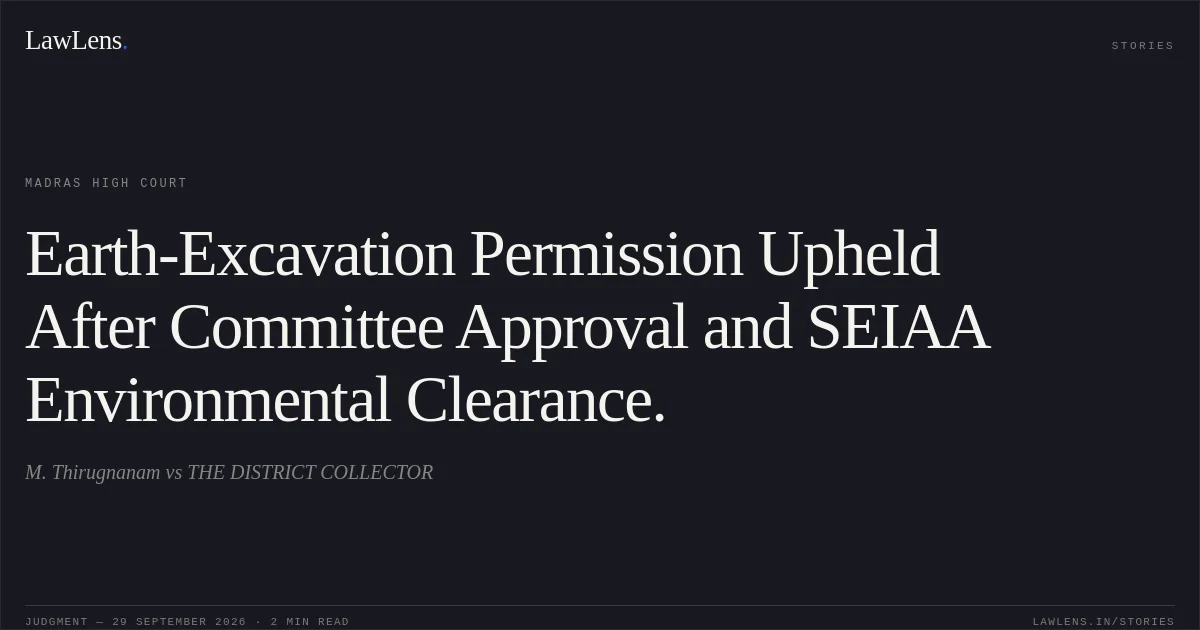
The petitioner filed a public-interest writ petition challenging the District Collector’s order dated 22 August 2026 permitting the third respondent to excavate ordinary earth from 2.22 hectares of Pavoor Big Eri, to a depth of 0.90 metres. He alleged that excavation would damage the lake bunds, reduce water storage, and disrupt water flow, and argued that local agriculturists could remove the earth instead.
Source reference: paras. 1–2; pp. 2–3The third respondent’s application had been considered by a Special Committee following field inspections and reports from relevant officials. The Committee approved the proposal, SEIAA granted environmental clearance, and the Collector issued permission subject to conditions, including a 90-day limit.
Source reference: paras. 4–8; pp. 4–7Issues
1. Whether the Collector’s permission to excavate ordinary earth from Pavoor Big Eri was liable to be quashed on the grounds that excavation would damage the lake, bunds, or water flow.
Source reference: paras. 2, 9; pp. 3, 72. Whether the permission could stand where the application had been considered under the applicable rules, approved by the Special Committee, and granted environmental clearance by SEIAA.
Source reference: paras. 5–8, 10; pp. 4–8Law Applied
The Court identified Rule 12(2-A) of the Tamil Nadu Minor Mineral Concession Rules, 1959, as governing permission to extract and sell ordinary earth from Government lands; under that rule, the application was to be considered by the Committee.
Source reference: paras. 5–6; p. 4The Court cited no judicial precedents or additional legal doctrines.
Source reference: no citationReasoning
The Court found that the application had undergone the prescribed consideration: officials conducted a field inspection, their reports were placed before the Special Committee, and the Committee approved the proposal before it was forwarded to SEIAA for environmental clearance.
Source reference: paras. 6–7; pp. 4–5The Collector’s order confined excavation to the approved area and plan, imposed conditions and provided for immediate cancellation if violations were detected. On that basis, the Court considered the petitioner’s apprehension of damage to the bunds misplaced. It also noted that the third respondent had made the required payments and that one month of the three-month permission period had already elapsed.
Source reference: paras. 8–10; pp. 5–8Holding
The Court declined to interfere with the Collector’s order and dismissed the writ petition.
It made no order as to costs and closed the connected miscellaneous petitions.
Source reference: paras. 10–11; p. 8Original Court PDF
M. ThirugnanamvsTHE DISTRICT COLLECTOR
Click to open original judgment
Original judgment, available to read, download and summarize on LawLens.in