Facts
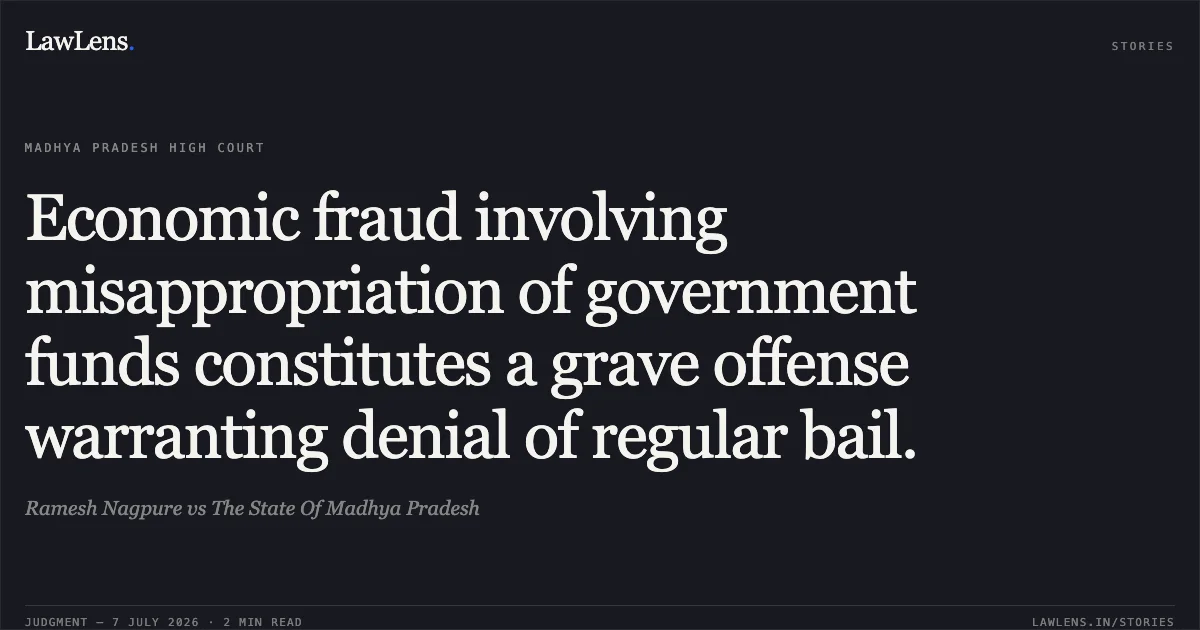
The applicant, a procurement centre in-charge, was accused of conspiring with society managers and a computer operator to procure 56.97 quintals of substandard paddy during the 2025–26 kharif season at the Mehkevar centre.
Source reference: para. 2An enquiry revealed that the accused attempted to cover up an inventory shortage by storing inferior grain in government gunny bags and manually stitching them to mimic standard procurement, allegedly causing financial loss to the government through the misappropriation of funds.
Source reference: para. 2The applicant was arrested on February 13, 2026, and filed this second bail application under Section 483 of the BNSS after the charge-sheet was filed.
Source reference: para. 1, 3Issues
1. Whether the applicant is entitled to regular bail under Section 483 of the BNSS in light of the filing of the charge-sheet and the lack of direct evidence of dishonest intention.
Source reference: para. 32. Whether the arrest was vitiated by non-compliance with the constitutional and statutory mandate of providing written grounds of arrest as per recent Supreme Court precedents.
Source reference: para. 3, 7Law Applied
Section 316(5) (Criminal Breach of Trust by public servant) and Section 3(5) (Common Intention) of the Bharatiya Nyaya Sanhita (BNS), 2023.
Source reference: para. 1The principle from L. Chandraiah v. State of A.P. (2004), which holds that mere negligence without dishonest intention does not establish criminal breach of trust.
Source reference: para. 3The mandate from Mihir Rajesh Shah v. State of Maharashtra (2025) and Vihaan Kumar v. State of Haryana (2025) that written grounds of arrest must be supplied to the arrestee, generally at least two hours prior to production before a Magistrate, unless exceptional circumstances exist.
Source reference: para. 3Reasoning
The court distinguished the applicant's case from the cited precedents, finding that the case diary established strong prima facie material of a coordinated conspiracy to defraud the State exchequer.
Source reference: para. 6, 7While the applicant argued that the investigation was complete and no dishonest intent was proven, the court highlighted that the gravity of the economic offence and the risk of tampering with sensitive evidence weighed against him.
Source reference: para. 7Regarding the procedural legality of the arrest, the court carved out specific exceptions to the requirement of immediate notification of grounds, such as cases involving pre-existing credible evidence of document manipulation, influence over witnesses, or serious financial fraud.
Source reference: para. 7(4)The court reasoned that in such "sensitive" cases, the need to protect the integrity of the investigation overrides the immediate procedural requirements cited by the applicant.
Source reference: para. 7, 8Holding
The court answered the issues in the negative, holding that despite the filing of the charge-sheet, the seriousness of the misappropriation and the potential for witness interference necessitated continued custody.
The court further held that in the context of heinous or complex financial crimes, stringent procedural mandates for arrest grounds may be interpreted in light of the immediate necessity to secure the investigation; consequently, the bail application was dismissed and bail refused.
Source reference: para. 7-8, 9Acts & Sections Cited
8 provisions across 3 statutes referred to in this judgment. Each provision opens on LawLens.
Bharatiya Nyaya Sanhita, 20233
Bharatiya Nagarik Suraksha Sanhita, 20233
Code of Criminal Procedure, 19732
Original Court PDF
Ramesh NagpurevsThe State Of Madhya Pradesh
Click to open original judgment
Original judgment, available to read, download and summarize on LawLens.in