Facts
The petitioner, Vice-President of the Indian Orthopaedic Association (IOA), was appointed Election Officer for the IOA’s 2020 online elections conducted during the COVID-19 pandemic.
Source reference: para. 2–3Although Right2Vote was initially selected as the proposed voting-platform vendor, the petitioner subsequently engaged Nityam Software Solutions Pvt. Ltd. and executed an MOU with it on 29 September 2020.
Source reference: para. 4–5Following the declaration of the election results, unsuccessful candidates alleged procedural irregularities in the vendor-selection process, payment of ₹1,91,750 from the petitioner’s personal account, non-conduct of an independent audit, deficiencies in election data, and irregularities in the operation of the electronic platform.
Source reference: para. 6–8FIR No. 25/2021 was registered under Sections 420, 120B and 34 IPC read with Sections 66, 66C and 66D of the IT Act. Though the petitioner was not named in the FIR, he was later arrayed as an accused in the chargesheet.
Source reference: para. 9The chargesheet also referred to disputed voting activity, including votes received after the deadline, late voter registrations, continuing reminders and incomplete database logs.
Source reference: para. 10–12The Chief Metropolitan Magistrate took cognizance and summoned the petitioner by order dated 17 August 2022.
Source reference: para. 14During the proceedings, the parties to related civil litigation settled their disputes, and the settlement was recorded by the High Court on 28 May 2025.
Source reference: para. 15Issues
Whether the allegations and material in the chargesheet, taken at face value, disclosed the ingredients of cheating under Sections 415 and 420 IPC against the petitioner?
Source reference: para. 27, 34–39Whether the material disclosed the petitioner’s participation in a criminal conspiracy under Section 120B IPC or a shared common intention attracting Section 34 IPC?
Source reference: para. 40–46Whether the allegations established any computer-related offence, identity theft or cheating by personation under Sections 66, 66C or 66D of the IT Act against the petitioner?
Source reference: para. 47–54Whether the summoning order reflected the requisite application of mind to the petitioner’s distinct role and the ingredients of the offences alleged?
Source reference: para. 55–58Whether the subsequent settlement between the private parties supported quashing of the criminal proceedings against the petitioner?
Source reference: para. 59–63Law Applied
The Court applied the inherent jurisdiction under Section 482 CrPC and the categories identified in State of Haryana v. Bhajan Lal, particularly where the allegations, even if accepted in full, do not prima facie constitute an offence.
Source reference: para. 28–30Relying on Anand Kumar Mohatta v. State (NCT of Delhi), it held that the High Court may examine the prima facie existence of offences even after filing of the chargesheet.
Source reference: para. 31Section 420 IPC requires deception, dishonest inducement and delivery of property or a corresponding act caused by such inducement; dishonest intention must exist at the inception.
Source reference: para. 34–35Criminal conspiracy under Section 120B IPC requires an agreement or meeting of minds to commit an illegal act, while Section 34 IPC requires a criminal act done in furtherance of a shared criminal intention.
Source reference: para. 40–46Section 66 of the IT Act requires a dishonest or fraudulent act falling within Section 43; Sections 66C and 66D require, respectively, misuse of another person’s electronic identity and cheating by personation through a computer resource.
Source reference: para. 47–50A summoning order must reflect application of mind to the allegations, material and distinct role of each accused, though it need not contain an elaborate evidentiary analysis.
Source reference: para. 55–58A settlement between private parties does not automatically terminate a criminal prosecution, but unimpeachable settlement material may be considered under Section 482 CrPC where the prosecution is otherwise unsustainable.
Source reference: para. 59–62Reasoning
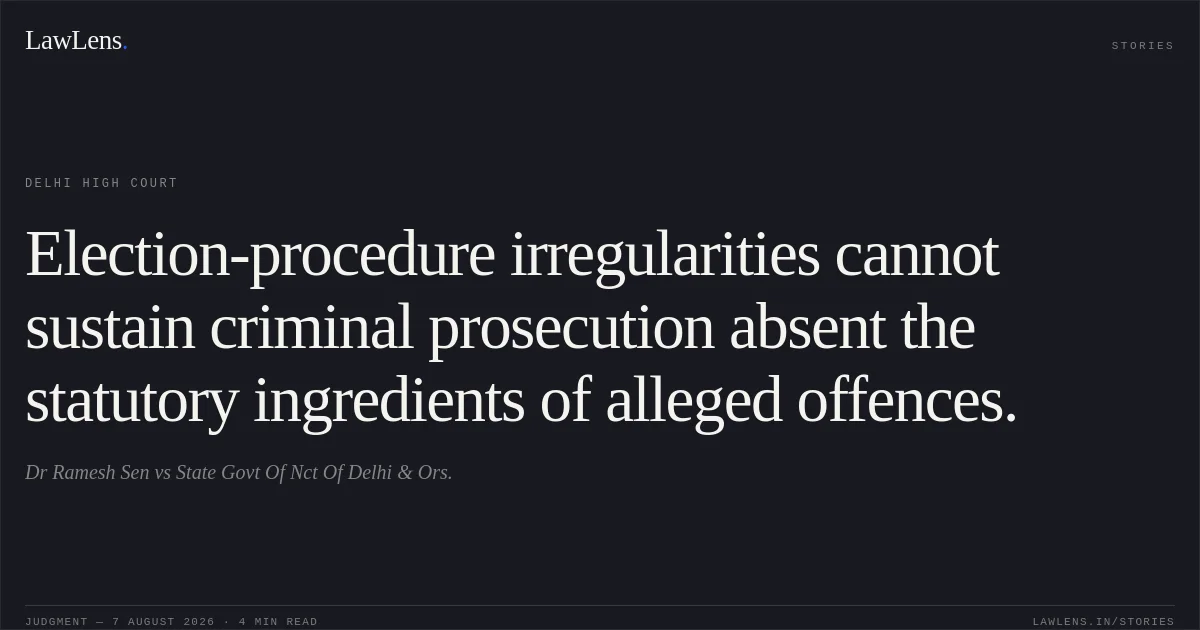
The Court held that the alleged replacement of Right2Vote, engagement of Nityam, personal payment of the vendor’s charges and failure to obtain an independent audit amounted, at their highest, to disputed administrative or procedural decisions.
Source reference: para. 36–39The chargesheet identified no false representation by the petitioner, no person deceived or induced by him, no delivery of property pursuant to such inducement, and no financial benefit obtained by him.
Source reference: para. 36–39There was also no communication, instruction or other material showing an agreement between the petitioner and Nityam to manipulate votes, alter voter records, operate the platform beyond the deadline or interfere with election results; hence, conspiracy and common intention were not established even prima facie.
Source reference: para. 41–46The technical irregularities were attributed to the operation and record-maintenance of Nityam’s platform, without evidence that the petitioner accessed the backend, altered data, misused another person’s password or electronic identity, or impersonated anyone.
Source reference: para. 48–54The summoning order merely stated that sufficient material existed and failed to distinguish the petitioner’s role from that of Nityam or identify how the statutory ingredients applied to him.
Source reference: para. 55–58The later settlement further showed that the underlying private dispute had substantially been resolved, although the Court expressly treated the settlement as a supporting circumstance rather than the sole basis for quashing.
Source reference: para. 59–63Holding
The Court answered the issues in favour of the petitioner.
It held that the chargesheet did not prima facie disclose cheating under Section 420 IPC, conspiracy under Section 120B IPC, common intention under Section 34 IPC, or offences under Sections 66, 66C and 66D of the IT Act against him.
Source reference: para. 64–67The prosecution against the petitioner was therefore held to fall within the first Bhajan Lal category and to constitute an abuse of the process of court.
Source reference: para. 67The petition was allowed; the chargesheet in FIR No. 25/2021, the cognizance and summoning order dated 17 August 2022, and all consequential proceedings were quashed insofar as they concerned the petitioner.
Source reference: para. 68–69The Court clarified that its observations were confined to the petitioner and did not affect the proceedings against the remaining accused.
Source reference: para. 68–69Acts & Sections Cited
8 provisions across 3 statutes referred to in this judgment. Each provision opens on LawLens.
Code of Criminal Procedure, 19733
Indian Penal Code, 18603
Information Technology Act, 20002
Original Court PDF
Dr Ramesh SenvsState Govt Of Nct Of Delhi & Ors.
Click to open original judgment
Original judgment, available to read, download and summarize on LawLens.in