01Facts
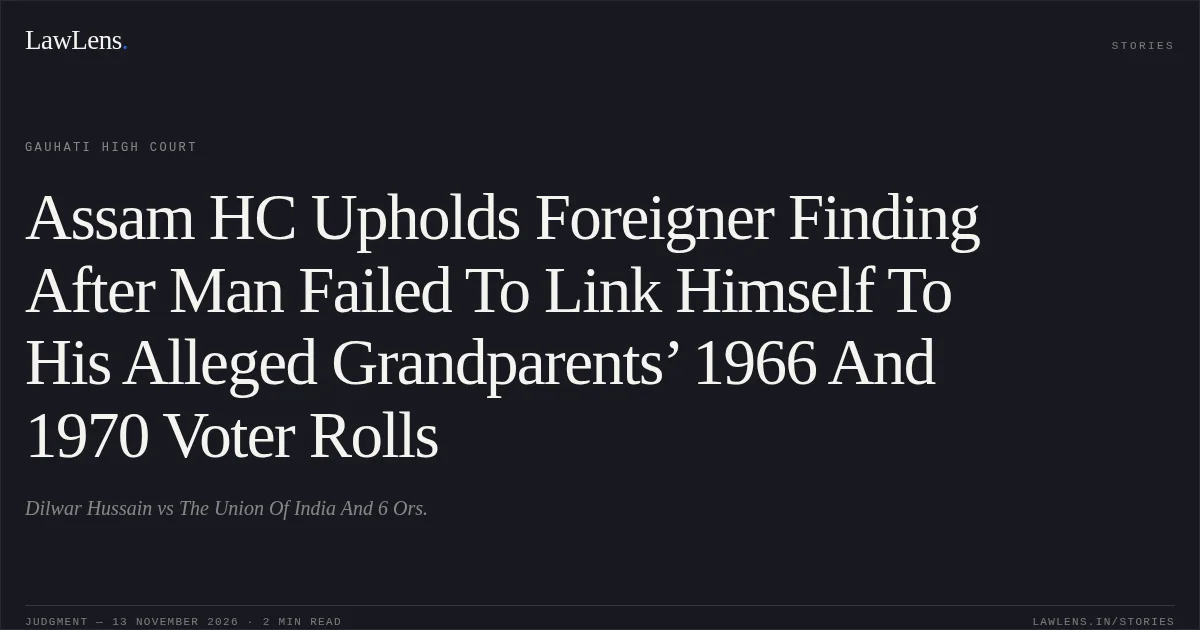
The petitioner challenged a Foreigners Tribunal opinion dated 22 October 2018 declaring him a foreigner who entered Assam from Bangladesh on or after 25 March 1971.
¶ 2He claimed that he was born in Palahjuri village and relied on electoral rolls from 1966, 1971 and 2005, as well as a PAN card, EPIC and certificates issued by the Village Headman and Gaon Panchayat Secretary.
¶ 3–4The Tribunal rejected those materials and held that he had not established his own or his family’s presence in India before the relevant date.
¶ 6–8The High Court considered his challenge under Article 226 of the Constitution.
¶ 202Issues
i.1. Whether the Tribunal’s finding that the petitioner had failed to establish his citizenship and family linkage was vitiated by jurisdictional error or improper treatment of the evidence.
¶ 22–23ii.2. Whether the electoral rolls and other documents relied upon by the petitioner established his lineage and his or his family’s presence in Assam before 25 March 1971.
¶ 16–17, 2203Law Applied
Section 6-A(2) of the Citizenship Act, 1955 provides that qualifying persons of Indian origin who entered Assam before 1 January 1966 and have ordinarily resided there since entry are deemed citizens from that date; the Court considered continuous residence relevant to the petitioner’s claim.
¶ 14–15A certified electoral roll may establish that a named person was an elector of the constituency, but does not conclusively establish another person’s parentage or lineage through that elector.
¶ 17Under Manowara Bewa @ Manora Bewa v. Union of India, a Gaon Panchayat certificate is not, merely by its issuance or countersignature, a public document; its execution and contents require proof, including examination of its author.
¶ 19Basiron Nessa v. Union of India requires a Gaonburah certificate to be supported by records, rather than oral testimony alone.
¶ 19Relying on Diluwara Khatun v. Union of India, the Court held that a document bearing the State Emblem when issued by an authority not authorised to use it is inadmissible.
¶ 20The Court also relied on Mustt. Rabiya Khatun v. Union of India and Md. Babul Islam v. Union of India concerning the insufficiency, without supporting proof, of PAN cards and EPICs as evidence of citizenship or relationship.
¶ 21In exercising supervisory rather than appellate jurisdiction, the High Court would not substitute its view absent jurisdictional error, denial of a hearing, refusal to admit admissible evidence, or a finding dehors the evidence.
¶ 23Provisions in the judgment · 1 · Linked ones open on LawLens
Representation of the People Act, 1951 Section 36
04Reasoning
The electoral rolls showed names across 1966, 1971 and 2005, but the petitioner did not establish the relationships connecting those individuals to him; the 1971 roll contained only one entry, and the rolls did not prove lineage.
¶ 13, 16–17The Court also noted gaps in the petitioner’s account of his family and residence, including his failure to provide relevant personal and family details in his written statement.
¶ 12, 16The certificates were unsupported by their authors and were found to bear an unauthorised State Emblem, while the PAN card and EPIC lacked corroborating evidence sufficient to establish the claimed relationship or citizenship.
¶ 18–21The Court therefore found no jurisdictional error or other basis for interference with the Tribunal’s assessment.
¶ 22–2305Holding
The Court dismissed the writ petition, upheld the Tribunal’s opinion declaring the petitioner a foreigner of the post-25 March 1971 stream, and directed that the consequences of that opinion follow.
¶ 24The interim bail granted to the petitioner was vacated and revoked.
¶ 25The parties were left to bear their own costs.
¶ 24Original Court PDF
Jamsed AlivsThe Union Of India And 6 Ors
Click to open original judgment
Original judgment, available to read, download and summarize on LawLens.in