Facts
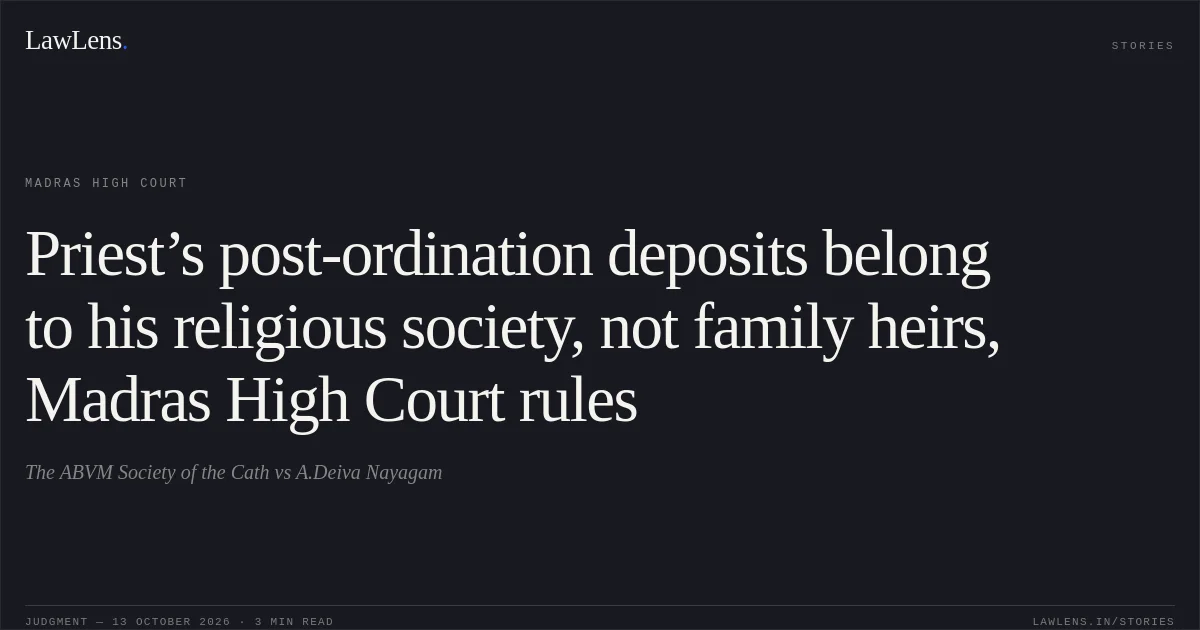
Rev. Fr. Deivakumar Arulanantham joined the appellant religious society and was ordained a priest in 1989.
Source reference: para. 2.1–11He later acquired property in Bengaluru, sold it in 2015, and deposited the proceeds—approximately ₹56 lakh—in fixed deposits in his name.
Source reference: para. 2.1–11After his death in 2018, his brothers and niece sought a succession certificate to collect the deposits; the Society filed a competing petition, relying in part on a 1988 document headed “My Last Will” and on the priest’s religious commitments.
Source reference: para. 2.1–11The District Judge allowed the relatives’ petition and dismissed the Society’s petition.
Source reference: para. 2.1–11The Society appealed both orders.
Source reference: para. 2.1–11Issues
1. Whether the 1988 document, though not proved as a valid Will, could be considered as a religious undertaking supporting the Society’s claim to the deposits
Source reference: para. 15(i)2. Whether the priest’s relatives were entitled to succeed to the deposits under the Indian Succession Act despite his entry into the religious order
Source reference: para. 15(ii)3. Whether the trial court erred in conducting separate, rather than joint, proceedings on the competing succession petitions.
Source reference: para. 15(iii)Law Applied
The Court considered the Indian Succession Act, including Section 384 governing appeals from succession-certificate orders and Sections 41–48 concerning succession to an Indian Christian’s property; Section 88 of the Indian Trusts Act, under which a person in a fiduciary position must hold an advantage gained in breach of that position for the beneficiary; and Section 144 of the Code of Civil Procedure, which provides for restitution following reversal or modification of an order.
Source reference: para. 17.5–17.9, 18.1–18.4, 18.11, 27.1, 30.1It also referred to Article 26 of the Constitution and Canon Law, including Canon 668 and the Society’s rules on poverty and sharing resources.
Source reference: para. 17.5–17.9, 18.1–18.4, 18.11, 27.1, 30.1Relying on Sital Das v. Sant Ram, AIR 1954 SC 60, and Krishna Singh v. Mathura Ahir, AIR 1982 SC 686, the Court applied the principle that entry into a religious order may be treated as “civil death” in relation to natural-family ties and property interests, while distinguishing property acquired before religious profession from property acquired afterwards.
Source reference: para. 17.5–17.9, 18.1–18.4, 18.11, 27.1, 30.1It also relied on Montfort Brothers of St. Gabriel v. United India Insurance Co. Ltd., (2014) 3 SCC 394, R. Rev. Casmir Gnanadickam v. …, 1998 (3) MLJ 501, and Sruti Seva Trust v. SBI, 2019 SCC OnLine Mad 39661, in considering a religious institution’s claim to interests associated with a member’s religious life.
Source reference: para. 17.5–17.9, 18.1–18.4, 18.11, 27.1, 30.1Reasoning
The Court did not treat the 1988 document as a valid testamentary disposition, but considered it as evidence of an undertaking connected with the priest’s religious commitment; it also noted the relatives’ evidence concerning the document and the Society’s rules.
Source reference: para. 15.2.2–15.2.5The Court found that the property was acquired after the priest entered the religious order and that the deposits represented the proceeds of its sale.
Source reference: para. 18.2, 18.9–18.13, 28.1–29It relied on the priest’s religious obligations, the Society’s governing rules and the evidence about the acquisition and source of funds to conclude that the deposits were not beneficially his personal estate, notwithstanding that they stood in his name.
Source reference: para. 18.2, 18.9–18.13, 28.1–29It distinguished inherited family property, which would not become Society property merely because of later religious profession, and held the authorities concerning diocesan priests or inherited property inapplicable on the facts.
Source reference: para. 18.2, 18.9–18.13, 28.1–29The Court further held that the trial court should have assessed the connected claims and evidence together; as the relatives had received the deposits during the appeals, restitution followed from the Society’s established entitlement.
Source reference: para. 27.1, 30.1Holding
The Court allowed both appeals, set aside the order granting a succession certificate to the relatives and the order dismissing the Society’s petition, and allowed S.O.P. No. 30 of 2019.
It directed the relatives to remit the amount received to the Society within one month, without interest; if they failed to do so, the amount would carry interest at 9% per annum from the date of judgment until payment.
Source reference: para. 32.2–32.4Acts & Sections Cited
12 provisions across 3 statutes referred to in this judgment. Each provision opens on LawLens.
Indian Succession Act, 1925
Indian Trust Act, 18821
Code of Civil Procedure, 19081
Original Court PDF
The ABVM Society of the CathvsA.Deiva Nayagam
Click to open original judgment
Original judgment, available to read, download and summarize on LawLens.in